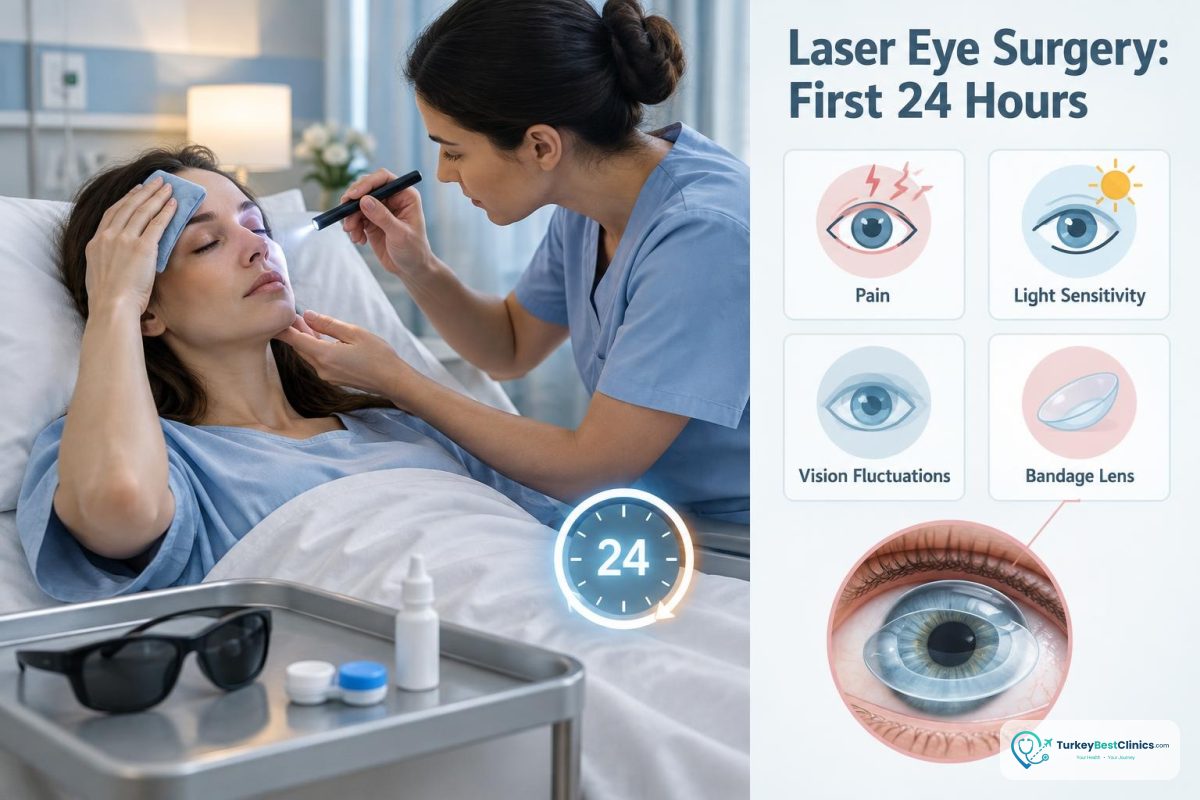
What Can You Expect During the First 24 Hours After Laser Eye Surgery?
During vision correction procedures performed with an excimer laser, the first day is important for protecting the eye surface and checking that healing is progressing appropriately. With surface techniques such as PRK and LASEK, the corneal epithelium takes time to close again, so burning, stinging, watering, light sensitivity and temporary blurred vision may be more noticeable.
After LASIK, a different follow-up plan is used because of the corneal flap, and a bandage contact lens may not routinely be required. Therefore, when assessing the use of a protective lens, you should consider not only the term laser eye surgery but also the procedure performed, corneal thickness, epithelial healing and the surgeon’s examination findings.
During the first 24 hours, the aim is not necessarily to achieve completely clear vision immediately, but to protect the corneal surface from trauma, control pain and identify signs of infection or unexpected healing at an early stage. Before discharge, the clinic should provide written instructions on how to protect your eyes, which symptoms require contact and when the first follow-up appointment will take place.
Key areas of monitoring during the acute phase
- Checking the eye surface and visual acuity during the first hours after the procedure.
- If PRK or LASEK was performed, confirming that the bandage contact lens is centered and correctly positioned over the cornea.
- Using sunglasses, resting in a dimly lit area and keeping the eyes closed to reduce light sensitivity.
- Receiving clear instructions to avoid rubbing the eyes, getting water in them, using makeup and being in dusty environments.
- Reassessing the corneal epithelium the following day or within the short interval determined by the surgeon.
Bandage Contact Lens Safety After PRK and LASEK
A protective contact lens may be used after PRK and LASEK to provide mechanical protection while the epithelial layer on the corneal surface heals. This is generally a sterile, soft, highly oxygen-permeable lens placed not primarily to correct refractive error, but to reduce friction between the eyelid and the healing surface.
The length of time the lens remains in place is not fixed. It is usually removed within a few days based on epithelial closure, the appearance of the eye surface, the level of stinging, dryness and the slit-lamp examination; however, only the ophthalmologist who performed the procedure should determine the exact timing. Removing, reinserting or replacing the lens at home is not safe.
Points to consider while using a protective lens
- Avoid touching the lens, trying to adjust its edge or rubbing your eye.
- If the lens moves out of position or falls out, contact the clinic; do not reinsert it yourself.
- Limit contact between your eyes and water when showering, swimming, using a sauna or being exposed to heavy steam.
- If you experience a sudden decrease in vision, increasingly severe pain, marked discharge, intense redness or flashes of light in one eye, contact the clinic without waiting for the scheduled appointment.
- An ophthalmologist should examine your eye before the contact lens is removed.
The presence of a bandage lens does not mean that the first 24 hours will be completely pain-free. Discomfort, watering and light sensitivity may occur, particularly after PRK and LASEK; the severity and course of symptoms vary according to individual healing characteristics.
Hospital and Companion Support for Excimer Laser Treatment in Turkey
If you are travelling from abroad, it is important for the procedure to be planned at an institution holding a Health Tourism Authorization Certificate issued by the Ministry of Health and having suitable operating-room infrastructure for eye surgery. This certificate shows that health tourism services are subject to certain administrative requirements; by itself, it does not guarantee a specific visual outcome or complication-free recovery.
When choosing a center, ask which technology the excimer laser platform uses, how suitability for surgery is assessed with corneal topography and tomography, at which stage a femtosecond laser is used if applicable, and where the first postoperative examination will take place. Key factors Turkish ophthalmologists assess for refractive procedures such as PRK, LASEK and LASIK include corneal thickness, corneal maps, the tear film, pupil diameter and the degree of existing refractive error.
Having the procedure performed in a fully equipped hospital or a surgical unit that complies with applicable regulations is important for sterilization, access to emergency intervention and slit-lamp examination facilities. Requesting written information about the laser device model, its calibration process and the surgical team’s procedure protocol is a reasonable safety measure.
Companion and transportation planning during the first 24 hours
Depending on the package, VIP transfers, a hotel near the hospital, interpreter support and initial care supplies may be provided; however, their scope and duration should be clearly stated in the written quotation. Before the first examination is completed, you should plan not to travel long distances alone and to avoid activities that require rubbing your eyes or exposure to intense light.
Having your companion stay with you at the hospital, choosing a hotel within a short distance of the clinic and having access to low-key options such as a quiet walk in a nearby park or an indoor hotel wellness area while you rest may improve your comfort. The need to rest with your eyes closed, avoid contact with water and stay away from intense sunlight sets the limits of this plan.
Comparison of the First Day After PRK, LASEK and LASIK
The choice of procedure is not determined solely by comfort on the first day. Your corneal structure, occupational needs, tendency toward dryness, participation in contact sports and examination results should be assessed together.
| Methods Compared for You | Most Important Potential Advantage for You | Your Recovery and Hospital Stay |
|---|---|---|
| PRK or LASEK with a bandage contact lens | Surface laser treatment without creating a flap within the cornea; may be considered under certain conditions for contact sports | Usually same-day discharge; more noticeable stinging and light sensitivity during the first days, with close monitoring until the epithelium heals |
| LASIK or femtosecond laser-assisted LASIK | Vision may become clear sooner, and pain from the surface epithelium is often more limited during the first days | Usually same-day discharge; a bandage contact lens is not used in most routine cases, but special eye protection is required to protect the flap |
This table provides a general framework and does not determine suitability for surgery. Which method will be more comfortable during the first 24 hours may vary according to the condition of your eye surface and the surgeon’s plan.
Cost and Package Details for Laser Eye Treatment in Turkey
In Turkey, the total cost of refractive laser treatment for both eyes and standard early postoperative follow-up may be approximately €1,500–€3,000 in 2026. First-24-hour clinical observation, a bandage contact lens, transfers, accommodation, advanced corneal mapping or additional follow-up services may not be included in the package; therefore, do not make your decision based solely on the advertised starting price.
| Country | Approximate range for both eyes | Package elements that may affect the price |
|---|---|---|
| Turkey | €1,500–€3,000 | Choice of PRK, LASEK or LASIK; corneal imaging, bandage lens, hotel and transfers |
| United Kingdom | £3,000–£5,000 | Procedure type, surgeon’s assessment and postoperative follow-up |
| Germany | €2,500–€4,500 | City where the center is located, laser platform used and duration of follow-up |
| United States | $3,000–$6,000 | Whether both eyes are included, technology selection and the surgical center’s pricing policy |
These ranges are not a diagnosis or a personalized quotation. In the written quotation, check separately whether the preoperative examination, corneal topography and tomography, first-24-hour examination, bandage lens removal, emergency contact line, local transportation and online follow-up after returning to your country are included.
Factors That Affect the Price and First-Day Process
- The surgeon’s expertise and experience: Consider the surgeon’s experience in refractive surgery, monitoring epithelial healing after PRK or LASEK and managing LASIK flap complications.
- Technology and procedure: The choice of wavefront- or topography-guided excimer laser, femtosecond laser, PRK, LASEK or LASIK may affect the cost and the care plan during the first 24 hours. The need for a bandage contact lens should be explained separately, particularly for surface techniques.
- Clinic location: In major centers such as Istanbul, Ankara or Izmir, prices may vary together with hospital infrastructure, the hotel’s distance from the clinic, transfer time and the accessibility of follow-up appointments.
The preoperative assessment should explain whether checks such as corneal topography, pachymetry, tear-film assessment, eye-pressure measurement and retinal examination are required. You may need to keep your return date flexible depending on the result of the first examination and the safe removal of the bandage lens.
Three Questions to Ask Before Leaving Turkey
- Based on which examination finding will my bandage contact lens be removed after PRK or LASEK, and is it safe for me to fly before the lens is removed?
- If my pain increases, my vision decreases or the lens falls out during the first 24 hours, how can I reach the eye surgery team at night?
- After I return to my country, on which dates will my online follow-up be scheduled for corneal epithelial closure, dry eye and fluctuating vision?
Planned online follow-up after you return home may help assess changes in vision, pain severity, redness, light sensitivity and whether the protective lens has been removed; however, an online consultation does not replace a slit-lamp examination. If an unexpected symptom develops, you should attend an ophthalmic emergency service in your country and inform the surgical team in Turkey at the same time.