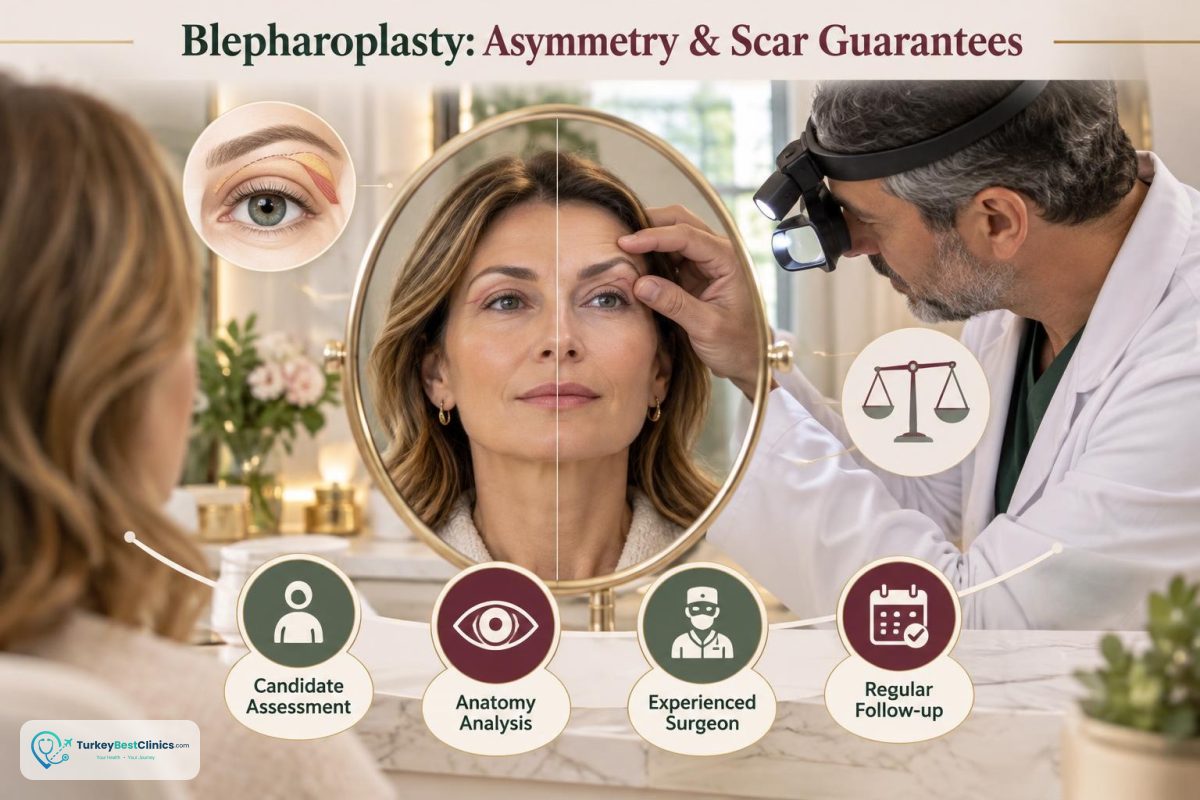
Mirror Appearance and Realistic Aesthetic Goals After Blepharoplasty
Eyelid surgery (blepharoplasty) aims to correct excess skin and fat on the upper eyelids, as well as bags or laxity on the lower eyelids. The goal is not only to create a younger appearance, but also to achieve a more refreshed look, a more balanced facial expression, and a more natural appearance in the mirror during daily social life.
After surgery, a slight difference between the eyes, swelling, or temporary crease irregularities may occur. A completely scar-free result or mathematically perfect symmetry cannot be guaranteed because the eye sockets, brow height, skin elasticity, and healing response are not identical on both sides.
Measurable planning instead of guarantees
A reliable clinic explains achievable goals rather than promising results such as no scarring or perfect symmetry. Photograph analysis, an in-person examination, dry-eye assessment, visual field evaluation, and, when necessary, an ophthalmology consultation may form the basis of the surgical decision.
Safety Standards for Eyelid Surgery in Turkey
When receiving treatment in Turkey as part of medical tourism, check whether the clinic holds a Health Tourism Authorization Certificate approved by the Ministry of Health of the Republic of Turkey. This document is an important administrative indicator that the healthcare provider is authorized to offer international healthcare services; however, it does not by itself guarantee a specific aesthetic outcome.
A Turkish plastic surgeon or ophthalmologist planning blepharoplasty should assess upper-eyelid skin excess, lower-eyelid fat herniation, eyelid laxity, and ocular surface problems separately. Review the surgeon’s experience with upper and lower blepharoplasty, transconjunctival approaches for the lower eyelid, external-incision eyelid surgery, and procedures such as canthoplasty when needed, using the surgeon’s own pre- and postoperative records.
Topics to review during the consultation
- Brow position, the upper-eyelid crease, and natural anatomical differences between the eyes
- Lower-eyelid laxity, the tear trough, and cheekbone support
- Dry eye, eyelid closure strength, and previous procedures around the eyes
- Incision placement, suturing technique, and how the scar may appear over time
- The follow-up and correction protocol if asymmetry becomes more pronounced
Blepharoplasty Packages and Planning Your Stay in Turkey
Depending on the clinic and selected plan, a package may include VIP airport-to-clinic transfers, hotel accommodation, interpreter support, and initial aftercare instructions. Before your flight, the follow-up examination, suture-removal timing, and products to be used for aftercare should be clarified in writing; medication selection and duration of use must be determined solely by the surgeon’s assessment.
For eyelid surgery, a plan of approximately 5–7 days in Turkey commonly includes the preoperative assessment, the procedure, and an early follow-up visit. The duration may vary depending on whether the surgery involves the upper eyelids, lower eyelids, or both. Suture checks are often scheduled within a few days, while swelling and bruising may take longer to become less noticeable in social settings.
In Istanbul, an accompanying person may take short breaks in enclosed shopping areas on the day of the procedure and during the following lighter recovery days, or plan a quiet dining experience in the evening. Avoiding sun, wind, and long walks is advisable. In Antalya and Izmir, choose short activities in shaded, dust-free areas rather than relaxing by the sea; postpone excursions that could expose the eye area to sunlight, chlorinated water, or wind.
Blepharoplasty Costs in Turkey and Country Comparison
The figures below are approximate ranges that vary according to the scope of treatment, the surgeon’s expertise, whether one or both eyelid areas are treated, and accommodation services. A definitive quote should be prepared after the examination, photograph assessment, and treatment technique have been determined.
| Country | Approximate blepharoplasty cost | What affects the price |
|---|---|---|
| Turkey | €2,500–€5,500 | Upper, lower, or combined procedure; follow-up and some package services |
| United Kingdom | GBP 4,500–8,500 | Surgeon, hospital, anesthesia, and follow-up coverage |
| Germany | €4,000–€7,500 | Type of surgery, clinic facilities, and anesthesia |
| United States | USD 6,000–12,000 | Surgeon’s fee, facility, anesthesia, and regional price differences |
A lower overall cost in Turkey does not automatically mean lower quality or guarantee a specific result. Likewise, a higher price does not guarantee a scar-free or completely symmetrical outcome. Ask for the surgeon’s fee, operating room, anesthesia, medications, follow-up visits, possible additional nights of accommodation, and revision assessment to be listed separately in writing.
Surgical Factors Influencing the Risk of Asymmetry and Scarring
Surgeon’s expertise and experience: Choosing a surgeon who assesses upper- and lower-eyelid anatomy together and asks about dry eye and eyelid-closure problems before surgery is important. Review the surgeon’s own results archive for examples involving different age groups, skin characteristics, and single or combined blepharoplasty procedures. Also check whether the photographs were taken under the same lighting and from the same angle.
Technique and tissue approach: On the upper eyelid, the incision is generally placed within the natural eyelid crease whenever possible. On the lower eyelid, a transcutaneous approach with an external incision may be considered when excess skin and laxity are prominent. If fat bags are the main concern, a transconjunctival approach through the inside of the eyelid may not require an external skin incision in some cases. The suitability of these methods depends on the anatomical examination and does not mean that the result will be scar-free.
| Compared techniques | Key distinguishing advantage | Effect on recovery time |
|---|---|---|
| Transcutaneous lower blepharoplasty | Allows excess skin and eyelid laxity to be addressed through the same external incision | Swelling or scar maturation may take longer because of the external incision and skin healing |
| Transconjunctival lower blepharoplasty | May avoid an external skin incision by accessing lower-eyelid fat bags from inside the eyelid | If excess skin is not present, external wound healing may be more limited; bruising and edema may still occur |
Clinic location: In Istanbul, Antalya, and Izmir, prices may vary according to operating room standards, access to hospital facilities, hotel level, and international patient coordination. More important than the city where the clinic is located are access to emergency assessment, direct follow-up by the surgeon, and a communication plan that remains available after you return to your country.
Realistic expectations regarding permanent scarring and asymmetry
Even when incisions are placed within natural creases, wound healing varies from person to person. Raised, dark, or noticeable scars may be associated with infection, wound separation, sun exposure, a genetic tendency toward certain scar responses, or problems during aftercare. Small differences between the eyelids are often a natural part of facial anatomy. If marked asymmetry, difficulty closing the eyelids, worsening pain, or changes in vision occur, contact the surgical team without delay.
Postoperative Decisions and Three Frequently Asked Questions
- When should the difference between the eyes be assessed after blepharoplasty? Early swelling can make symmetry difficult to judge. The surgeon should determine the follow-up schedule and the appropriate waiting period for final assessment based on your individual healing process.
- Does the transconjunctival technique for the lower eyelid guarantee a scar-free result? This approach may avoid an external skin incision; however, it does not completely eliminate the risks of bruising, edema, ocular surface symptoms, or irregularities related to existing excess skin.
- How is follow-up managed if asymmetry or a scar becomes more noticeable after returning home? Before surgery, clarify in writing how photograph and video consultations, a local ophthalmology or plastic surgery assessment, and, if necessary, an in-person check-up in Turkey will be arranged.
When seeking guarantees, the most reliable approach is to focus not on statements such as no scarring or perfect symmetry, but on documented authorization, the surgeon’s blepharoplasty experience, individual anatomical analysis, a transparent cost breakdown, and a postoperative follow-up plan. This framework can support a more informed assessment of eyelid surgery in terms of visual satisfaction and everyday comfort.