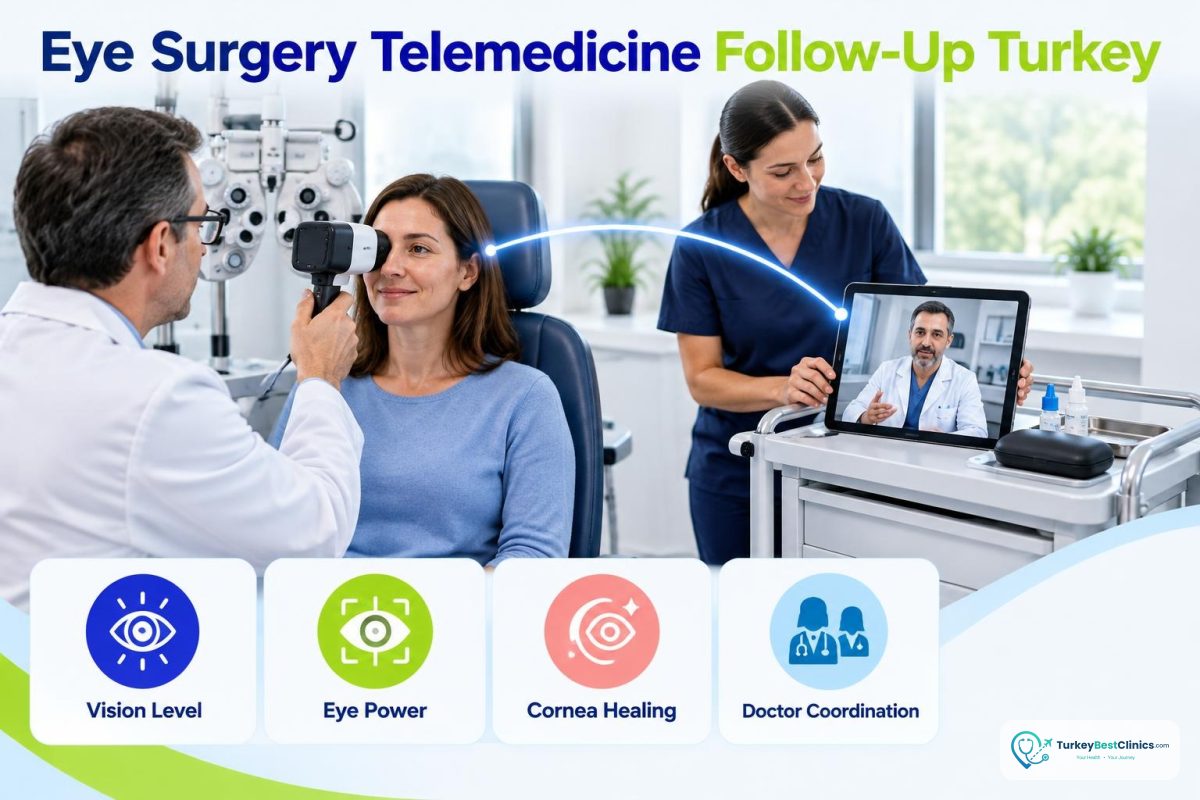
Digital Follow-Up from Turkey for Vision Prescription and Corneal Healing
Returning to your country after laser eye surgery or surgery performed on the cornea does not mean that the follow-up process has ended. Visual acuity, changes in your prescription, dryness, light sensitivity, glare and recovery of the corneal surface are assessed at regular intervals.
During telemedicine consultations, your eye surgeon in Turkey reviews your daily symptoms, visual performance and local examination results together. A camera image alone cannot reliably confirm corneal healing; therefore, digital assessment is supplemented by an in-person eye examination in your country when necessary.
Two surgical options that influence the recovery approach
Recovery timelines vary according to the procedure performed. The comparison below can help you understand which follow-up considerations may be relevant, particularly after laser vision correction procedures.
| Options Compared for You | Key Advantage for You | Your Recovery and Hospital Stay |
|---|---|---|
| LASIK | Because the epithelial layer on the corneal surface can be preserved, vision generally recovers more quickly; dryness and light sensitivity are still monitored during the early period. | Discharge is usually planned for the same day. The first digital check-up takes place within a few days, with subsequent appointments scheduled according to the surgeon’s protocol. |
| PRK or trans-PRK | The approach applied to the corneal surface may provide an alternative for certain corneal thicknesses and surface characteristics. | Surface healing may take longer. As pain, stinging and blurred vision may be more noticeable in the first few days, local examinations and online follow-up are coordinated more closely. |
Turkey’s Surgical and Digital Safety Standards for Corneal Follow-Up
It is important to plan surgery at a healthcare facility that holds a Health Tourism Authorization Certificate issued by the Turkish Ministry of Health and has suitable operating-room infrastructure for eye surgery. Sterilization protocols, operating-room infection control, calibration of corneal measurement devices and access to emergency eye assessment should be explained before the procedure.
Review your eye surgeon’s case experience, particularly in refractive surgery, corneal topography, corneal tomography and postoperative dry-eye management. During the assessment in Turkey, measurements such as corneal thickness, tear film, corneal curvature, prescription stability and fundus examination findings may be recorded to form the basis of the follow-up plan.
Limits of remote assessment
- Measuring visual acuity at home is not as standardized as a clinical vision test.
- A smartphone photograph cannot reliably show small changes on the corneal surface or measure intraocular pressure.
- If corneal opacity, infection, an epithelial defect or elevated intraocular pressure is suspected, an in-person eye examination is required in your country.
- If you experience severe pain, rapidly declining vision, increasing redness, heavy discharge, prominent flashes of light or a new curtain-like shadow, seek local emergency eye care without waiting for an online consultation.
Postoperative Eye Surgery Package and Companion Planning
The organizational plan may include airport and clinic transfers, accommodation, interpreter support and essential guidance needed during the initial care period. Preoperative measurements may include corneal topography or tomography, pachymetry, tear-film assessment, refraction and a detailed biomicroscopic examination, depending on the type of procedure.
After LASIK, a few days of observation in Turkey may generally be sufficient; for procedures such as PRK, where surface healing takes longer, the duration may vary according to epithelial checks and the surgeon’s assessment. Before returning to your country, request a written discharge summary, measurement results, examination images, the prescribed care plan and the communication protocol to follow in an emergency.
Your companion’s ability to stay with you at the hospital, accommodation within a short distance of the clinic and sufficient rest without straining your eyes should be planned in advance. Particularly during the first few days, when screen use, sun exposure, dust and prolonged walking may be restricted, your companion can take short walks in a nearby quiet park or use the hotel’s wellness facilities to the extent permitted by the surgeon.
Key steps in the online follow-up process
- Initial contact: During the consultation after discharge, you will be asked about pain, stinging, light sensitivity, redness and changes in vision.
- Sharing local measurements: Visual acuity, refraction, intraocular pressure and biomicroscopy results obtained in your country are sent securely to the surgeon in Turkey.
- Visual and daily records: Morning and evening fluctuations in vision, dryness, glare and screen tolerance are recorded in a brief follow-up diary.
- Follow-up intervals: Periods such as the first few days, the first week, the first month and the third month are personalized according to the surgical technique and examination findings.
- Remote coordination: When necessary, the surgeon in Turkey compares reports and images with your eye doctor in your country and determines the timing of the next check-up.
Cost of Telemedicine Eye Follow-Up in Turkey and Country Comparison
The cost of digital follow-up after eye surgery varies according to whether it involves a single consultation, a multiple-appointment package, coordination with a local doctor and specialist review of the images. The figures below are approximate average ranges for guidance only; they may not automatically include the surgery fee, local examinations, diagnostic tests or emergency services.
| Country | Approximate Range for Postoperative Digital Eye Follow-Up | Commonly Included Services |
|---|---|---|
| Turkey | €150–€600 | Multiple online consultations, surgeon assessment and report coordination |
| United Kingdom | £130–£550 | Private ophthalmology consultation or remote check-up; local tests may be charged separately |
| Germany | €180–€700 | Remote physician assessment and, when necessary, examination at a private clinic |
| United States | $250–$900 | Telehealth consultation, surgeon review and additional eye measurements |
A single digital consultation may not always be sufficient to assess corneal healing. Biomicroscopy, intraocular pressure measurement, corneal mapping or dry-eye tests performed in your country may be charged separately; this distinction should be clearly stated in the written quotation.
Factors Determining the Cost and Process of Eye Follow-Up
- Specialization and experience of the doctor: Specialized experience in refractive surgery, corneal diseases and the assessment of complications after LASIK and PRK may affect the scope of the consultation and the time required to review reports.
- Technology, technique and type of measurement: The scope of the process may vary depending on whether corneal topography, Scheimpflug-based corneal tomography, pachymetry, wavefront analysis, biomicroscopy imaging and tear-film tests are used.
- Clinic location: Surgical infrastructure and international coordination services may differ in major centers such as Istanbul, Ankara and Izmir. Transferring local examinations performed outside these cities to the surgeon in Turkey may require additional reporting and communication planning.
When requesting a quotation, do not check only the number of online consultations. Confirm in writing who will review the measurement results, which healthcare facility you will be referred to in an emergency, the data security procedures and whether communication support with a local eye doctor is included.
Next Steps for Eye Follow-Up After Returning Home
The following questions can help you clarify your postoperative follow-up plan and direct you to relevant eye health topics on the portal:
- How often should I have refraction and visual acuity measurements to determine whether my prescription has remained stable? How can early fluctuations be distinguished from a permanent change in prescription?
- Which tests should be performed in my country to assess corneal healing? Depending on your surgeon’s follow-up plan, which of the following may be necessary: topography, tomography, pachymetry, biomicroscopy and tear-film assessment?
- When should symptoms such as dryness, glare or night-vision problems be reassessed? Which symptoms can wait for a routine online follow-up consultation, and which require an eye examination locally on the same day?
Before your first consultation, have your surgery date, procedure performed, initial prescription, latest measurement results, care products you use, the onset of your symptoms and your local doctor’s report ready. This enables the eye surgeon in Turkey to conduct the digital consultation not merely as a general conversation, but as a coordinated follow-up process supported by measurable data.