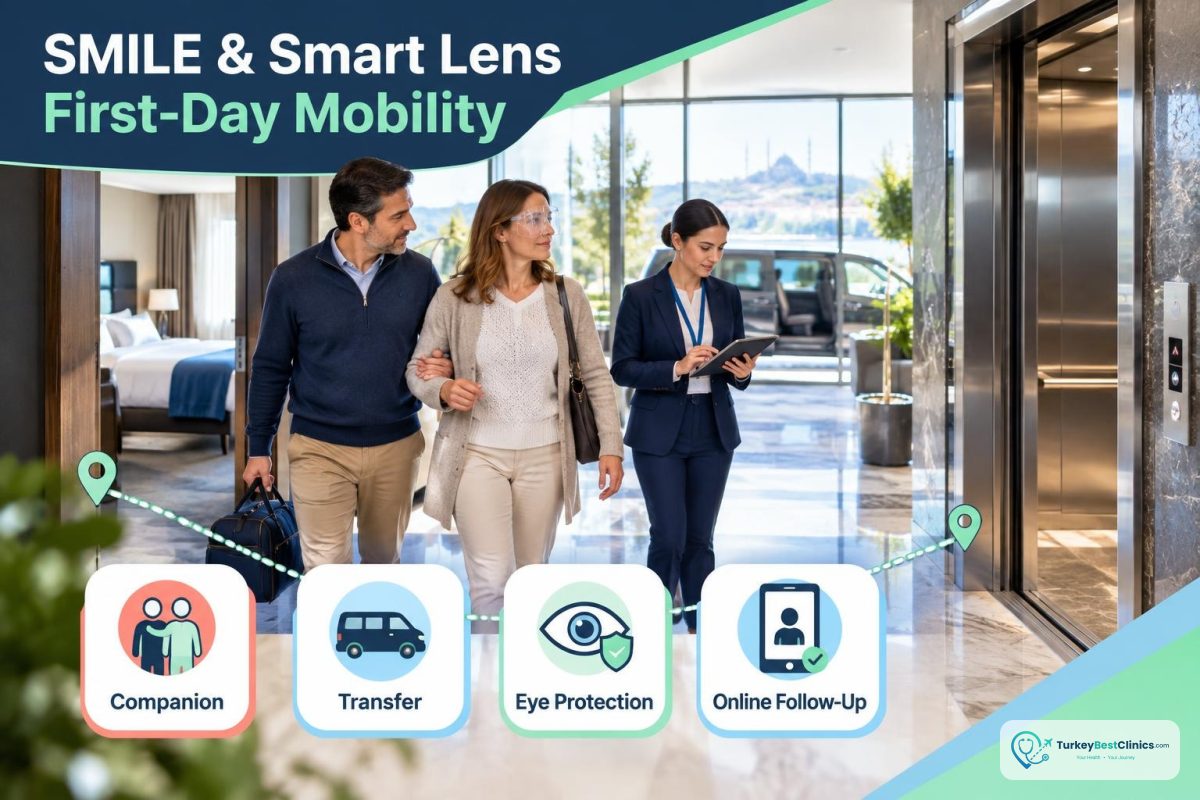
What Does the First Day After SMILE and Smart Lens Surgery Involve?
The day after SMILE laser or smart lens surgery generally involves controlled walking over short distances within the hotel and a transfer to the clinic for the first check-up. This does not mean that you have fully returned to your daily routine; visual clarity, light sensitivity and eye-surface discomfort may vary from person to person.
Getting out of bed, going to the bathroom and sitting for short periods can usually be planned in the hotel room. However, you should not drive, walk around the city alone, use stairs quickly, carry heavy items or rub your eyes. Having a companion with you on the first day, particularly after smart lens surgery, is an important part of the safety plan.
During SMILE, a small incision is made in the cornea. During smart lens surgery, an artificial lens is placed inside the eye; therefore, the measurements taken at the first check-up and movement restrictions may not be the same for both procedures. The exact plan is prepared according to the preoperative eye examination and the surgeon’s discharge instructions.
Clinical Safety Standards for SMILE Incisions and Smart Lens Surgery
It is important to plan your eye surgery in Turkey at a healthcare facility that holds a Health Tourism Authorization Certificate issued by the Ministry of Health and clearly shares information about its surgical infrastructure. Sterilization protocols in the operating room, regular maintenance of biomedical equipment, emergency intervention capabilities and the postoperative observation process should be explained in writing.
For SMILE, the model of the femtosecond laser platform, corneal thickness and topographic evaluation protocol are reviewed. For smart lens surgery, the biometry device, intraocular pressure measurement, retinal evaluation and lens power calculation method are assessed. The experience of Turkish ophthalmologists in refractive surgery, corneal laser procedures and cataract surgery should not be considered as an advertising claim alone, but together with the methods and measurement infrastructure used.
Postoperative Sterilization and Transportation Plan
For the vehicle taking you to the clinic for your first check-up, you may need window shades or sunglasses to reduce direct sunlight. Having the driver stay with you rather than leaving you alone, keeping your companion with you at the clinic entrance and arranging your return to the hotel on the same day provide a safer process.
If you experience worsening eye pain, marked redness, sudden loss of vision, intense flashes of light, a newly developing curtain-like sensation or eye pain accompanied by nausea, do not wait for your scheduled check-up; contact the center where your surgery was performed or emergency medical services without delay.
First-Day Organization in a SMILE and Smart Lens Package
A medical tourism plan may include airport-clinic-hotel transfers, hotel accommodation, interpreter support when needed and the organization of initial care supplies. Since package contents vary by center, you should confirm in writing in advance how many hours and days transportation will be provided after surgery, whether companion transportation is included and whether additional overnight fees apply.
For SMILE, most short-trip plans take into account preoperative measurements, the procedure day and the check-up the following day. For smart lens surgery, a longer stay in Turkey may be recommended because of retinal examination and intraocular pressure monitoring. The flight date should not be finalized until visual stability and check-up findings are considered suitable.
It is important that your companion can stay with you at the hospital, that the hotel is within a short transfer distance of the clinic and that a suitable rest routine is arranged in the room. Without straining your eyes, your companion can have a quiet rest at the hotel wellness area or take a short, quiet walk in a park that is compatible with your postoperative restrictions; crowded, dusty and intensely sunny environments should be avoided.
Next-Day Mobilization Protocol
- Waking up: Get out of bed slowly and sit for the first few minutes to check whether you experience dizziness or balance problems.
- Moving around the room: Walk short distances with your companion supporting your arm; remove fall hazards such as loose carpet edges and cables, and ensure adequate lighting.
- Transfer to the clinic: Close your eyes and rest in the vehicle, protect yourself from direct sunlight and do not apply makeup, wash your face or rub your eyes in the vehicle.
- After the check-up: Do not begin shopping, long walks, museum visits or prolonged screen use until your vision measurement and physician assessment have been completed.
Cost Comparison of SMILE and Smart Lens Surgery in Turkey
The ranges below show approximate medical tourism prices that vary according to the procedure, laser or lens technology used, surgeon, clinic, examinations, accommodation and transfer services included. A definitive quotation should be prepared after the examination and measurements are completed; a clinic should not be selected based solely on the lowest price.
| Procedure and country | Approximate total price | Notes on the price |
|---|---|---|
| Turkey – SMILE | €2,000–€3,500 | Both eyes, measurements and transfers may be included in some packages |
| Turkey – Smart lens | €3,500–€6,500 | Lens type, biometry, retinal examination and hospital coverage are determining factors |
| United Kingdom – SMILE | GBP 5,000–8,000 | Preoperative assessment and follow-up coverage vary by center |
| United Kingdom – Smart lens | GBP 6,000–10,000 | Lens selection and hospital fees affect the total |
| Germany – SMILE | €4,000–€7,000 | Prices vary according to the private center and laser platform used |
| Germany – Smart lens | €5,000–€9,000 | Examination, lens and operating room fees may be calculated separately |
| United States – SMILE | USD 5,000–8,000 | The price for both eyes, follow-up and additional measurements may be charged separately |
| United States – Smart lens | USD 6,000–12,000 | Lens type and surgical center fees create a wide price range |
Factors Affecting the First Check-Up and Recovery
Having a comfortable and safe first postoperative day depends on more than the procedure itself. The following factors may affect both clinical planning and the timing of the check-up:
- The physician’s expertise and experience: For SMILE, experience with corneal topography and laser planning is important. For smart lens surgery, experience with biometry, astigmatism assessment and retinal examination is significant. Ask which measurements the surgeon uses to select the procedure and what follow-up plan would be applied in the event of a complication.
- Technology, technique and materials: For SMILE, the femtosecond laser and corneal lenticule extraction technique are evaluated. For smart lens surgery, lens designs such as trifocal or EDOF lenses, the biometry device and the viscoelastic material used are considered. The optical properties of the lens should be assessed together with expectations regarding night-time light scatter and near vision.
- Clinic location: A short transfer distance to the clinic, travel time from the airport, and a hotel with an elevator and a low-risk room layout make it easier to attend the first check-up on time. Traffic in large cities, long car journeys and arranging the check-up at a different facility may make mobilization more difficult.
After SMILE, dryness and light sensitivity on the corneal surface may be assessed. After smart lens surgery, factors such as intraocular pressure, corneal edema and visual adaptation may be evaluated during the check-up. For this reason, ask in advance whether the check-up involves more than visual acuity testing, which devices will be used and in which language the results will be explained to you.
Online Follow-Up and Frequently Asked Questions After the Check-Up
After the first check-up, your return-home plan is finalized according to your visual measurements and the clinical appearance of your eye. The center may provide online follow-up by sharing your reports and check-up results; video consultations, secure file sharing and communication with your local eye doctor when necessary may be part of the process.
- Can I walk back to the hotel alone the day after SMILE or smart lens surgery? Short-distance movement within the room may be possible in many plans; however, companion support is safer for reaching the clinic, using stairs and walking outdoors. Even if your vision is sufficiently clear, you should not be expected to drive.
- Which measurements are taken at the first check-up, and who decides whether I can fly? Visual acuity, the eye surface, the cornea or lens area, intraocular pressure and, when necessary, the retina are assessed. The decision about flying and returning home should be made according to the examination findings of the ophthalmologist who performed the surgery.
- When is online follow-up not sufficient after I return to my country? In the event of sudden reduced vision, severe pain, marked redness, flashes of light, a curtain-like sensation or increasing discharge, you should not rely solely on an online consultation. Contact the surgical center and obtain an urgent eye examination where you are located.
When planning from abroad, having the surgical method, first check-up date, need for a companion, hotel-clinic transfer, flight clearance and responsibility for online follow-up included in one written schedule makes decision-making easier. It is not possible to confirm that SMILE or smart lens surgery is suitable for you without a personal examination.