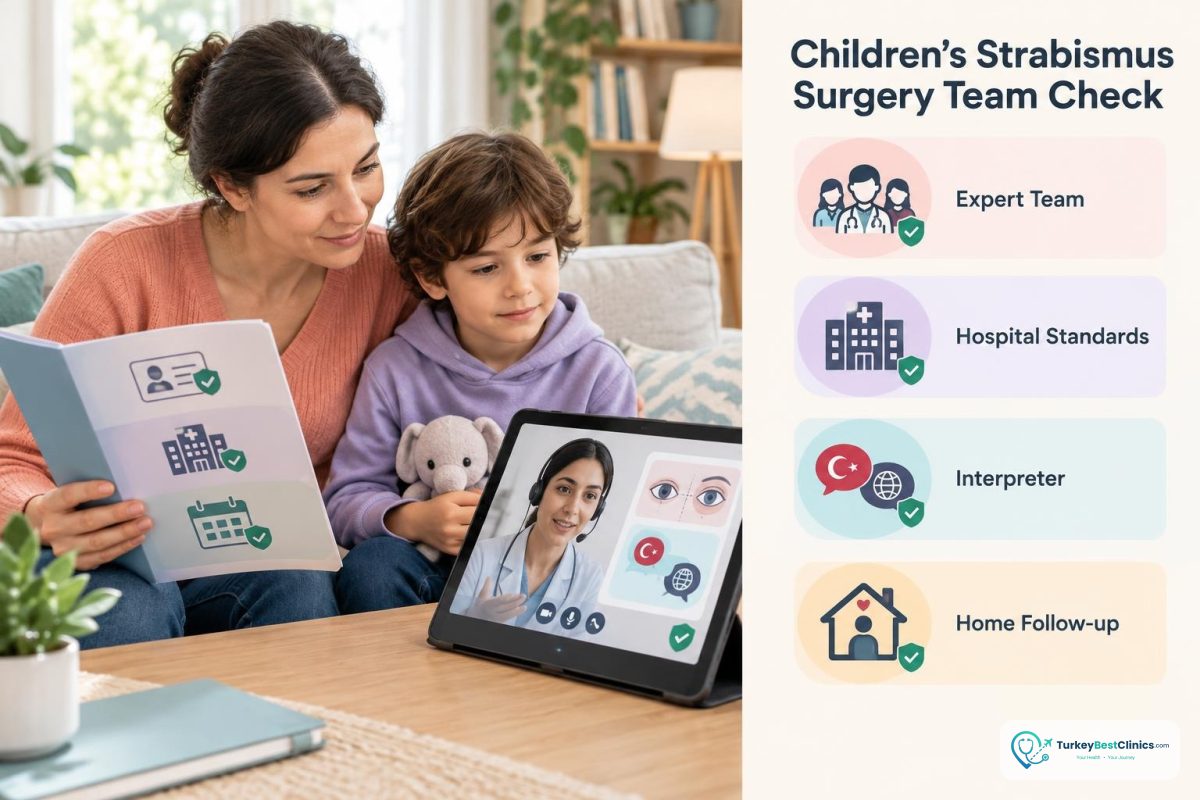
Identifying the Right Team for Your Child’s Strabismus Surgery
In pediatric eye care and strabismus surgery, looking only at a clinic’s general reputation is not enough. The pediatric ophthalmology team must be able to assess your child according to their age, the direction of the strabismus, and differences in eye movements, while managing the preoperative and postoperative process clearly.
When planning from abroad, review three areas together: the surgeon’s regular experience with pediatric strabismus cases, the hospital’s pediatric anesthesia and sterilization infrastructure, and the language in which written and verbal communication will take place. These three areas are not independent; they are complementary parts of a safe plan.
Documents You Can Request During the Initial Consultation
- Specialization and professional background in pediatric ophthalmology or strabismus
- The approximate annual number of strabismus surgeries performed on children
- Information about the Ministry of Health Health Tourism Authorization Certificate of the hospital where the surgery will be performed
- A written summary of the preoperative assessment, anesthesia, and follow-up protocol
- Consent and discharge documents prepared in a language your child can understand
Safety and Language Standards in Pediatric Eye Surgery in Turkey
When choosing a service under Turkey’s health tourism framework, verify whether the clinic or healthcare provider holds a Health Tourism Authorization Certificate issued by the Ministry of Health. You can check whether the certificate is current and whether it actually covers the healthcare facility where the surgery will be performed by requesting the certificate number directly from the provider.
An authorization certificate does not replace the surgeon’s personal experience with a specific procedure. Therefore, request concrete information about pediatric ophthalmology training, experience in eye muscle surgery, frequency of working with different age groups, the approach to postoperative reassessment, and coordination with pediatric anesthesia, especially for pediatric strabismus.
Questions That Make Experience Measurable
- How many pediatric strabismus surgeries were performed in the last 12 months?
- What was the age range of the patients, and what surgical plan was most commonly used?
- What assessment criteria are used for procedures involving the muscles of one or both eyes?
- How are eye alignment, eye movements, and visual development monitored after surgery?
- How will communication with the responsible doctor be handled if there is an unexpected outcome or a need for additional surgery?
Regarding communication, do not rely solely on a flag icon on the website or general call center support. Clarify in writing which language the surgeon will use for the medical explanation, whether a professional interpreter will attend the consent consultation, how the anesthesia team will communicate, and which line can be reached 24 hours a day in an emergency.
Strabismus Surgery Package and Your Child’s Preparation Plan
An organizational package may include airport or hotel-to-hospital VIP transfers, accommodation near the hospital, professional interpreter support, and initial care recommendations after discharge. Request written details and a list of exclusions for medications or medical products, prescription arrangements, and accompanying-person services.
Before strabismus surgery, eye alignment and movements, visual acuity, the need for glasses, the risk of amblyopia, and previous surgery records are assessed. Where necessary, orthoptic measurements and an anesthesia evaluation are arranged. The surgical team will determine whether blood tests or additional assessments are needed based on your child’s general health; ask in advance which tests will be accepted in Turkey and which will be accepted in your home country.
Check in advance whether your accompanying person can stay with your child in the hospital and what the room’s visitor rules are; staying at a hotel near the hospital can make transportation after surgery easier. While your child rests, the accompanying person may take short walks in nearby parks or use quiet wellness areas, as appropriate for the period when surgery may require limiting eye rubbing.
Step-by-Step Travel and Follow-Up Protocol
- Current eye examination results, previous surgical reports, and eyeglass prescriptions are shared digitally.
- During a video consultation, the surgeon explains the limits of the assessment and which examinations must be performed in Turkey.
- After arrival, an in-person eye examination, measurements, and pediatric anesthesia assessment are completed.
- After surgery, the discharge criteria, eye care instructions, and follow-up date are provided in writing.
- After you return home, online follow-up consultations are used to assess photographs, examination reports, and symptoms; when necessary, communication with your local eye doctor is arranged.
Cost of Pediatric Strabismus Surgery in Turkey and Country Comparison
The figures below are approximate international health tourism ranges that may be seen for pediatric strabismus surgery at private healthcare facilities. The surgeon’s plan, whether one or both eyes are treated, anesthesia, hospital stay, and travel services can change the total; a definitive price can only be provided after examination and review of the medical records.
| Country | Approximate procedure cost | Currency | Scope that should generally be reviewed |
|---|---|---|---|
| Turkey | 2,000–5,500 | € | Examination, surgery, anesthesia, and short-term hospital follow-up; package inclusions should be verified separately |
| United Kingdom | 4,500–9,000 | £ | Scope of the private hospital, surgeon, anesthesia, and follow-up care |
| Germany | 4,000–8,000 | € | Hospital, surgical team, anesthesia, and follow-up services |
| United States | 7,000–15,000 | $ | Separate billing for the doctor, hospital, anesthesia, and postoperative follow-up visits |
When comparing quotes, do not look only at the total amount. Listing the surgeon’s fee, operating room and anesthesia charges, eye examination, interpreter, accommodation, transfers, and any potential additional follow-up separately can reduce uncertainty about later costs.
Criteria Determining the Surgical Team’s Experience and Communication Language
- Doctor’s specialization and experience: Request measurable information about training in pediatric ophthalmology and strabismus surgery, the number of pediatric cases handled in the last 12 months, experience with different types of strabismus, and postoperative reassessment rates. The statement very experienced is not sufficient on its own unless supported by documentation or explainable data.
- Technique and technical infrastructure: The surgical plan may vary depending on options such as eye muscle recession, muscle resection, coordinated muscle surgery in both eyes, or, in selected cases, an adjustable suture approach. In children, the suitability of adjustable sutures depends on age, ability to cooperate, and the surgeon’s assessment; ask why the method is being recommended and what the alternative is.
- Pediatric anesthesia and hospital infrastructure: Confirm that the anesthesiologist regularly works with children, and review the operating room sterilization protocols, postoperative observation area, and access to pediatric support units if needed.
- Clinic location: In Istanbul, Ankara, Izmir, and other centers, prices may vary according to the hospital’s location and the costs of international patient services, accommodation, and transportation. The airport-to-hospital distance, duration of follow-up visits, and potential emergency care location should be provided in writing before travel.
- Foreign-language and interpreter system: The interpreter must be able to convey not only everyday conversation but also medical terms such as strabismus angle, eye movement, surgical muscle, anesthesia risk, and discharge warnings. Using a professional interpreter during critical consent consultations supports complete answers to the child’s and accompanying person’s questions.
How Can You Assess Language Competence During the Consultation?
During the initial video consultation, ask for the following points to be explained clearly: the purpose of the surgery, the expected recovery process, the need for glasses or patching, the follow-up schedule, travel restrictions, and which symptoms require urgent medical attention. After the consultation, request a written summary of the same information; if the verbal explanation differs from the documents, ask for the discrepancy to be corrected before the surgery date.
Your Checklist and Further Questions About Pediatric Strabismus
Before making a decision, keep the responses from the surgeon, hospital, and international patient department together in one file. In particular, request further clarification if the scope of the quote, the interpreter’s role, the emergency contact line, the length of the hospital stay, and the online follow-up plan after returning home are not provided in writing.
- For my child, should conventional eye muscle surgery or, in selected cases, an adjustable suture approach be considered?
- How will amblyopia, the need for glasses, and orthoptic measurements be assessed before strabismus surgery?
- After returning home from Turkey, which reports, photographs, and local eye examination details will be used for online follow-up?
Collecting answers to these questions from different clinics in the same format will help you compare not only prices but also the team’s experience and communication quality. Final surgical suitability should be determined after your child has undergone an in-person eye examination and pediatric anesthesia assessment.