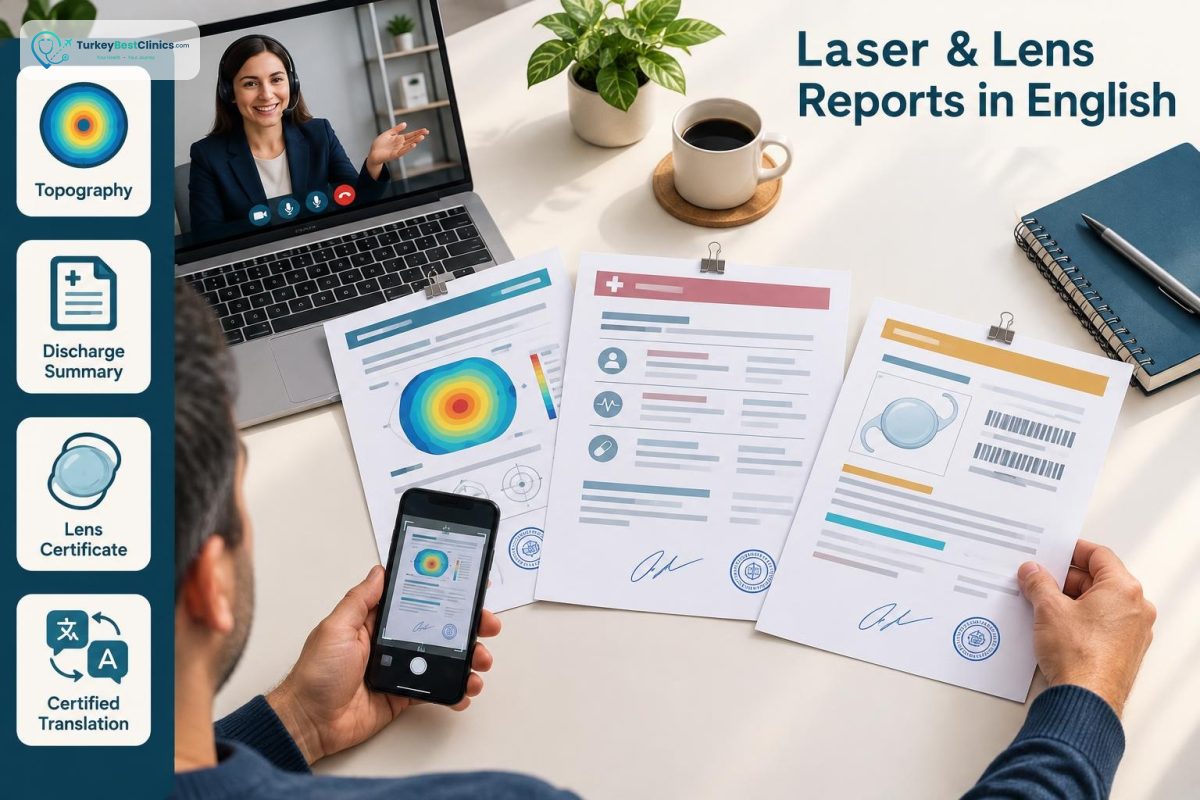
Your English Medical File for Laser and Lens Surgery
When planning laser eye surgery or intraocular lens surgery in Turkey, you need to obtain not only the surgical outcome but also the preoperative measurements and technical information about the materials used, so that an ophthalmologist in your home country can evaluate your case. This file may include corneal topography or tomography, refraction measurements, intraocular pressure, biometry, the operative note, the discharge summary and product information for the lens used.
These documents can be prepared in English; however, there is no general rule that “all reports are automatically provided in English after every procedure.” Depending on the clinic or hospital, documents may be issued directly in English, prepared bilingually in Turkish and English, or issued in Turkish and then professionally translated separately.
In laser procedures in particular, a “lens certificate” is generally not expected. This document is relevant to phakic lenses implanted inside the eye or intraocular lenses used in cataract surgery. Clarifying this distinction from the outset can help you avoid requesting an unnecessary document or overlooking an important surgical record.
Key documents you may request
- Corneal topography or tomography: Shows corneal curvature, irregularities and, on some devices, measurements related to corneal thickness. Records taken before laser treatment and, when considered necessary, afterward are valuable for comparison.
- Discharge summary: Summarizes the diagnostic assessment, procedure performed, surgery date, method used, follow-up plan and important precautions.
- Operative note: May provide more technical information about the type of laser, technique used, eye-specific treatment details and the course of surgery.
- Lens certificate and implant card: May include the lens brand, model name, diopter value, serial or lot number, manufacturer details and implantation date.
- English-language physician letter: Written for the ophthalmologist in your home country, it provides a clear summary of the preoperative findings, procedure performed and ongoing follow-up needs.
Safety of Topography Records and Intraocular Lens Documents
Planning surgery at a fully equipped hospital or a healthcare facility operating in compliance with applicable regulations is important not only for surgical safety but also for the continuity of your medical records. When receiving healthcare services as part of medical tourism, you can check whether the facility holds a “Health Tourism Authorization Certificate” issued by the Ministry of Health of the Republic of Türkiye.
This certificate indicates that the healthcare facility is authorized to provide international health tourism services; by itself, it does not guarantee that every report will be prepared in English or that a particular medical outcome will be achieved. You should also obtain written confirmation of who will sign the report, which language it will be issued in and when an electronic copy will be delivered.
Technical details that enhance document reliability
- Topography or tomography printouts should include the measurement date, device type, eye identification and, where possible, raw measurement data.
- The discharge summary should state the exact procedure name, distinguish between the right and left eyes, identify the laser platform or surgical method used, indicate whether any complications occurred and include recommendations for subsequent check-ups.
- Intraocular lens documents should contain manufacturer, model, diopter, serial or lot number and implantation details that are consistent with one another.
- For electronic files, PDF format, the clinic stamp, the physician’s signature or verifiable electronic signature details are preferable.
- In English translations, units of measurement, eye-related abbreviations and lens diopter values should not be changed.
Measurement records used by Turkish ophthalmology teams in procedures such as corneal topography, excimer laser planning, femtosecond laser treatment, phakic lens implantation and cataract surgery can provide a valuable starting file for your specialist at home. However, each doctor may still consider their own examination and updated measurements in your country necessary.
English Documentation Package for Laser or Lens Surgery
In packages that include transfers, accommodation, interpreting and initial aftercare support, preparing documents in English may be listed as a separate item. Therefore, ask for the package agreement to specifically include “English discharge summary,” “English topography printout,” “lens implant certificate” and “operative report”; the general phrase “medical documentation” is not sufficiently clear.
The possibility for your companion to stay with you at the hospital, the hotel’s proximity to the hospital and access to low-intensity options such as a quiet park walk or wellness area during your recovery can make planning easier, particularly on the days of your initial check-ups. Instructions such as avoiding rubbing your eyes, limiting exposure to water and dust after laser treatment, or avoiding strenuous physical activity after lens surgery should also be incorporated into your companion’s plans.
Preoperative document checklist
- Share your current eye examination, previous surgical records and information about any lenses you use digitally before the procedure.
- Clarify whether topography, corneal thickness measurement, biometry or retinal assessment will be performed.
- Ask whether the English report will be prepared directly by the physician or by a sworn translator.
- Obtain written confirmation of whether the documents will be delivered on the day of surgery, at discharge or after online follow-up.
- Provide the clinic in advance with any specific format, signature, stamp or certified translation requirements requested by your ophthalmologist at home.
After laser procedures, discharge on the same day or after a short observation period may often be planned. After lens surgery, the frequency of check-ups and the length of stay in Turkey vary depending on the technique used, the condition of the eye and the physician’s assessment. It may be safer not to finalize your flight plans before discharge has been approved and your first follow-up examination has taken place.
Comparing English Reports, Translation and Surgery Costs
Document preparation fees are not subject to a single international tariff. The ranges below are examples of market ranges in which laser or lens surgery and basic English medical records, check-ups and translation services may be priced together; they should not be treated as definitive quotations because costs vary according to the procedure, lens type, hospital, city, additional tests and exchange-rate fluctuations.
| Country | Approximate range for surgery and basic medical records | Availability of English documents |
|---|---|---|
| Türkiye | €1,500–€4,500 | English or bilingual documentation is included in some packages; sworn translation may be charged separately. |
| United Kingdom | £3,000–£7,000 | Documents are generally in English; the scope of detailed imaging and lens certification varies by center. |
| Germany | €2,500–€6,000 | English translation of basic German records may be required separately. |
| United States | $3,500–$8,000 | English medical records are widely used; advanced measurements and follow-up fees may be charged separately. |
The cost of reports and translation alone may be much lower than the cost of surgery. However, the total may increase if new topography, biometry, a physician assessment or a detailed medical letter is requested. When obtaining a quotation, make sure the surgery fee, English report, imaging files, lens certificate, initial follow-up and online follow-up service are listed as separate items.
Factors That Change the Report Content and Process
The scope of the documents and the total cost do not depend solely on the language selected. The following factors may affect both the level of detail in the file and the service fee:
- Physician’s specialization and experience: Expertise in corneal surgery, refractive surgery or intraocular lens procedures may affect the scope of the preoperative assessment, operative note and medical letter sent to your ophthalmologist at home.
- Technology and method used: Laser procedures such as LASIK, PRK or SMILE may change the level of detail in corneal topography, tomography and pachymetry records. In phakic lens or cataract surgery, biometry, toric lens calculations and the implant card become additionally important.
- Clinic location: Hospital, imaging, translation and accommodation costs may differ in Istanbul, Ankara, Izmir and other cities. Airport transfers or intercity transportation may also be added to the overall plan.
- Document verification method: A basic English summary, detailed physician letter, notarized or sworn translation, wet signature and apostille request are different services.
- Procedure type and follow-up needs: The follow-up schedule, required measurements and scope of the records sent to your country differ between laser treatment and intraocular lens surgery.
If online follow-up will be arranged after you return home, it is useful for the reports to be shared through a secure portal, for the resolution of imaging files to be preserved and for the details of the local ophthalmologist you should contact in an emergency to be included in the file. Online follow-up does not replace an in-person examination; vision loss, severe pain, marked redness or sudden changes in vision require urgent eye assessment in the country where you are located.
Next Steps for Your English Medical File After Treatment
- Will English documents be provided automatically? How can you obtain written confirmation from the clinic before treatment of the language and signature format in which topography, the discharge summary, operative note and lens certificate will be delivered?
- Which measurements are required for laser treatment? Which of your corneal topography, tomography, pachymetry and surgical parameters should be included in your file for assessment by your ophthalmologist at home?
- What information should a lens certificate contain? How can you compare the model, diopter and serial or lot number on the implant card with the operative report and biometry records?
The safest approach is to obtain your ophthalmologist’s document requirements in writing before the date of surgery. Then ask the healthcare facility in Turkey for a clear delivery plan covering English or bilingual reports, raw imaging files, a surgical summary and, if necessary, a sworn translation.