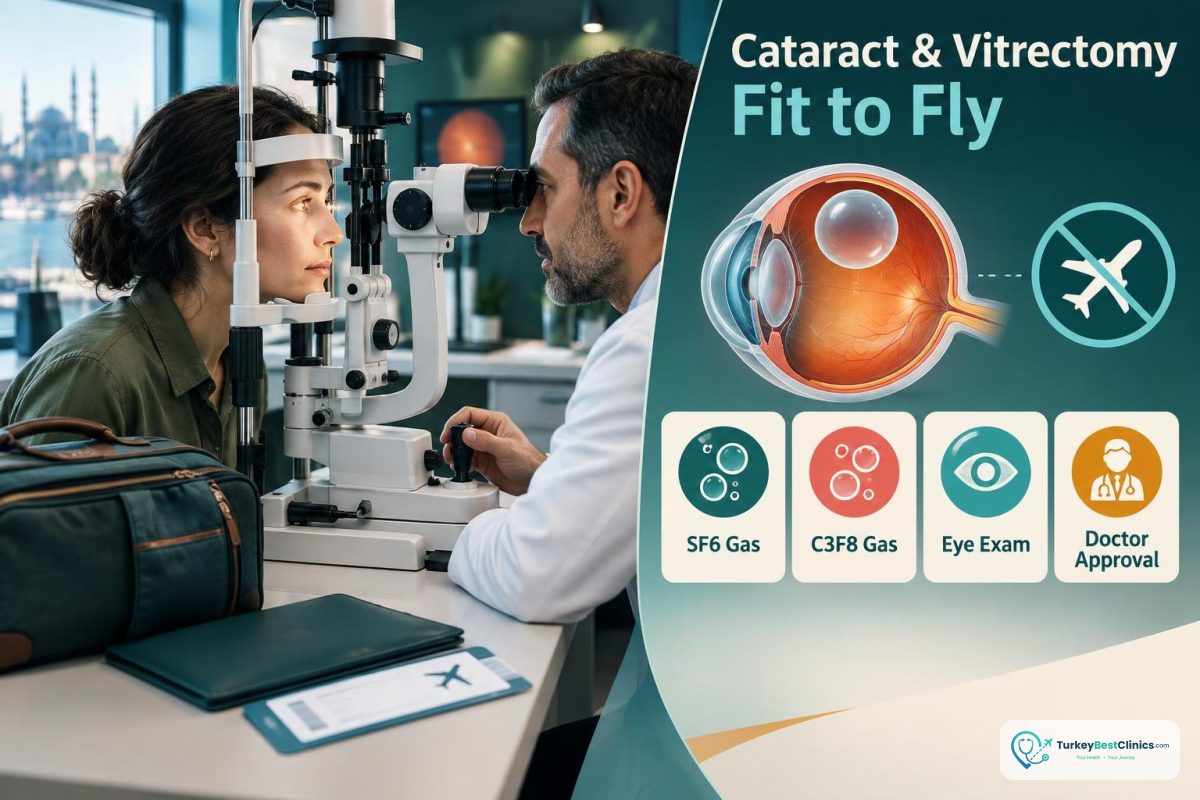
How Do Intraocular Gas and Cabin Pressure Affect Flight Safety?
After cataract surgery, permanent gas is not placed inside the eye in most cases. However, retinal detachment, macular hole, and similar vitreoretinal surgeries may involve leaving air or an expanding gas tamponade inside the eye. As cabin pressure decreases compared with sea level during a flight, the gas inside the eye may expand and rapidly increase intraocular pressure to dangerous levels.
For this reason, a Fit to Fly report is not issued solely based on the appearance of the surgical wound. The type and amount of intraocular tamponade, intraocular pressure, retinal condition, cornea, visual acuity, and duration of the planned flight are assessed together.
If it is known that air or gas is still present in your eye, you will not be cleared to fly, even if the airline requests a report. The decision to fly should be based on the examination findings of the ophthalmologist who performed the surgery or who has reviewed your medical records in detail.
Safety Protocol in Turkey After Cataract Surgery and Vitrectomy
Flight assessment after cataract surgery
After standard phacoemulsification and intraocular lens implantation, if no expanding gas is present inside the eye, fitness to fly can often be assessed at an early stage. However, no definite date is given before checking intraocular pressure, corneal edema, signs of infection, wound healing, and visual acuity.
Following uncomplicated cataract surgery, some physicians may assess patients for a short flight within a few days. More cautious planning may be necessary for long-haul or connecting flights. The exact timing depends on the surgical technique used, the eye’s response, and the flight route.
Checking gas tamponade after vitrectomy
The use of air, SF6, or C3F8 tamponade after vitrectomy directly affects flight planning. Air is generally absorbed more quickly than these gases, while SF6 and especially C3F8 may remain inside the eye for weeks. The complete disappearance of gas cannot be determined simply by how your vision feels; a slit-lamp examination and fundus assessment are required.
In Turkey, ensuring that the facility where the surgery will be performed holds a Health Tourism Authorization Certificate issued by the Ministry of Health is an important administrative safety consideration for international patients. In retinal surgery, the treatment plan may be supported by specialized examinations such as a peripheral retinal examination, optical coherence tomography, ocular ultrasonography, or intraocular pressure measurement.
Full hospital-grade sterilization, access to emergency retinal and anesthesia support, the ability to monitor intraocular pressure after surgery, and the preparation of medical reports in English or another suitable language can make your return journey abroad safer. The surgeon’s experience in retinal surgery, the gas tamponade used, and the expected absorption time of that gas should be clearly documented in your medical records.
Fit to Fly Package and Length of Stay in Turkey
Depending on the plan, airport-hospital transfers, a hotel near the hospital, interpreter support, and essential coordination during the initial care period may be arranged. Whether your companion can stay with you at the hospital, choosing a hotel within a short distance of the hospital, and planning quiet park walks or suitable wellness facilities nearby while you rest should all be organized according to any head and eye movement restrictions after retinal surgery.
After cataract surgery, the first follow-up is usually performed on the day of surgery or the following day. After vitrectomy, depending on the type of gas and retinal findings, you may need to stay in Turkey for several days to several weeks. In particular, your return ticket should not be finalized before the gas has been completely absorbed.
A Fit to Fly assessment generally includes reviewing the surgical report, the name of the tamponade used, the latest intraocular pressure, visual acuity measurements, and the most recent retinal examination. The report should state the date of surgery, the date from which you are fit to fly, whether gas remains in the eye, any required positioning instructions, and contact details for use in an emergency.
When Can a Fit to Fly Report Be Issued?
There is no single universally applicable number of days. The general approach is to confirm during an examination shortly before the flight that no expanding gas remains inside the eye and that the eye is clinically stable.
| Surgery or tamponade status | General approach to flight planning | Essential check before issuing the report |
|---|---|---|
| Uncomplicated cataract surgery without gas | Assessment can be performed within a few days in many cases; the exact timing depends on the physician’s examination. | Intraocular pressure, wound, cornea, signs of infection, and vision |
| Intraocular air tamponade | Flights are not planned until the air has been completely absorbed; the absorption time varies from person to person. | Confirmation by examination that no air bubble remains |
| SF6 gas | The gas generally remains for a period measured in weeks; flying is not appropriate until it has completely disappeared. | Complete gas absorption, intraocular pressure, and retinal condition |
| C3F8 gas | Because it is long-acting, flight restrictions may last longer; in some cases, patients must wait several weeks or more. | Confirmation of a gas-free eye through slit-lamp and retinal examination |
If the postoperative examination is satisfactory, many centers issue the report close to the flight date, for example on the same day or within the few days before the flight. This helps reduce the risk of a new change in intraocular pressure or retinal status after the report has been issued. If the airline has its own medical form or report format, you should find this out in advance.
Comparison of recovery time and surgical approaches
| Approaches compared for you | Most important potential advantage for you | Your recovery and hospital stay |
|---|---|---|
| Vitrectomy using gas tamponade | May provide stronger internal support to help the retina or macular region heal. | Usually involves a short period of hospital observation; however, flight restrictions may last for weeks depending on the type of gas. |
| Air tamponade or a gas-free vitreoretinal approach | May reduce the flight risk associated with gas expansion and, in some situations, allow an earlier travel assessment. | Varies according to the extent of surgery; retinal monitoring and intraocular pressure checks remain essential. |
This table should not be used on its own to choose a surgical method. The location of the retinal tear, the extent of the detachment, macular involvement, other eye conditions, and findings observed during surgery determine which tamponade is appropriate.
Factors That Affect Fit to Fly Costs and the Process
The figures below are approximate international ranges that may vary depending on whether treatment, postoperative examinations, and report services are priced together or separately. A definitive quote can be provided after determining whether gas remains in the eye, whether a new examination is needed, and whether the report must be prepared in the airline’s required format.
| Country | Assessment and report after cataract surgery | Assessment and report after vitrectomy |
|---|---|---|
| Turkey | Approximately €100–300 | Approximately €150–500 |
| United Kingdom | Approximately £150–450 | Approximately £300–900 |
| Germany | Approximately €180–450 | Approximately €350–1,000 |
| United States | Approximately $250–700 | Approximately $500–1,500 |
- Physician’s specialization and experience: Experience in retinal surgery, gas tamponade management, and complex postoperative examinations may affect the scope and cost of the assessment.
- Technique and type of tamponade: Phacoemulsification, pars plana vitrectomy, and the use of air, SF6, or C3F8 may change the number of examinations required, the observation period, and when the report can be issued.
- Clinic location: Examination and transfer arrangements may be priced differently in centers with strong international flight connections, such as Istanbul. A hotel near the hospital, interpreter services, and companion coordination may also affect the overall plan.
Steps to Take and Important Questions Before Your Flight
Especially when vitrectomy and gas tamponade are involved, it is safer not to finalize your flight reservation before the first postoperative retinal examination. Clearly inform the airline and your companion that you will not fly while gas remains in your eye, and keep the surgical team’s written instructions regarding anesthesia or diving restrictions.
After you return to your country, an Online Follow-up process may be arranged. This follow-up assesses changes in vision, pain, redness, flashes of light, new floaters, and compliance with the positioning requested by the doctor. However, an online consultation cannot replace an in-person fundus examination when one is required.
- Is there an exception for flying while SF6 or C3F8 gas remains in my eye? Even if the amount of gas appears to have decreased, you should not fly until complete absorption has been confirmed by a physician’s examination. This issue must be assessed in relation to the gas tamponade and flight safety.
- Which eye checks are needed before flying after cataract surgery? Intraocular pressure, the cornea and surgical incision, signs of infection, and visual acuity are assessed; the report date is determined according to the most recent examination.
- How should head positioning and emergency follow-up be planned for a long flight after vitrectomy? The tamponade used, the retinal area involved, and the surgeon’s positioning instructions are assessed together. A plan for online follow-up after returning home and, if necessary, consultation with a local retinal specialist is also established.
If you develop severe eye pain, sudden vision loss, marked redness, nausea or vomiting, intense flashes of light, or a curtain-like shadow, do not wait to decide about your flight and seek urgent ophthalmic assessment. A Fit to Fly report is more than an administrative document authorizing travel; it is a physician’s assessment that your eye is suitable for safe travel at that time after surgery.