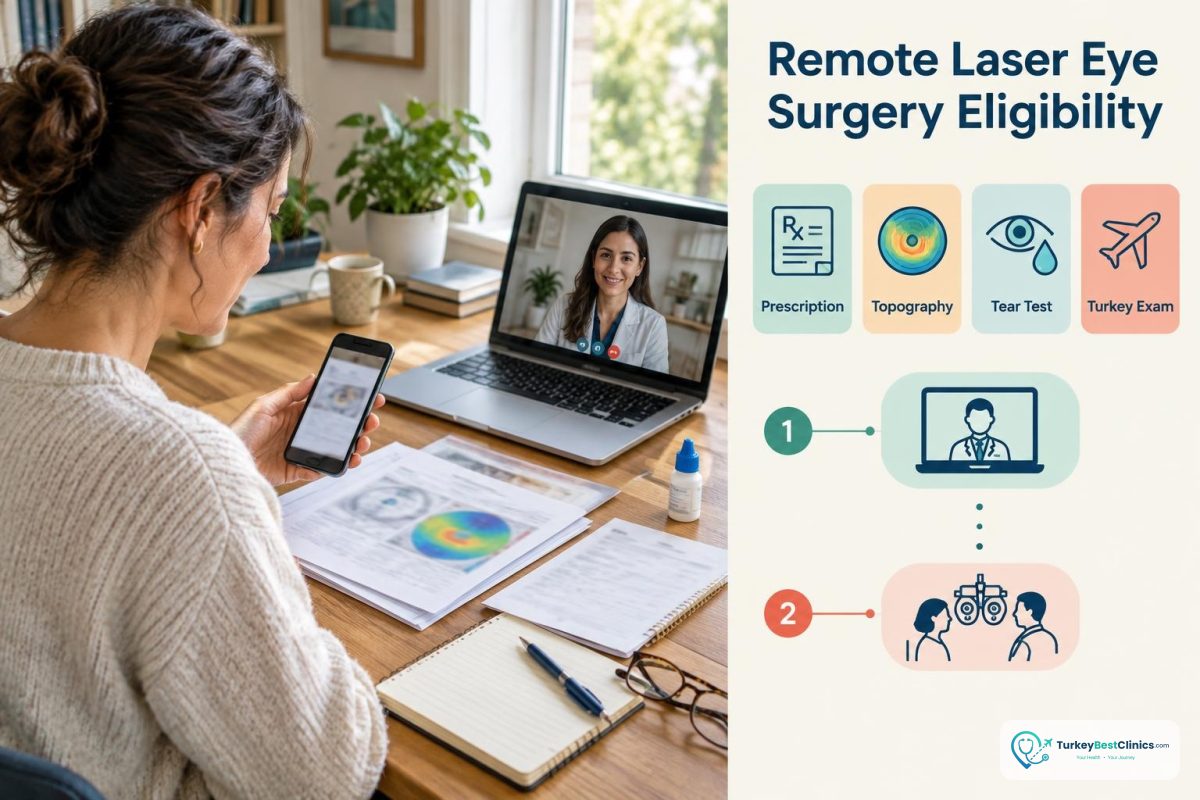
How Can Laser Eye Surgery Eligibility Be Assessed Before Travel?
A meaningful preliminary assessment of your suitability for laser eye surgery can be carried out before you travel to Turkey. This involves reviewing information such as your current glasses or contact lens prescription, most recent examination report, corneal topography or tomography, and the type of contact lenses you use.
This online stage can help you plan your trip more efficiently and shorten the examination time in Turkey. However, a remote assessment does not constitute final approval for surgery; details such as the ocular surface, corneal thickness, intraocular pressure, pupil size and retina must be measured directly at the clinic.
Expected improvements in visual quality, reduced dependence on glasses or contact lenses, and greater comfort in daily life are important parts of this decision. However, satisfaction with your appearance in the mirror or in social situations depends not only on reducing the prescription, but also on selecting the right method and having realistic expectations.
Corneal Topography and Safety Standards in Turkey
Laser eye assessments in Turkey should be carried out at clinics holding a Health Tourism Authorisation Certificate issued by the Republic of Türkiye Ministry of Health and by ophthalmologists authorised in the relevant specialty. The certificate is an important checkpoint showing that the clinic meets certain administrative and service standards for international healthcare processes; it does not, by itself, guarantee the surgical outcome.
Turkish ophthalmologists use corneal laser techniques such as LASIK, PRK and SMILE to correct myopia, hyperopia and astigmatism. Eligibility assessment considers more than the eye prescription; it also examines corneal thickness, the regularity of the corneal surface, signs of irregular astigmatism, the tear film and whether the prescription has remained stable recently.
Data Reviewed During a Remote Preliminary Assessment
- Glasses prescription from the last 6–12 months and changes in prescription
- Contact lens type, wearing duration and date of discontinuation, if applicable
- Corneal topography or tomography report and, where possible, the raw images
- Corneal pachymetry, meaning measurement of corneal thickness
- History of dry eye, allergies, blepharitis or recurrent eye infections
- Previous eye surgeries, trauma and relevant systemic health information
Although these documents are useful for remote pre-screening, the quality of the measurement devices, the date of the report and the technical adequacy of the images can affect the assessment. If you wear contact lenses, measurements taken before discontinuing them for the period specified by the clinic may not be reliable because the shape of the cornea can change temporarily.
Laser Eye Surgery Package: Examination, Measurements and Travel Planning
A planned package in Turkey may include an initial in-clinic assessment, a detailed refractive examination, the necessary corneal imaging, initial post-procedure check-ups, VIP transfers, hotel accommodation, interpreter support and initial care products. The exact scope is determined by the method planned for both eyes and the service agreement offered by the clinic.
Even if the remote preliminary assessment appears favourable, a decision to operate is generally not made on the same day in Turkey; measurements are repeated, the ocular surface is checked and the ophthalmologist completes the clinical examination. Most travel plans for laser eye procedures allow for an approximately 3–5-day stay; this may be extended if additional follow-up or borderline measurements are required.
On the day of the procedure and during the following days of light recovery, your companion can spend short periods in indoor shopping areas in Istanbul or choose a quiet museum or historic bazaar visit; in Antalya, brief hotel activities with limited exposure to wind and strong sunlight are more suitable. In Izmir, indoor dining venues and short city itineraries with rest breaks should be chosen; dusty, windy and lengthy outdoor excursions should be postponed, especially during the early recovery period.
Key Differences Between LASIK and SMILE
| Methods Compared | Key Advantage | Effect on Recovery Time |
|---|---|---|
| LASIK | A corneal flap is created, potentially allowing rapid visual recovery across a broad prescription range | Vision usually becomes clear quickly; the doctor's protective recommendations should be followed during the early period to help manage dryness and protect the flap |
| SMILE | A lenticule is removed through a small incision in the cornea; the absence of a large flap may offer advantages in some active lifestyles | Vision may become clear more gradually than with LASIK; fluctuations can occur during the first few days |
This table does not indicate which method should be chosen. A safe choice between LASIK and SMILE cannot be made without assessing the corneal structure, type of prescription, tear film and lifestyle together; in some cases, surface laser treatment such as PRK or non-laser options may be considered.
Laser Eye Surgery Costs in Turkey
The approximate total cost of laser vision correction for both eyes in most private centres in Turkey may range from €1,500 to €3,500. These figures are indicative market ranges only; the examination scope, selected technique, follow-up period and whether travel services are included should be checked separately in the written quotation.
| Country | Approximate Price for Both Eyes | Note on What the Price Includes |
|---|---|---|
| Turkey | €1,500–€3,500 | Examination, procedure and package services may vary by clinic |
| United Kingdom | £3,000–£6,000 | Varies according to the technique and follow-up plan |
| Germany | €2,500–€5,000 | Initial assessment and follow-up appointments may be charged separately |
| USA | $4,000–$8,000 | At most centres, pricing depends on both eyes, the technology and the follow-up package |
When requesting a quotation, it is important to ask in writing for the total price for both eyes, preoperative measurements, postoperative check-ups, the enhancement policy and the conditions for refunds if unexpected examination findings make treatment unsuitable. Very low prices or prices presented as a single line item should not be compared until the scope is clarified.
Clinical Criteria That Affect Eligibility and the Process
The Ophthalmologist's Expertise and Refractive Surgery Experience
Choose an ophthalmologist based not only on the total number of procedures performed, but also on their experience interpreting corneal tomography, assessing high astigmatism, managing dry eye and postponing treatment when an application is unsuitable. During the consultation, a discussion explaining why a method is recommended and which findings could prevent the procedure is valuable for transparency.
Laser Technology and the Corneal Approach
Creating a LASIK flap with a femtosecond laser, reshaping the corneal surface with an excimer laser and removing an intracorneal lenticule with the SMILE technique are different surgical approaches. In addition to the brand of the device, the compatibility of the measurement system with corneal tomography, the personalisation of the treatment plan and how safety checks are performed are also important.
Clinic Location and Follow-up Arrangements
Clinics in Istanbul, Antalya and Izmir may differ in terms of transport, accommodation and follow-up arrangements. Before travelling, clarify when the first postoperative check will take place, whether you will need to return to the clinic for a second check and how communication with your ophthalmologist in your home country will be managed.
Three Important Questions to Ask After a Remote Assessment
- Based on my corneal tomography, which of LASIK, SMILE or PRK appears most suitable, and which measurements need to be repeated in Turkey for a final decision?
- How long should I stop wearing contact lenses, and do I need any specific preparation for the tear film or corneal surface before travelling?
- On which day will postoperative vision checks take place, when will flying be permitted, and which reports will be sent to the ophthalmologist providing follow-up care in my home country?
Obtaining written answers to these questions can help you understand the limits of a remote preliminary assessment and plan your trip to Turkey without taking unnecessary risks. Even if the online review of your reports is favourable, final eligibility should be determined after a comprehensive examination and up-to-date measurements at the clinic.