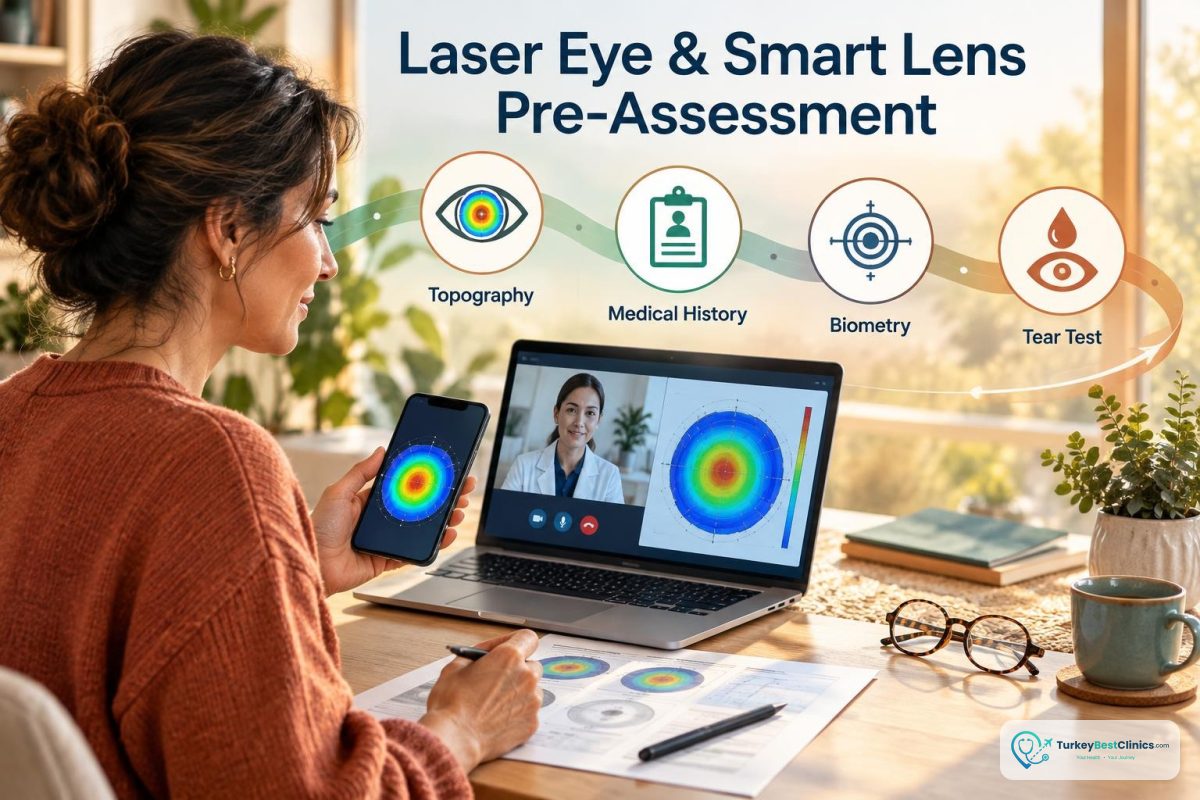
Your Initial Roadmap Before Traveling to Turkey: Corneal Topography
Corneal topography is a specialized measurement that displays the curvature and surface regularity of the cornea on the front of your eye using color-coded maps. When planning laser eye surgery, it provides preliminary information about the cornea’s shape, thickness, and regularity; however, it is not sufficient on its own to determine whether surgery should be performed.
You can begin an initial online assessment by sending the Turkish clinical team your topography report, eyeglass prescription, age, type of contact lenses you use, and current eye complaints. This stage helps identify which tests are missing and whether laser-based or lens-based options require more detailed evaluation.
Key differences between laser- and lens-based options
| Methods Being Compared for You | Most Important Potential Benefit for You | Your Recovery and Hospital Stay |
|---|---|---|
| Corneal reshaping laser surgery | When corneal thickness is adequate and topography is regular, it aims to reduce dependence on glasses or contact lenses | Usually same-day discharge; visual recovery varies according to the procedure and the condition of the ocular surface |
| Smart lens or refractive lens exchange | Evaluates replacing the eye’s natural lens with an artificial lens without applying laser treatment to the corneal tissue | Usually involves a short hospital stay; near-and-distance vision balance and visual adaptation vary from person to person |
These two options are not automatic alternatives to one another. Age, current prescription, corneal thickness, dry eye, lens condition, retinal health, and expectations are assessed together.
Topography, Biometry, and Surgical Safety Standards in Turkey
As part of medical tourism, it is important to check whether the provider you choose holds a Health Tourism Authorization Certificate issued by the Ministry of Health of the Republic of Türkiye. This certificate indicates that health tourism services are provided within the applicable legal framework; nevertheless, you should also review the physician’s area of expertise, the hospital’s operating-room infrastructure, and whether the proposed method is explained specifically for you.
For laser surgery, corneal topography and tomography, pachymetry, tear-film measurements, and refraction values may be assessed together. For smart lens evaluation, optical biometry, intraocular lens power calculation, intraocular pressure measurement, a dilated fundus examination, macular imaging, and, when necessary, assessment of corneal endothelial cells may be considered.
Specific points to review when assessing a physician’s experience
- The physician’s area of expertise in refractive surgery and intraocular lens procedures.
- Which procedures, such as Femto-LASIK, PRK, or SMILE, the physician performs and how their annual case volume for these procedures is documented.
- The information provided and measurement protocol used for multifocal, trifocal, EDOF, or monofocal lens options.
- Whether preoperative biometry results are reviewed by a second ophthalmologist.
- The facility’s procedures for sterilization, equipment maintenance and calibration, and emergency management in the operating rooms.
Online file review does not replace a medical diagnosis. If the topography image quality is poor, measurements taken with different devices are inconsistent, or active infection, significant dryness, or another problem is suspected, the decision may be deferred until a clinical examination is performed.
What Is Included in Your Laser Eye and Smart Lens Package
Depending on the planned service, airport or city VIP transfers, accommodation, interpreter support, and essential guidance during the initial care period may be arranged. Package details should be clarified in writing according to whether surgery will be performed on one or both eyes, the number of follow-up visits, and the length of stay.
It may be possible to plan for your companion to stay with you at the hospital, accommodation close to the healthcare facility, and quiet activities suited to any restrictions on screen use, sunlight exposure, or extensive walking after laser surgery. During smart lens surgery, your companion may assist with transportation and daily needs if you experience temporary blurred vision or light sensitivity during the first few hours.
Steps in the online preliminary assessment
- Preparing your documents: Your corneal topography or tomography, current eyeglass prescription, previous surgical reports, duration of contact lens use, and any available fundus images are shared through a secure channel.
- Reviewing measurement quality: The device used to obtain the image, how recent the measurement is, blinking artifacts, and the readability of the map are checked.
- Reviewing your medical history: Information is collected about dry eye, corneal disease, glaucoma, retinal problems, systemic diseases, previous eye surgeries, and current treatments.
- Initial consultation: The physician explains laser and smart lens options in terms of expected visual quality, night vision, light scatter, and near-vision requirements.
- In-person confirmation in Turkey: Final measurements are repeated, missing tests are completed, and the decision to proceed with surgery is made after the written informed-consent process.
If you wear contact lenses, you may need to stop wearing them for a certain period before topography. Because this period varies depending on whether the lenses are soft, toric, or rigid gas-permeable, you should follow the instructions provided by the optometrist or clinic performing the measurement.
Cost Comparison of Laser Eye and Smart Lens Procedures in Turkey
The figures below are approximate surgical ranges for both eyes and may differ from the fee for an online preliminary assessment. The device, lens model, hospital selected, additional tests, number of follow-up visits, accommodation, and exchange-rate fluctuations may affect the total cost.
| Treatment option | Turkey | United Kingdom | Germany | United States |
|---|---|---|---|---|
| Laser eye surgery | €1,500–€3,500 | £4,000–£7,000 | €3,000–€5,500 | $4,000–$7,000 |
| Smart lens or refractive lens exchange | €3,000–€6,500 | £6,000–£10,000 | €5,000–€9,000 | $7,000–$12,000 |
When requesting a quote, compare in writing not only the total price but also whether both eyes are included, the type of laser or lens used, biometry and retinal tests, postoperative follow-up, the communication protocol if complications occur, and the scope of online follow-up after you return to your country.
Factors That Can Change the Topography Result and Treatment Plan
- Physician expertise and experience: Refractive laser and intraocular lens surgery involve different decision-making processes. The surgeon’s experience with irregular corneas, high myopia, presbyopia, and lens selection may affect the plan.
- Technology and procedure: PRK, Femto-LASIK, or SMILE may be considered for laser treatment, while monofocal, trifocal, EDOF, or toric lenses may be considered for lens procedures. These options are evaluated together with the corneal map, astigmatism, near-vision expectations, and retinal assessment.
- Clinic location: In major centers such as Istanbul, access to advanced imaging and multidisciplinary specialist assessment may be broader. However, transportation, length of stay, and access to follow-up appointments may change the overall cost.
- Recency of measurements: Dry eye, contact lens use, or insufficient blinking during measurement can affect topography results. Therefore, a definitive surgical plan should not be based on an old map.
- Additional eye findings: Suspected keratoconus, thin corneas, high intraocular pressure, risk of retinal tear, early cataract, or macular findings may lead to a change in procedure or postponement of surgery.
Online follow-up after returning to your country
During postoperative follow-up, visual acuity, pain, redness, light sensitivity, and symptoms of dryness may be assessed through online consultations. However, for matters such as intraocular pressure, corneal healing, or the retina, you may need to share reports from in-person examinations performed in your country with the team in Turkey.
Practical Questions to Ask After the Initial Consultation
- If my corneal topography shows irregularities or a thin cornea, which alternatives to laser treatment and which additional tests would be considered?
- When selecting a smart lens, how do trifocal, EDOF, toric, and monofocal options compare in terms of night vision and expectations for reading at near?
- How can I coordinate the preoperative measurements performed in Turkey with follow-up examinations in my country using the same clinical protocol?
The key to making an online preliminary assessment safe is not simply obtaining a quick price; it is ensuring that the quality of the topography, additional tests, surgical choice, and postoperative follow-up plan are documented transparently. The final decision should be made with your informed consent after a complete eye examination and up-to-date measurements have been completed in Turkey.