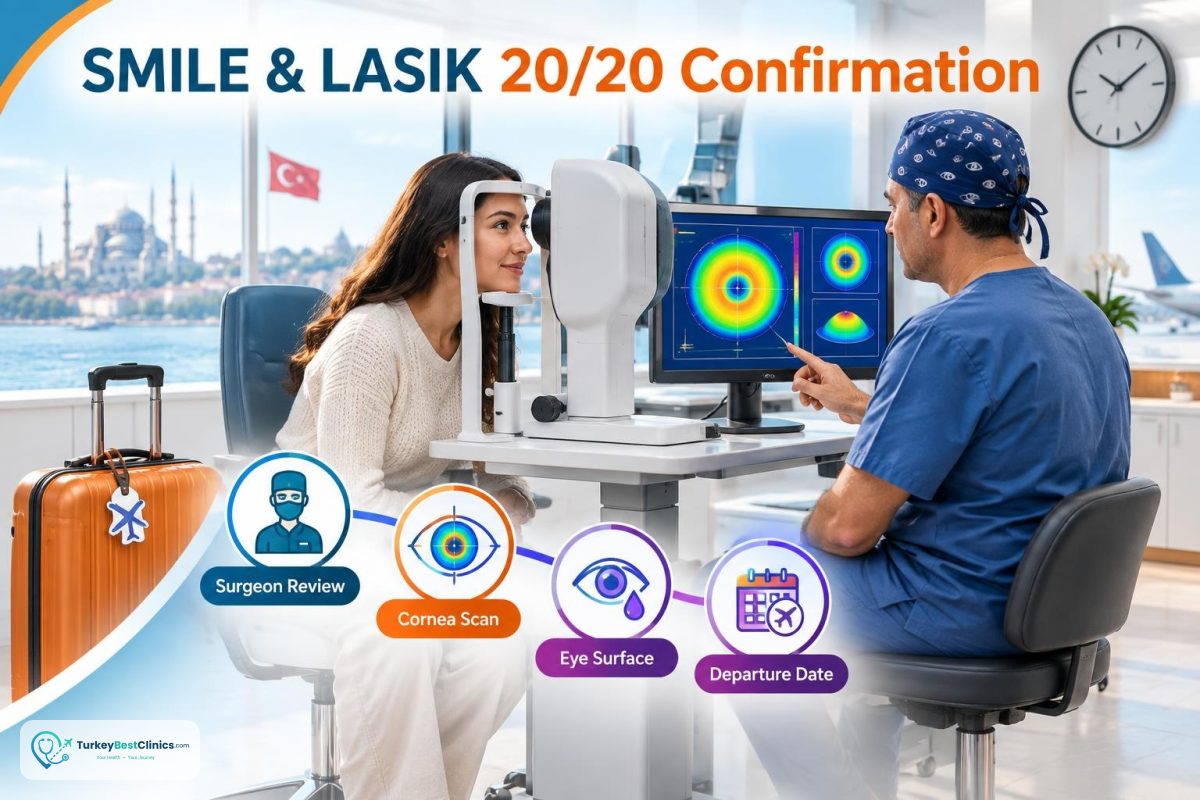
What Glasses-Free Vision Really Means After SMILE and LASIK
After SMILE or LASIK surgery in Turkey, your level of glasses-free vision can be measured with a standard visual acuity test before you leave the country. A 20/20 result on the Snellen chart indicates that you can read the standard line from a specific distance; however, clarity in daily life, contrast sensitivity, and night vision require a broader assessment than this single measurement.
Tearing, light sensitivity, fluctuating clarity, and dryness may occur during the first hours or days after the procedure. Therefore, reaching 20/20 during an examination does not necessarily mean that your final visual result has fully stabilized; your surgeon will interpret the early measurement together with the clinical findings and healing progress.
Practical Differences Between SMILE and LASIK
| Methods Compared | Key Advantage That Makes a Difference | Impact on Recovery Time |
|---|---|---|
| SMILE | A lenticule created within the cornea is removed through a small incision; a large corneal flap is not created. | Functional vision generally improves within a short period, although sharpness and dry-eye symptoms may fluctuate for several weeks depending on the individual. |
| LASIK | A corneal flap is created with a femtosecond laser, and the cornea is reshaped with an excimer laser; vision often recovers quickly. | Early clarity may develop rapidly, but dry eye and nighttime light scatter may require longer follow-up. |
The suitability of either method is not determined by your prescription alone. Corneal thickness, topography or tomography findings, tear film, corneal irregularities, pupil diameter, and existing eye conditions are also assessed.
Corneal Measurements and Safety Standards in Turkey
If you are traveling from abroad, checking whether the clinic operates under a Health Tourism Authorization Certificate issued by the Ministry of Health of the Republic of Türkiye is an important starting point when evaluating the facility’s international application and follow-up procedures. The certificate alone does not guarantee a specific visual result; it helps assess whether the procedure is being performed at an authorized healthcare facility with appropriate expertise and follow-up arrangements.
Turkish ophthalmologists have gained experience in various technical stages of SMILE and LASIK, including femtosecond laser flap creation, excimer laser ablation, topography- or wavefront-guided planning, and lenticule extraction. In addition to the model of the device used by the clinic, its calibration records, the repeatability of preoperative measurements, and the surgeon’s approach to patients with similar corneal characteristics are also important.
Areas Assessed Before Surgery
- Manifest and cycloplegic refraction measurements
- Corneal topography or tomography
- Assessment of corneal thickness by pachymetry
- Tear film, ocular surface, and eyelid margin examination
- Fundus examination, intraocular pressure, and corneal biomechanics assessment
- Whether previous contact lens use may affect the measurements
If you wear contact lenses, you may be asked to stop wearing them for a specific period, depending on the lens type, to ensure reliable measurements. Rather than determining this period yourself, obtain written instructions from the clinic in advance.
SMILE and LASIK Travel Package: From the Procedure to Your Return
The planned package may include VIP airport transfers, hotel accommodation, interpreter support, and initial aftercare instructions; the medication or eye-drop schedule will be explained according to your examination and your surgeon’s recommendations. The length of your stay in Turkey is determined by whether the preoperative examination, procedure, early follow-up, and fitness-to-fly assessment can all take place during the same trip; in many plans, allowing a follow-up window of several days is advisable.
On the day of the procedure and during the following days of mild recovery, your companion may plan a quiet indoor museum visit, a short Bosphorus cruise, or a controlled gastronomic experience in Istanbul; in Antalya, resting near the hotel and taking short car-based trips may be preferable, while in Izmir, short city-center activities away from the wind may be considered. Follow your surgeon’s restrictions regarding dust, intense sunlight, seawater, swimming pools, smoky environments, and long outdoor walks; avoid activities that could cause you to rub your eyes or expose them to water.
Vision Checks Before Leaving the Country
During an early follow-up appointment, visual acuity, the ocular surface, the condition of the corneal epithelium, intraocular pressure, and healing at the treatment area may be examined. If considered necessary, distance vision may be retested under different lighting conditions, and the combined visual performance of both eyes may be assessed.
Even if a 20/20 measurement is obtained, your flight date will not be determined by this result alone. If you have redness, significant pain, increasing light sensitivity, sudden vision loss, or marked blurring in one eye, your travel plans should be postponed and you should contact the treating team without delay.
SMILE and LASIK Cost Comparison in Turkey
The approximate total cost of laser eye surgery in Turkey varies according to the procedure type, whether both eyes are planned together, and the scope of the preoperative assessment and follow-up. The figures below are approximate ranges provided solely for international market comparison; a final quotation is prepared after examination and treatment planning.
| Country | Approximate SMILE or LASIK Cost | Currency |
|---|---|---|
| Turkey | €1,500–€3,500 | Euro |
| United Kingdom | £2,000–£4,500 | GBP |
| Germany | €2,500–€5,000 | Euro |
| United States | $4,000–$7,000 | USD |
When comparing quotations, do not look only at the starting price. Confirm in writing whether the examination, device use, postoperative check-ups, unexpected early assessments, interpretation services, and communication support after leaving the country are included in the package.
Factors That Can Change the Visual Outcome and Overall Duration
- The surgeon’s expertise and experience: The surgeon’s experience with SMILE, femtosecond LASIK, and excimer laser procedures may affect planning, particularly in cases involving high myopia, astigmatism, thin corneas, or irregular topography.
- Technology and method used: Lenticule extraction with SMILE, femtosecond laser flap creation, wavefront- or topography-guided excimer laser planning, and the corneal analysis systems used may change the cost and scope of the process.
- Clinic location: In health tourism centers such as Istanbul, Antalya, and Izmir, facility expenses, surgical infrastructure, hotel partnerships, and international coordination services may vary.
- Corneal and ocular surface findings: Dryness, blepharitis, irregular astigmatism, or borderline corneal thickness may require additional assessment or ocular surface preparation before the procedure date.
- Follow-up plan: Repeating preoperative measurements, the number of early follow-up visits, and the remote communication protocol after leaving the country may affect the length of the trip and the overall scope of services.
These factors do not mean that a 20/20 result can be guaranteed. Suitability is determined after jointly evaluating measurement safety and a realistic visual goal; in some cases, safe and stable vision may take priority over the goal of being glasses-free.
Next Steps to Know Before Leaving the Country
- If I achieve 20/20, can I return to my country? Even if the vision test is positive, your surgeon must complete an examination of the cornea and ocular surface. The decision regarding air travel is based on the procedure type, symptoms, aftercare plan, and examination findings together.
- Why can clarity fluctuate after SMILE or LASIK? Tear film irregularity, corneal healing, light sensitivity, and temporary dryness may change sharpness during the early period. Do not miss the scheduled follow-up appointments so that this progress can be monitored.
- What records should I obtain if follow-up is needed abroad? Request the surgical report, preoperative and postoperative prescriptions, corneal topography or tomography, the laser method used, follow-up results, and written aftercare instructions.
Before scheduling your appointments, provide the clinic with your current prescription, contact lens history, previous eye procedures, and any known ocular surface symptoms. This allows the preoperative assessment, surgery date, and pre-departure check in Turkey to be planned more realistically.