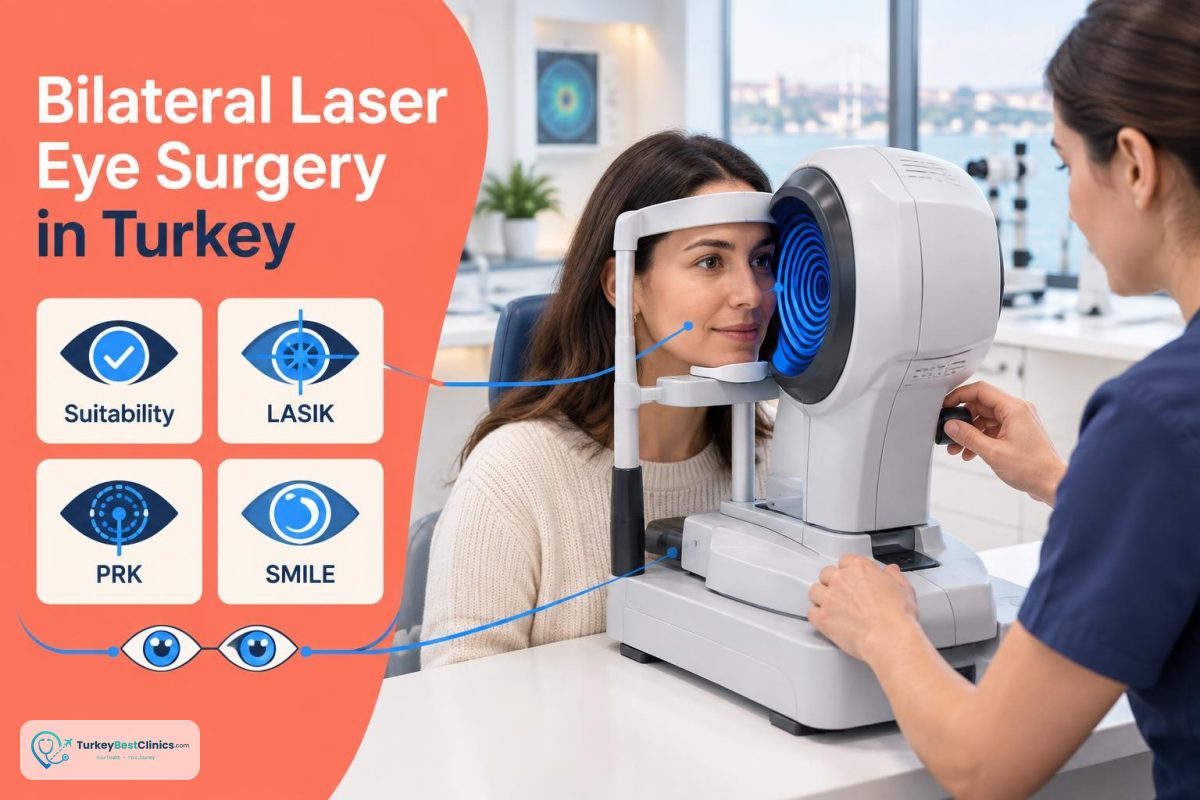
What does laser treatment on both eyes during the same session mean?
As part of laser eye surgery in Turkey, treating both eyes on the same day, usually during the same session, is an option that is commonly considered. This can allow the transition away from glasses or contact lenses to progress under a single treatment plan, while daily life, social activities, and travel arrangements can be resumed sooner.
However, same-session treatment is not automatically suitable for everyone. Corneal thickness and shape, the degree of myopia or hyperopia, astigmatism, tear-film quality, retinal findings, and overall eye health are assessed through detailed measurements. The final decision is made by an ophthalmologist after an examination and corneal mapping.
Key differences between LASIK, PRK, and SMILE
- LASIK: A thin flap is created in the cornea, which is then reshaped with a laser. Visual recovery is generally quick, but the corneal structure and the presence of dry eye require detailed assessment.
- PRK: The procedure is performed on the corneal surface without creating a flap. Stinging, light sensitivity, and slower visual recovery may occur during the first few days; it may be considered as an alternative in cases such as thin corneas.
- SMILE: This technique involves removing a lenticule through a small corneal incision. It may be considered for suitable ranges of myopia and astigmatism, with suitability depending on corneal measurements.
None of these methods should be selected based solely on price or a short travel schedule. The aim is to identify the technique that supports visual satisfaction and everyday comfort while maintaining long-term safety.
Safety and authorization framework for corneal laser surgery in Turkey
When traveling to Turkey from abroad, an important first step is checking whether the clinic holds a Health Tourism Authorization Certificate issued by the Ministry of Health of the Republic of Türkiye. This certificate indicates that the relevant administrative and operational requirements for providing international healthcare services have been met; it does not, by itself, guarantee a specific outcome or complication-free recovery.
The clinic should also clearly disclose the center where the surgery will be performed, the diagnostic equipment used, and the follow-up plan. Corneal topography or tomography, pachymetry, refraction testing, tear-film assessment, and slit-lamp examination form the basis of laser planning. Turkish ophthalmologists have gained clinical experience with corneal reshaping techniques such as LASIK, PRK, and SMILE across different prescription ranges and corneal profiles; during your consultation, it is more meaningful to ask which techniques and case characteristics the doctor works with most frequently.
Safety assessment should also cover sterilization procedures, regular equipment maintenance and calibration records, an emergency communication channel after surgery, and the approach to remote follow-up after you return home. An active eye infection, uncontrolled dry eye, certain corneal irregularities, or a mismatch between expectations and measurements may lead to postponement of the procedure or a recommendation for a different approach.
What may be included in a package for laser surgery on both eyes?
A health tourism package may include VIP transfers between the airport, clinic, and hotel, accommodation, interpreter support when needed, and the arrangement of basic products required during the initial care period. Package contents vary from one center to another, so the surgery, tests, follow-up examinations, additional procedures, and cancellation terms should be confirmed in writing.
The length of stay in Turkey for laser eye surgery may vary depending on the selected technique. The preliminary assessment and measurements are usually performed on the first day; if eligibility is confirmed, the procedure may be scheduled for the same day or the following day. An early check-up is generally performed soon after LASIK or SMILE, whereas surface healing may take longer after PRK, so the return date should be determined according to the doctor’s examination findings.
You may need to stop wearing contact lenses for a period before the procedure; the required interval varies according to the lens type and corneal measurements. Specific instructions regarding flying, screen use, makeup, water exposure, sun exposure, and driving should be incorporated into your travel plans.
In Istanbul, suitable options for an accompanying person may include visits to indoor, quiet museums, a short Bosphorus tour, or dining experiences that allow you to rest at the hotel. After the procedure, it is more appropriate to avoid extensive walking and windy environments. In Antalya and Izmir, short activities in shaded areas close to the clinic should be preferred; swimming pools, the sea, sand, dust, and intense sun exposure should be postponed until permitted by the recovery instructions.
Key points when comparing LASIK with PRK and SMILE
- LASIK: Its main distinguishing advantage is that, with a suitable corneal structure, functional vision generally recovers quickly. Because a flap is created, contact sports and the risk of impact to the eye area require additional consideration.
- PRK: Its main distinguishing advantage is that no corneal flap is created. Since surface healing takes longer, comfort during the first few days and travel plans need to be arranged more carefully.
- SMILE: Its main distinguishing advantage is that it is performed through a small incision and may offer a different profile regarding corneal nerves and tear comfort in some suitable candidates. The speed of visual recovery varies according to individual measurements.
Cost overview: Turkey, the United Kingdom, Germany, and the United States
In Turkey, the approximate total cost of laser eye surgery for both eyes may generally range from €1,500 to €3,500, depending on the technique, center, and services included in the package. The figures below are approximate international comparison ranges; examinations, additional tests, accommodation, transportation, and revision terms may not always be included in the price.
- Turkey: Approximately €1,500–€3,500; both eyes, the initial assessment, and certain follow-up examinations may be included in the package.
- United Kingdom: Approximately £2,500–£5,000; costs vary according to the center, technique, and surgeon’s experience.
- Germany: Approximately €2,000–€4,500; preliminary examination, surgery, and follow-up fees may be listed as separate items.
- United States: Approximately $4,000–$7,000; although the price is generally quoted for both eyes, you should ask separately about additional measurements and the scope of follow-up care.
Instead of comparing prices alone, consider the total travel cost, number of postoperative check-ups, communication in the event of complications, coordination after returning home, and the technology used. Do not make a decision without obtaining written details of which services are excluded from an unusually low quote.
Factors that affect the price and process of laser surgery on both eyes
- Surgeon’s expertise and experience: The scope of the surgeon’s work in corneal and refractive surgery may influence planning, particularly in cases of high myopia, astigmatism, a tendency toward dry eye, or borderline corneal measurements. Ask separately about the techniques used by the surgeon, annual procedure volume, and follow-up approach.
- Technology and technique: The use of a femtosecond laser to create the LASIK flap, the excimer laser platform, personalized planning using corneal topography or tomography, and the selection of SMILE or PRK may affect the price. Clarify whether techniques such as wavefront-guided or topography-guided planning are genuinely included in the recommendation.
- Clinic location: In health tourism centers such as Istanbul, Antalya, and Izmir, rent, operating-room infrastructure, interpreter services, and transfer services may affect costs. The center’s location also determines travel time to the clinic for early follow-up and accommodation arrangements for an accompanying person.
Steps to take before making a decision
At the initial stage, provide the clinic with your current prescription, contact lens history, previous eye procedures, products you use regularly, and any known dry-eye symptoms. Then request written information about which tests will be performed, whether both eyes will be treated during the same session, and the payment policy if you are found unsuitable.
Three specific questions to answer during your assessment
- Based on my corneal topography and pachymetry, which of LASIK, PRK, or SMILE is supported for both eyes? This helps ensure that the choice is based not only on the prescription but also on corneal safety and visual expectations.
- If both eyes are treated during the same session, when will the first check-up take place, and how many days will I be advised to stay in Turkey if PRK is selected? This allows your flight date, accompanying-person arrangements, and return-to-work schedule to be planned realistically.
- If I develop dry eye, an unexpected change in vision, or require additional assessment after surgery, how will follow-up be managed in Turkey and after I return home? Emergency communication, coordination with a local ophthalmologist, and any potential additional fees should be clarified in advance.
Correcting both eyes with laser during the same session may be a practical option for everyday comfort when appropriate measurements and realistic expectations are present. However, the safest plan is to determine the technique and travel date based not only on price or promises of rapid recovery, but on a personal eye examination and a detailed follow-up plan.