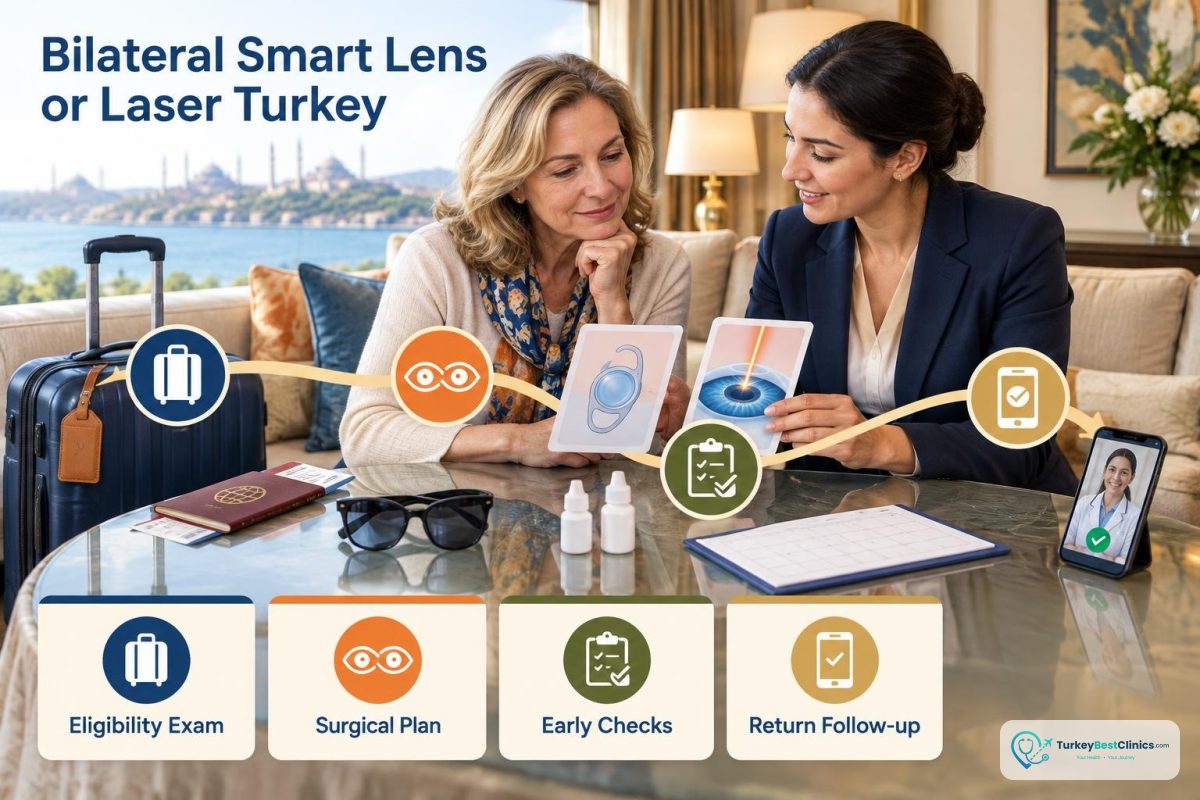
How Is Vision Correction for Both Eyes Planned?
Bilateral smart lens or laser surgery aims to address refractive errors in both eyes during a single trip to Turkey. However, treating both eyes on the same day, in the same session, or at short intervals is not an automatic standard; corneal structure, ocular surface health, lens status, age, prescription stability, and overall health are assessed together.
Laser surgery generally involves reshaping the cornea. In smart lens surgery, the eye’s natural lens is replaced with an artificial intraocular lens featuring multifocal, trifocal, or EDOF characteristics. The appropriate approach is not determined solely by your prescription; detailed biometry and an intraocular examination are required.
Key conditions for bilateral treatment in a single session
- There must be no active infection, significant inflammation, or uncontrolled ocular surface disease in either eye.
- For laser surgery, corneal thickness, topography, and biomechanical risk indicators must fall within safe surgical limits.
- For smart lens surgery, intraocular pressure, retina, macula, optic nerve, and lens measurements must be considered suitable.
- The refractive error must have remained stable for a certain period, and measurements taken on different days must produce consistent results.
- Postoperative check-ups must be able to continue in Turkey and through online follow-up after returning home.
- Potential complications, effects on night vision, dry eye, the possible need for additional glasses, and the possibility of revision surgery must be understood during the informed-consent process.
Safety Standards in Turkey for Bilateral Laser and Smart Lens Surgery
It is important that the procedure be planned at a facility holding a Health Tourism Authorization Certificate issued by the Ministry of Health of the Republic of Türkiye and operating within a fully equipped hospital infrastructure. You should ask about operating-room sterilization protocols, single-use surgical supplies, emergency equipment, and up-to-date records for biometry and corneal imaging systems.
For laser surgery, femtosecond laser, excimer laser, corneal topography or tomography, and pachymetry results are evaluated together. In smart lens surgery, optical biometry, intraocular lens power calculation, biomicroscopic examination, fundus assessment, and, when necessary, macular OCT form the basis of the surgical plan.
When assessing the experience of Turkish ophthalmologists, do not rely solely on a general statement of specialization. Obtain written information about the surgeon’s regular procedure volume in femto-LASIK, PRK, refractive lens exchange, or phacoemulsification, the measurement protocols used, the complication-management plan, and the approach to postoperative follow-up. Particularly when both eyes are planned for treatment in the same session, there should be an alternative protocol for unexpected differences in measurements or a change in the surgical decision during the procedure.
Your preoperative safety file
- Your current glasses and contact lens prescription, together with records of any previous eye surgery.
- The contact lens discontinuation period specified by your doctor to reduce measurement changes related to contact lens use.
- Manifest and cycloplegic refraction, corneal topography or tomography, pachymetry, and tear-film assessment.
- If smart lens surgery is planned, optical biometry, intraocular pressure, and retinal and macular examinations.
- Any blood tests and anesthesia assessment required based on your general health.
The Process in Turkey for a Smart Lens or Laser Surgery Package
The planned package may include VIP airport-hotel-hospital transfers, accommodation, interpreter support, and arrangements for initial care or prescriptions. Accommodation should be selected to provide easy access to eye examinations; you should also plan not to drive after the procedure and to avoid environments that may irritate your eyes.
It is important that your companion be permitted to stay with you at the hospital within the applicable rules, that the hotel be close to the hospital, and that your companion be able to reach you easily during clinical check-ups. While you rest, your companion may reduce the stress of waiting by taking short walks in parks that do not strain the eyes, spending quiet time in the hotel wellness area, or engaging in safe social activities near the hospital; however, restrictions on pools, saunas, intense sunlight, and dusty environments must be followed.
Process protocol and estimated length of stay
- Remote pre-assessment: Your prescription, previous reports, age, contact lens use, and expectations are reviewed. This stage is not a final eligibility decision.
- Detailed examination in Turkey: The ocular surface, cornea, retina, intraocular pressure, and repeated measurements are assessed. If there is a discrepancy between the initial online assessment and the clinical measurements, surgery may be postponed.
- Information and consent: The options of treating both eyes on the same day, performing the procedures on separate days, or cancelling the procedure are discussed in terms of the balance between risks and benefits.
- Surgery and early check-up: After laser treatment, a short observation period may generally be sufficient. For smart lens surgery, overnight or short-term clinical observation may be planned depending on the anesthesia used and the surgeon’s protocol.
- Follow-up period in Turkey: The first check-up is usually performed the following day; additional checks are scheduled according to the procedure and signs of healing in the eye. A stay of several days may be sufficient for laser surgery, while smart lens surgery may require a follow-up window of approximately one week or longer in many plans.
- Online follow-up: After you return to your country, photographs, measurements, and reports from a local ophthalmologist may be reviewed through a secure communication channel. Online follow-up does not eliminate the need for local medical assessment in an emergency.
Cost Comparison of Bilateral Laser and Smart Lens Surgery in Turkey
The figures below are approximate, indicative ranges for both eyes and are provided to reflect the variable packages available in the international health tourism market in 2026. The final cost depends not only on the surgical method but also on the scope of measurements, lens model, hospital stay, medications, and follow-up care.
| Procedure | Turkey | United Kingdom | Germany | USA |
|---|---|---|---|---|
| Laser surgery for both eyes | €1,500–€3,500 | £3,500–£7,000 | €3,000–€6,000 | $4,000–$8,000 |
| Smart lens surgery for both eyes | €3,500–€7,000 | £6,000–£12,000 | €5,000–€10,000 | $6,000–$14,000 |
In Turkey, the average budget for bilateral surgery may be estimated at approximately €2,000–€3,000 for laser treatment and €4,500–€6,000 for smart lens surgery, depending on the method. These figures are for market comparison rather than a quotation; in the written price document, check separately which eye examinations, lens, operating-room use, medications, transfers, and early check-ups are included.
Criteria That May Change the Surgical Decision for Both Eyes
- Surgeon’s expertise and experience: For laser surgery, review the surgeon’s experience with femto-LASIK, PRK, or other corneal procedures when indicated. For smart lens surgery, assess experience with phacoemulsification, refractive lens exchange, toric lens planning, and complication management.
- Technology, method, and materials: For a laser decision, corneal topography, tomography, pachymetry, and the femtosecond or excimer platform used are important. For a smart lens decision, optical biometry, the lens power calculation method, and the compatibility of trifocal, EDOF, or toric lens designs with your visual expectations should be evaluated.
- Clinic location: Access to the airport and a fully equipped hospital, the time required for next-day check-ups, access to additional examinations if needed, and sufficient observation time before a long flight all affect planning. Accommodation far from the medical center may increase the transportation burden during the early period.
Comparing laser and refractive lens approaches
| Methods Compared for You | Most Important Potential Advantage for You | Your Recovery and Hospital Stay |
|---|---|---|
| Cornea-based laser surgery: femto-LASIK or appropriately selected surface laser treatment | Changing the curvature of the cornea without entering the internal structures of the eye; the possibility of rapid visual recovery in suitable cases with adequate corneal thickness and a low risk of ectasia | Discharge on the same day or a short observation period in many plans; follow-up within several days and return-home planning depend on the method |
| Refractive lens exchange: trifocal, EDOF, or toric smart lens | The opportunity to address near-vision expectations in later life and significant lens-related refractive error within the same surgical plan | Usually a short observation period; initial check-ups are performed in Turkey, and visual stabilization may take longer than with laser surgery |
This table does not determine individual suitability. Bilateral treatment may be postponed or another option may be preferred for people with thin or irregular corneas, significant dry eye, retinal risk, uncontrolled intraocular pressure, or unrealistic expectations.
Answers to Three Critical Questions After Your Trip to Turkey
- Is having both eyes operated on the same day really suitable for me? A definitive decision should not be made without jointly assessing corneal thickness and topography, the tear film, retinal examination, biometry results, and the surgeon’s bilateral surgery protocol.
- What are the differences between smart lenses and femto-LASIK in terms of night vision and near vision? With trifocal or EDOF lenses, the possibility of light scatter and halos should be discussed. With laser surgery, your existing near-vision capacity and corneal healing should also be considered.
- After returning to my country, for which symptoms should I consult a local ophthalmologist? Increasing pain, marked redness, sudden reduction in vision, severe light sensitivity, discharge, or the new onset of a curtain-like shadow or flashes of light may require urgent local assessment; online follow-up should not delay this evaluation.
Safely completing bilateral laser or smart lens surgery during a single trip to Turkey depends on jointly establishing appropriate patient selection, a fully equipped hospital setting, confirmation of measurements, a sufficient stay in Turkey, and a regular follow-up plan after returning home. Planning the surgery date only after these medical and logistical conditions have been clarified, rather than scheduling it around your flight itinerary first, is the safer approach.