Factors Determining How Long You Should Stay in Turkey for Laser Eye Surgery
Laser eye surgery is a cornea-based vision correction procedure intended to reduce dependence on glasses or contact lenses. Key motivations may include greater comfort in daily life, improved satisfaction with your appearance, and less reliance on glasses during sports or social activities.
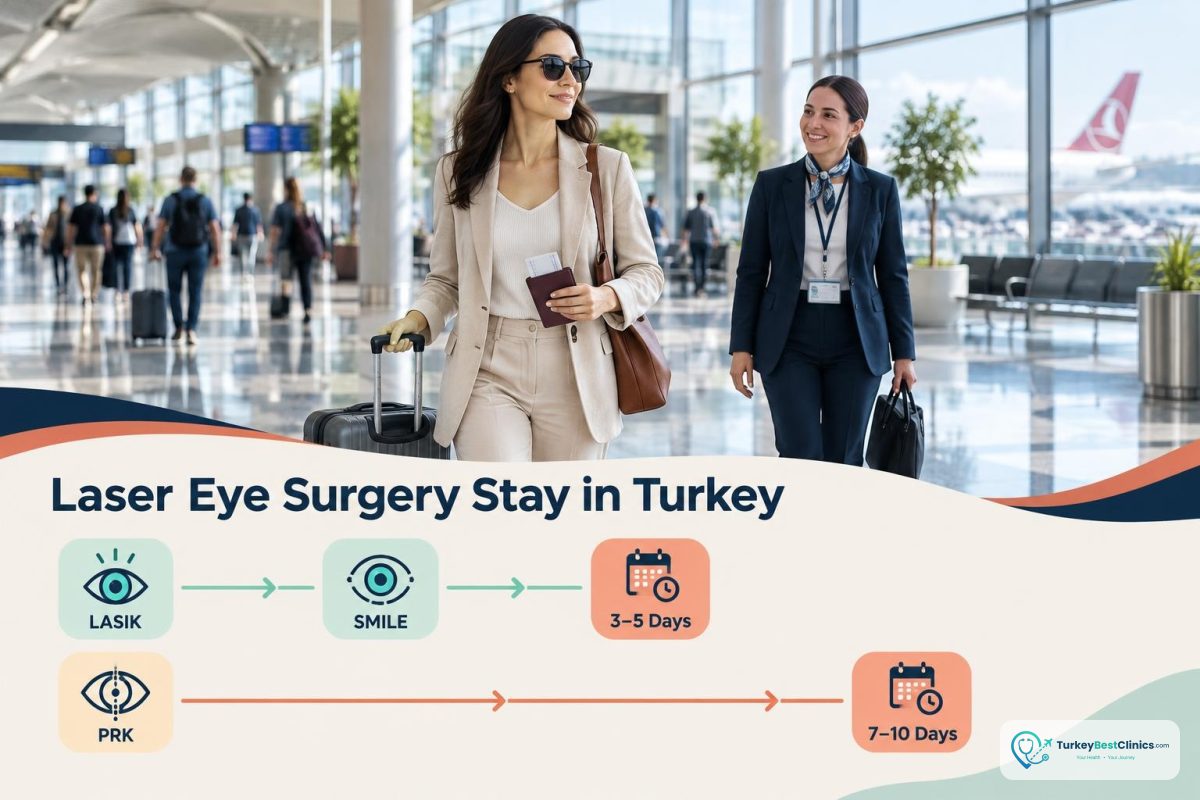
The time you need to spend in Turkey depends not only on the procedure itself, but also on the preoperative examination, corneal measurements, the first postoperative check-up, and the recovery pace associated with the chosen technique. Planning for 3–5 days is generally appropriate for LASIK or SMILE, while approximately 7–10 days is a more cautious timeframe for PRK because the epithelium needs time to heal.
Your flight date should not be determined solely by how clear your vision feels. The final check-up must be completed, the ocular surface must be evaluated, and your ophthalmologist must confirm that you are fit to fly.
Safe Travel Planning for LASIK, SMILE, and PRK
Ministry of Health authorization and clinical oversight
When receiving healthcare services as part of medical tourism in Turkey, choosing a clinic or healthcare institution with a Ministry of Health–approved International Health Tourism Authorization Certificate is an important part of the international treatment process. This certificate provides an official framework for medical tourism organization, information, and service coordination, but it does not by itself guarantee a specific visual outcome.
It is important for the eye clinic to routinely use measurements such as corneal topography, corneal tomography, pachymetry, and tear-film evaluation. When assessing Turkish ophthalmologists’ experience in laser refractive surgery, do not focus solely on a general statement such as “experienced team.” Consider their current case experience with procedures including LASIK, surface ablation, and small-incision lenticule extraction, as well as their complication-management protocol and postoperative follow-up plan.
Corneal measurements assessed during the evaluation
- Pachymetry and corneal topography or tomography to assess corneal thickness and shape.
- Confirmation of the degree of myopia, hyperopia, and astigmatism through repeated refraction measurements.
- Evaluation of the tear film, dry-eye symptoms, eyelids, and corneal surface.
- A basic examination of the retina, intraocular pressure, and overall eye health.
- Joint consideration of age, prescription stability, previous eye surgeries, and expectations.
These assessments help determine which method is appropriate and how long it may be safer for you to stay in Turkey. The final decision should be based on an in-person examination and measurements, not solely on an online consultation.
Laser Eye Surgery Packages and Your Stay in Turkey
Medical tourism packages typically include airport-to-clinic VIP transfers, accommodation at a partner hotel, interpreter support when needed, and initial care instructions. The exact scope should be confirmed in writing based on the clinic and accommodation selected. On the first day, detailed eye measurements are performed, the appropriate technique is determined, and a date is scheduled for the first postoperative check-up.
If LASIK or SMILE is planned, staying in Turkey for 3–5 days is a practical framework for most travel itineraries. After PRK, the epithelial layer on the surface heals more slowly, so 7–10 days or a longer period determined by your doctor may be necessary. Removal of the bandage contact lens and the first healing check directly affect your travel date.
On the day of the procedure and during the following days of mild recovery, your companion may plan a quiet coffee break indoors or a short museum visit in Istanbul, a sea-view program suitable for resting at the hotel in Antalya, or a brief culinary outing away from wind and dust in Izmir. Activities that may strain the eyes—including intense sunlight, seawater, swimming pools, smoky environments, and prolonged outdoor walks—should be limited, particularly during the first few days.
How two common methods affect the length of stay
| Methods Compared | Main distinguishing advantage | Impact on recovery time |
|---|---|---|
| LASIK | The cornea is reshaped with a laser after creating a flap on its surface; visual clarity often recovers quickly. | The first check-up is usually scheduled for the following day. If the measurements are suitable and recovery is uncomplicated, a 3–5-day stay may be sufficient. |
| PRK | The laser is applied after removing the epithelium from the corneal surface, so no flap is required; it may be an alternative when the corneal structure is suitable. | Surface healing is slower. A stay of 7–10 days is generally planned because of the bandage lens and initial follow-up appointments. |
SMILE may also be considered for some cases of myopia and astigmatism. Because a lenticule is removed through a small incision, a travel schedule similar to LASIK may be possible in terms of surface healing. However, suitability is determined by corneal measurements and prescription characteristics.
Laser Eye Surgery Costs in Turkey, the UK, Germany, and the USA
The figures below show approximate private healthcare price ranges for both eyes. Check in writing whether examinations, tests, follow-up appointments, transportation, and accommodation are included in the package. Prices may vary due to exchange-rate changes and the technique used.
| Country | Approximate cost | Notes |
|---|---|---|
| Turkey | €1,200–€2,500 | Varies according to the technique, surgeon, clinic, and services included in the package. |
| United Kingdom | £2,000–£4,500 | Approximate range for both eyes at private clinics. |
| Germany | €2,000–€4,000 | May vary depending on the technique and city. |
| United States | $3,000–$6,000 | Preoperative examinations and follow-up fees may be charged separately. |
Factors That Affect the Price and Length of Stay for Laser Eye Surgery
- The surgeon’s expertise and experience: Training in corneal and refractive surgery, case experience with the selected technique, the scope of the preoperative assessment, and the approach to follow-up in unexpected situations may affect the total cost.
- Technology and technique: The choice of LASIK, PRK, or SMILE, along with the use of a femtosecond laser, excimer laser platform, wavefront- or topography-guided ablation, and intraoperative eye-tracking systems, can change the cost.
- Clinic location: In medical tourism hubs such as Istanbul, Antalya, and Izmir, clinic operating costs, hotel standards, transfer distances, and international coordination services may differ.
- Prescription and corneal characteristics: High myopia, significant astigmatism, an irregular corneal surface, or signs of dry eye may require additional assessment, a different technique, or a longer follow-up period.
- Follow-up and travel arrangements: Assessments that cannot be completed in a single visit, bandage-lens monitoring, additional tear-film measurements, or postponement of the flight date may affect the total travel budget.
Rather than using the lowest price as your only decision criterion, compare which examinations and follow-up appointments are included in the total package. In particular, ask in advance how remote communication and coordination with your eye doctor in your home country would be managed if you experienced a postoperative problem and needed to avoid returning to Turkey.
Three Specific Questions to Ask Before Coming to Turkey
- Based on my corneal measurements, which of the LASIK, PRK, or SMILE techniques is being considered, and how many days am I advised to stay in Turkey for this method?
- Are the pachymetry, corneal topography, tear-film, and retinal checks scheduled for the first day included in the package, and on which day will the postoperative check-up take place?
- Who will perform the vision and corneal-surface check before my flight, and will an additional visit be required to remove the bandage lens after PRK?
The answers to these questions will indicate not only the price, but also whether your travel schedule is realistic. If you experience unexpected symptoms such as eye pain, marked redness, sudden changes in vision, or flashes of light, seek urgent medical evaluation rather than continuing with your travel plans.