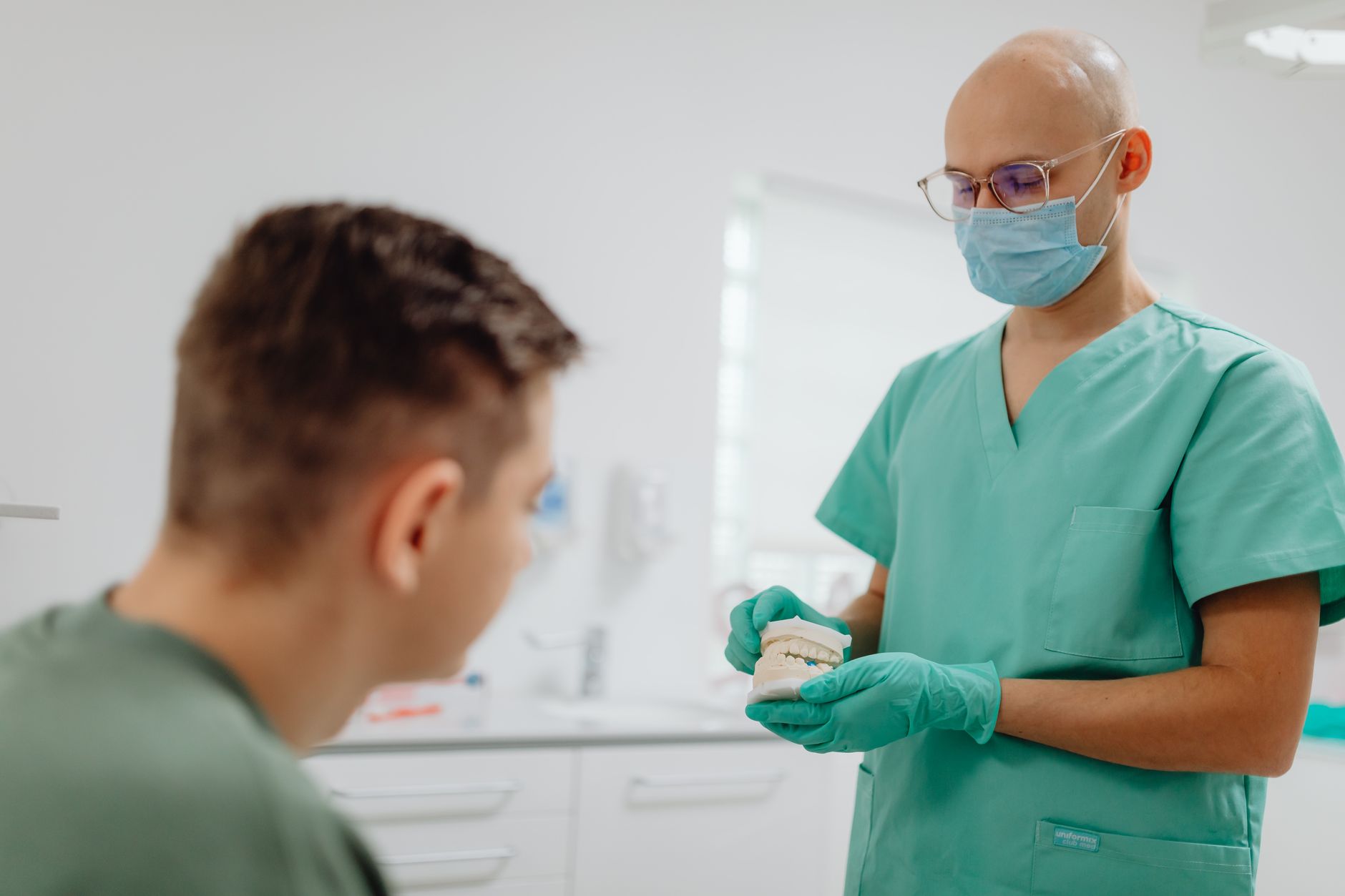
Why Is Choosing the Right Specialist Important in Dental Implants?
A dental implant is a restorative treatment planned on a titanium support placed into the jawbone to replace a missing tooth. The success of the procedure is closely linked to bone volume, gum health, bite relationship, and the accuracy of surgical planning.
For this reason, the question of “who performs it?” should be evaluated not only by title, but also by training in the relevant field and experience in implant surgery. Choosing the right specialist affects both surgical safety and long-term functional outcomes.
Who Places Implants in Turkey: Dentist, Jaw Surgeon, or General Surgeon?
In Turkey, dental implant procedures are most commonly performed by dentists and especially by oral and maxillofacial surgeons. In simpler cases, implant planning and placement may also be carried out by general dentists who have received training in this field.
A general surgeon, however, is not the specialty that routinely performs dental implants. The main focus of general surgery is intra-abdominal organs, hernias, gallbladder, breast, and similar surgical conditions; implant treatment, on the other hand, focuses on oral anatomy and the jawbone.
Which Specialty Stands Out in Which Case?
- General dentist: May be involved in simpler cases with sufficient bone volume and a plan for a single tooth or a limited number of implants.
- Oral and maxillofacial surgeon: Stands out in cases requiring sinus lifting, bone grafting, proximity to embedded anatomical structures, or advanced surgery.
- Prosthodontist: Plays a critical role in the design of the implant-supported prosthesis, bite relationship, and aesthetic planning.
This distinction is important because placing the implant in the bone and designing the restoration are not the same specialty area. Treatment often proceeds as a team effort.
What Standards Are Considered for Safe Implant Treatment in Turkey?
When treatment is planned in Turkey as part of health tourism, clinics with a Ministry of Health-approved Health Tourism Authorization Certificate are preferred. This certificate shows that foreign patient acceptance, communication, and organization are carried out within a defined framework.
The case experience of doctors working in implantology is also important; especially in cases involving insufficient bone, advanced age, smoking, a history of gum disease, or the need for multiple implants, experience can make a difference. Many centers in Turkey work with digital panoramic imaging, cone beam computed tomography (CBCT), and surgical guide planning.
Key Points Considered in Evaluation
- Bone measurement with CBCT: The implant diameter and length are determined accordingly.
- Soft tissue condition: Gum thickness and hygiene level affect the surgical plan.
- Adjacent anatomical structures: The sinus cavity, nerve canal, and neighboring teeth are evaluated.
- Prosthetic goal: It is clarified from the start whether the plan is for a single crown, bridge, or full arch.
What Is Included in an Implant Package?
In health tourism packages, VIP transfer, hotel accommodation, interpreter support, and initial care products are often organized together. This logistical structure makes the process more predictable, especially for short-term travelers.
In implant treatment, the stay in Turkey in many cases may be limited to a few days for the initial surgery; however, the period may be longer if bone grafting, sinus lifting, or multiple implants are planned. Before the procedure, a panoramic X-ray and often a CBCT scan are taken, and then a surgical plan is created according to bone thickness.
What Is Planned During Preparation?
- Imaging: Panoramic X-ray and, if needed, CBCT.
- Examination: Evaluation of the gums, bite, and neighboring teeth.
- Planning: Number of implants, diameter, length, and placement angle.
- Timing: Decision on whether it will be a single-stage procedure or delayed loading.
Implant Costs in Turkey, the UK, Germany, and the USA
In Turkey, the average cost of a single dental implant may range from approximately €500–€1,200 in many clinic segments. The final price varies depending on the implant brand, the need for bone support, and the design of the restoration.
| Country | Average Price | Currency |
|---|---|---|
| Turkey | €500–€1,200 | EUR |
| United Kingdom | £1,800–£3,000 | GBP |
| Germany | €1,500–€2,800 | EUR |
| USA | $3,000–$6,000 | USD |
This difference is due not only to the procedure fee, but also to the clinic infrastructure, the systems used, and the scope of the treatment plan. Total costs increase especially in cases requiring multiple implants or advanced surgery.
What Changes the Implant Price and Process?
The Doctor’s Specialty and Case Experience
In cases managed by an oral and maxillofacial surgeon, planning may be more detailed, especially in anatomically challenging areas. A simple single implant and a case requiring sinus lifting are not evaluated in the same price range.
The Implant System Used and the Surgical Method
One of the most concrete technical factors affecting the price is the implant system itself; for example, a one-piece implant, two-piece implant, immediate loading protocol, or the need for bone grafting changes the cost. In addition, some cases require a digital surgical guide, which calls for different planning than open surgery.
Clinic Location
In major cities such as Istanbul, Ankara, and Izmir, rent, equipment, and operational volume may be reflected in prices. Costs may be lower in smaller cities; however, doctor experience and the systems used should also be evaluated separately.
What Questions Should Be Asked When Making the Final Decision?
- What specialty was the person placing the implant trained in? The difference between simple and advanced surgical cases should be clarified.
- Is the bone sufficient according to the CBCT result? It should be understood in advance whether grafting or sinus lifting is needed.
- Is the plan for a single tooth or multiple implants? Treatment time, cost, and restoration choice change accordingly.
These three questions are the most practical starting point when choosing the right clinic and the right specialist. If you wish, the next step can be to move on to subtopics such as types of implants, sinus lifting, or all-on-4.