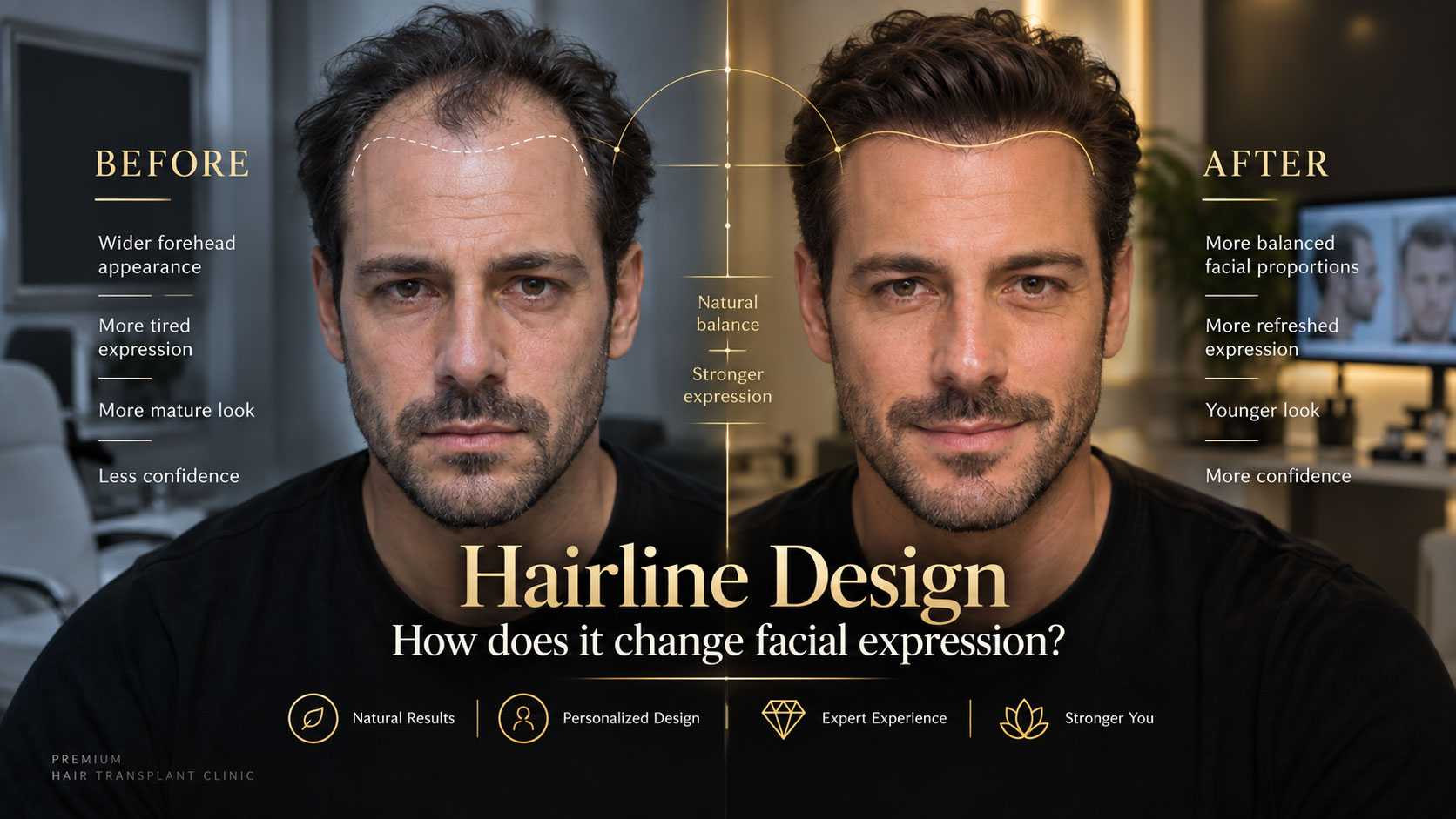
How Does Frontal Hairline Design Change Facial Appearance?
The frontal hairline is the area where the forehead meets the scalp and directly affects the overall proportions of the face. As hair loss causes the hairline to recede, the forehead may appear wider; careful planning creates a balanced frame that complements the facial features.
In Turkey, frontal hairline design should ideally be planned by a dermatologist or a plastic, reconstructive and aesthetic surgeon who specializes in hair transplantation. The physician evaluates the type of hair loss, graft capacity in the donor area, hair shaft thickness, facial length, and the likelihood of future hair loss together. The hairline should not be drawn solely according to a predetermined template.
Key elements of a natural appearance
- Planning the hairline at a height that suits the patient’s age and facial proportions
- Using single-hair grafts along the frontal hairline
- Creating a soft transition with slight irregularities instead of a sharp, ruler-straight appearance
- Balancing the temples according to the shape of the face
- Assessing the donor area while preserving its capacity in case of future hair loss
A very low or completely straight hairline may look dense in the short term but can produce an unnatural result over the years. Therefore, the goal is not simply to fill the frontal area but to use the available grafts within a long-term plan.
Safety Standards for the Frontal Hairline with FUE and DHI in Turkey
When choosing a clinic for medical tourism in Turkey, check whether it holds a Health Tourism Authorization Certificate approved by the Ministry of Health of the Republic of Türkiye. This certificate is an important administrative indicator of authorization to provide international healthcare services; however, the physician’s expertise, who performs the procedure, and the clinic’s protocol should also be examined separately.
A safe process for frontal hairline design begins with the physician’s assessment of the drawing and graft plan. Turkish physicians may plan techniques such as FUE, sapphire-tipped channel opening, and, when appropriate, the use of a DHI implanter, together with control of graft direction and angle. The key consideration is not the name of the technique but whether the physician supervises the placement of single-hair grafts along the hairline and the approach to preserving the donor area.
Division of responsibilities within the treatment team
- Physician: Examination, hairline design, graft count, donor-area assessment, and medical decisions
- Hair transplantation team: Support with graft extraction, separation, and placement according to the physician’s plan
- Clinic: Sterilization, operating-room conditions, follow-up planning, and emergency protocols
If the frontal hairline is determined solely by a technician or the name of the physician performing the procedure is not clearly disclosed, this should be questioned carefully. During the consultation, ask in writing why the hairline was selected at that height, how many grafts are planned, and whether future hair loss has been taken into account.
Frontal Hairline Design Packages and Treatment Process in Turkey
A medical tourism package may generally include VIP airport or hotel transfers, accommodation, interpreter support, and guidance regarding initial aftercare products. As package contents vary between clinics, you should confirm in writing before your flight which services are included, the number of accommodation nights, and any additional fees.
For frontal hairline planning, a stay of 3 to 5 days is often scheduled in Turkey; the exact duration varies depending on the number of grafts, whether the procedure can be completed in a single session, and the follow-up appointment. During the initial assessment, scalp photographs, density analysis, donor-area examination, and the history of hair loss are reviewed. Blood tests and additional medical assessments may be requested when necessary.
Stages from drawing to placement
- Facial proportions and the pattern of hair loss are assessed.
- The frontal hairline, midline, and temple transitions are marked by the physician.
- The required number of grafts and the technique to be used are explained.
- Grafts may be individually extracted from the donor area using the FUE technique.
- Microchannels are opened to provide a natural angle and direction along the frontal hairline.
- Single-hair grafts are placed along the hairline, while multiple-hair grafts are distributed in the areas behind it to create density.
- The initial check-up and aftercare instructions are provided.
The hairline does not reach its final appearance immediately after the procedure. Crusting and redness may occur during the first weeks, and some of the transplanted hair may temporarily shed. New growth usually begins over the following months, and it may be necessary to wait approximately 9 to 12 months for the final assessment.
Frontal Hairline Design Prices in Turkey and International Comparison
The average cost of hair transplantation focused on the frontal hairline in Turkey is often between €1,500 and €3,500. This range varies according to the number of grafts, the choice of FUE or DHI, physician involvement, clinic standards, and whether accommodation and transfers are included. The figures below are approximate market ranges and do not replace a personalized quotation.
| Country | Approximate price range | Currency | General scope |
|---|---|---|---|
| Turkey | 1,500-3,500 | € | FUE or DHI, clinic services, and accommodation in some packages |
| United Kingdom | 4,000-10,000 | £ | Physician planning and surgical services varying according to the number of grafts |
| Germany | 4,000-9,000 | € | Procedure varying according to the number of grafts and physician involvement |
| United States | 6,000-15,000 | $ | Generally calculated according to the number of grafts and the surgeon’s fee |
When comparing quotations, do not look only at the total price. The physician’s examination, who performs the drawing and channel-opening stages, the number of planned grafts, the approach to a possible revision, and follow-up support are just as important as the price.
Factors Determining Frontal Hairline Design Price and Naturalness
- Physician’s expertise and experience: Training in hair transplantation surgery, experience with frontal hairline and temple design, and the ability to determine graft angles and directions should be assessed together. In particular, you may review result photographs from different angles showing similar hairline designs performed previously.
- Technology, technique, and materials: Graft extraction with FUE, channel opening with a sapphire tip, or the use of a DHI implanter may result in different planning requirements and costs. DHI does not necessarily mean a more natural result in every case; the correct graft selection for the frontal hairline, the exit angle of the hair follicle, and the order of placement are more decisive.
- Clinic location: In major medical tourism centers such as Istanbul, clinic capacity and package services may affect the price. In cities such as Ankara, Izmir, or Antalya, transportation, length of accommodation, and the clinic’s operating-room facilities may change the total cost.
When assessing naturalness, do not look only at the first photograph after transplantation. Review results from at least 9 months later, the close-up appearance of the hairline, the transition of single-hair grafts, and the condition of any marks in the donor area together.
Three Specific Questions to Ask After Frontal Hairline Planning
- At what height in centimeters will my frontal hairline be planned, and how will this measurement relate to my facial proportions? This question helps ensure that the hairline is assessed not only according to aesthetic preference but also in relation to forehead height, facial length, and age-related expectations.
- Why is FUE, sapphire channel opening, or DHI being recommended for the placement of single-hair grafts along the frontal hairline? You can clarify why the technique was selected and during which stages the physician will be directly involved.
- How will my current donor capacity be preserved for possible future hair loss? The answer shows whether there is a plan that considers not only today’s frontal hairline but also hair density in the years ahead.
Before sharing photographs, having a video consultation, or attending an in-person examination, provide the healthcare team with complete information about your history of hair loss, previous procedures, and the hair-care products you use. Final suitability and technical selection should be determined by the physician after a personal examination.