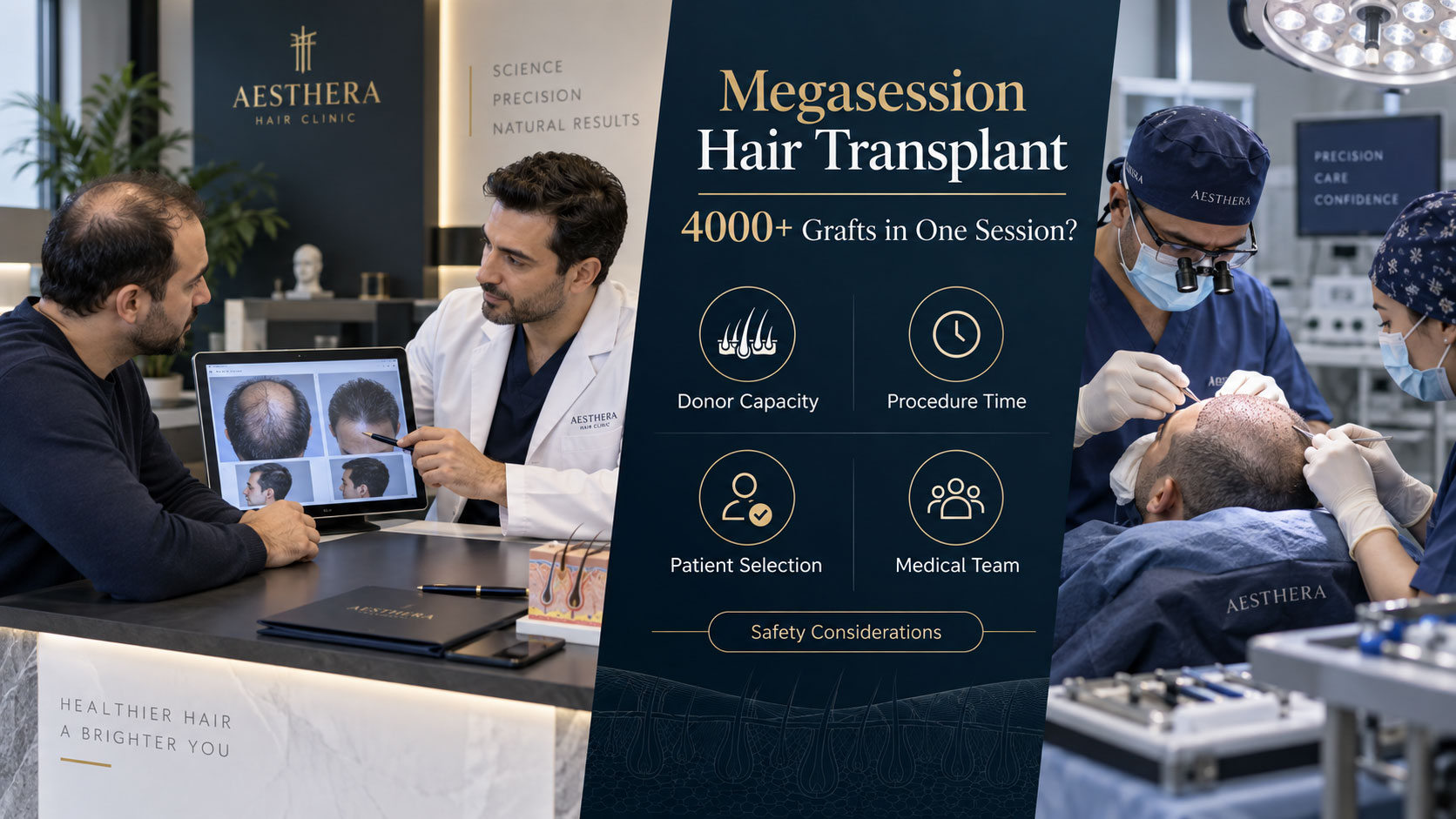
What Does a 4,000+ Graft Megasession Hair Transplant Involve?
Megasession hair transplantation refers to harvesting 4,000 or more hair grafts from the donor area and transplanting them into areas that are thinning or completely bald as part of a single surgical plan. A graft may contain one or more hair follicles; therefore, 4,000 grafts does not mean 4,000 individual hairs.
This approach may allow extensive hair loss to be addressed with fewer procedures. However, a high graft count alone does not mean a better result or a safer procedure. Donor-area density, follicle characteristics, procedure duration, hairline design, and the team’s microsurgical experience should all be assessed together.
When planning 4,000+ grafts in a single session, the key question is whether this number is biologically sustainable. Harvesting more follicles than necessary from the donor area may increase the risk of thinning and an uneven appearance in the years ahead.
Official Standards for Megasession Safety in Turkey
When planning hair transplantation in Turkey from abroad, you should verify whether the establishment holds a Health Tourism Authorization Certificate approved by the Turkish Ministry of Health. This certificate demonstrates authorization to provide services within the scope of health tourism; by itself, it does not guarantee a specific clinical outcome or a complication-free procedure.
A safe assessment should clearly explain which physician will perform the procedure, the healthcare team’s role in graft extraction and placement, the sterilization protocols used, and the emergency infrastructure available. Leaving all stages of the procedure to unnamed technicians is a point requiring particular attention, especially during long sessions involving 4,000+ grafts.
Evaluating Turkish Physicians’ Megasession Experience
Do not assess Turkish physicians’ hair transplantation experience solely by their total number of procedures. In techniques such as FUE and DHI, more concrete evaluation points include atraumatic graft extraction, preserving follicle direction in curly or fine hair, planning incision angles for high-density transplantation, and maintaining the viability of more than 4,000 grafts.
- The physician responsible for the procedure and their area of specialization should be provided in writing.
- Before-and-after images should show similar hair types, degrees of hair loss, and follow-up periods.
- The clinic should explain how the donor area is analyzed microscopically or based on density.
- Ask about the clinic’s protocol for unexpected bleeding, changes in blood pressure, or problems related to local anesthesia during the procedure.
What Is Included in a Megasession Hair Transplant Package?
The package may include VIP airport transfers, accommodation, interpreter support, and initial aftercare products or arrangements deemed appropriate by the physician. The scope should be confirmed in writing according to the clinic, hotel category, type of transfer, and need for assistance.
For a 4,000+ graft procedure in Turkey, the length of stay is generally planned around the initial consultation, the operation, and at least one follow-up visit; in practice, approximately 3 to 5 days may be required. Before the procedure, a scalp examination, donor-density measurement, medical history assessment, and blood tests may be performed according to the clinic’s protocol. Before traveling, be sure to inform the physician about existing medical conditions, bleeding tendencies, allergies, and regularly used treatments.
How a 4,000-Graft Session Is Performed
First, the hairline and transplant area are designed. Grafts are then extracted individually from the donor area using the FUE technique; some centers may use sapphire-tipped instruments for creating channels or DHI pens. The technique should be selected by the physician according to the hair characteristics and the transplant area.
A megasession may take a long time depending on the number of grafts and the team’s work plan. During lengthy procedures, maintaining fluid balance, preserving the sterile field, regularly monitoring vital signs, and keeping grafts in appropriate conditions are important for safety. Excessive fatigue, unnecessary pressure to work quickly, or uneven depletion of the donor area should not be accepted as standard practice.
Megasession Hair Transplant Cost in Turkey and Country Comparison
The average price of a 4,000+ graft hair transplant in Turkey may range from approximately €2,500 to €5,500, depending on the package contents and technical details. The figures below represent general market ranges for 2026; they should not be considered firm quotations because prices vary according to the city, physician, procedure scope, accommodation, and exchange-rate fluctuations.
| Country | Approximate price range | Pricing note |
|---|---|---|
| Turkey | €2,500–€5,500 | The procedure, follow-up visits, and some travel services may be included in the package. |
| United Kingdom | £7,000–£14,000 | Varies according to physician participation, graft count, and the city where the clinic is located. |
| Germany | €6,000–€12,000 | The scope of the procedure and the surgical team’s role affect the price. |
| United States | $8,000–$18,000 | Prices may reach the upper end of the range in metropolitan areas and for higher graft counts. |
When comparing quotations, do not look only at the total price. Check whether the fee includes the initial consultation, stages performed by the physician, follow-up appointments, additional nights of accommodation, transfers, interpreter services, aftercare materials, and assessment for possible revision procedures.
Factors Determining Megasession Cost and Safety Profile
- Physician’s specialization and experience: Experience in hair transplant planning is assessed not only by a high graft count, but also by calculating donor reserves, designing a natural hairline, creating gradual density transitions, and managing scar tissue from previous procedures. The responsible physician’s active involvement can affect the price and process plan.
- Choice of technique and materials: FUE, DHI, and sapphire-tipped channel-opening techniques require different equipment and workflows. A DHI pen does not provide better results in every case, and a sapphire tip does not guarantee safety on its own. The technique should be selected according to graft characteristics, hair thickness, curl level, and the size of the transplant area.
- Clinic location: Major health tourism hubs such as Istanbul offer a large number of clinics and pricing options, while cities such as Ankara, Izmir, and Antalya may differ in terms of price, transportation, and accommodation arrangements. When choosing a location, focus less on the city name and more on the clinic’s authorization certificate, hospital support, emergency access, and transparency regarding the treatment team.
As part of the safety assessment, you should also ask how many grafts are planned for extraction, how many hours the team will work in one day, how the donor area will be divided, and whether the procedure should be split into two sessions if necessary. If donor capacity is insufficient, a lower graft count or staged plan may be more appropriate than forcing 4,000+ grafts into a single session.
Three Specific Questions to Ask Before Choosing a Megasession
- Is 4,000+ grafts sustainable for my donor density? Which measurements will be used to assess donor-area density, hair-shaft thickness, scars from previous transplants, and the likelihood of future hair loss?
- Why is FUE, DHI, or sapphire channel opening being recommended? What will the responsible physician’s role be during graft extraction, storage, and placement?
- Which safety protocol is used during a lengthy megasession? How will vital signs, sterilization, graft storage conditions, postoperative follow-up, and communication after leaving Turkey be managed?
Before making a decision, send the clinic your recent photographs, hair-loss history, and records of any previous hair transplant procedures. The written quotation should clearly state the graft count, technique, treatment team, total duration, follow-up plan, and services not included. This allows you to compare not just the price, but how realistic the 4,000+ graft plan is for your hair characteristics and long-term donor reserve.