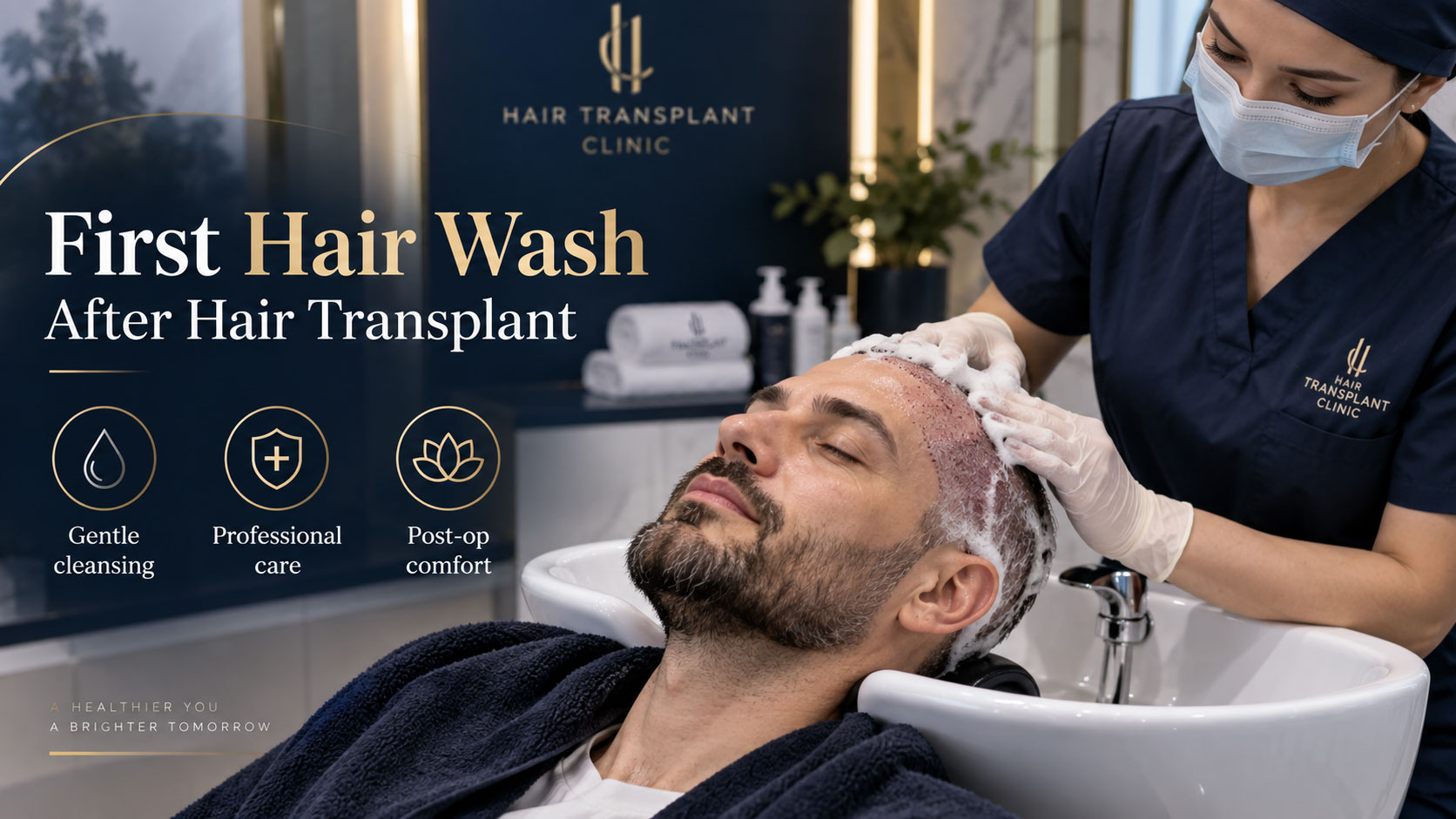
Why Is the First Wash After Hair Transplantation Important?
The first hair wash allows the crusts and superficial residue in the transplanted area to be cleaned in a controlled manner. At this stage, the aim is to maintain hygiene without rubbing the hair follicles and to support the healing process.
After FUE or DHI hair transplantation, when and where the first wash is performed depends on the clinic’s protocol, graft placement, and the appearance of the scalp. Therefore, rather than assuming that one approach is suitable for everyone, you should follow the specific instructions provided at discharge.
Many centers prefer to perform the first wash at the clinic. This allows the team to demonstrate directly how water should be applied to the transplanted area, as well as the foaming, rinsing, and drying steps, so that you can continue subsequent washes at home more carefully.
Clinical Safety Checks After FUE and DHI
When planning hair transplantation in Turkey, choosing a healthcare facility that holds a Ministry of Health-approved Health Tourism Authorization Certificate is important to ensure that the arrangements are managed through an authorized organization. Requesting written information about the certificate, the facility where the procedure will be performed, and the responsible physician supports a transparent evaluation.
When assessing Turkish physicians’ experience in hair transplantation, do not rely only on general promotional statements. Ask about specific details such as how grafts are harvested in FUE, the use of an implanter pen in DHI, graft number planning, hairline design, and who performs the first-wash protocol.
Key points checked during the first wash
- The team checks for excessive bleeding, significant discharge, or unexpected swelling in the transplanted area.
- The appearance of the grafts and the amount of crusting on the scalp are assessed.
- The water temperature, pressure, and application distance are demonstrated.
- The team explains how the foam should be applied to the scalp and how long it should remain there.
- Instead of rubbing with a towel, a patting technique is demonstrated for drying.
This check does not replace a medical examination. If you notice worsening pain, fever, widespread redness, foul-smelling discharge, or bleeding that does not stop, contact the clinic’s healthcare team without delay.
Hair Transplantation Packages and the First-Wash Plan
Depending on the hair transplantation arrangements, VIP transfers, hotel accommodation, interpreter support, and initial care products or prescribed products may be included in the package; you should check the scope in writing. In most plans, the first wash is performed at the clinic, and patients are generally asked to stay in Turkey for several days after the procedure.
Before the first wash, you are expected not to direct a high-pressure shower onto the transplanted area, not to remove the crusts, and to protect the head from friction. The clinic may determine the washing time based on the FUE or DHI technique, the number of grafts, and the condition of the scalp.
Typical sequence of a first wash performed at the clinic
- The scalp and transplanted area are visually examined.
- Water at a suitable temperature is applied to the area at low pressure.
- The recommended cleanser or foam is applied with the fingertips without pressing.
- The foam is rinsed off shortly afterward without creating friction on the scalp.
- The area is dried with patting movements using a clean towel or suitable material.
- The frequency of subsequent washes and the method to use at home are explained.
Under what conditions can the first wash be performed at home?
After checking the transplanted area, the clinic may allow you to wash at home. This option is more commonly related to your travel schedule, length of stay, or the clinic’s protocol; however, you should obtain clear written instructions for the first wash at home.
When washing at home, avoid directing high-pressure water onto the area, touching it with your fingernails, pulling off the crusts, or rubbing with a towel. If you are unsure about the product’s name or ingredients, consult the team that performed the procedure instead of using a new product on your own.
Hair Transplantation and First-Wash Costs in Turkey
The first wash is usually included in the hair transplantation package and is not priced as a separate procedure. Hair transplantation in Turkey may cost approximately €2,000–€4,500; the total price can vary depending on the number of grafts, the scope of the technique, accommodation, and the number of follow-up appointments.
The figures below are approximate ranges based on market research for 2026. Before accepting a quote, check in writing whether the first wash, follow-up examinations, care products, transfers, accommodation, and interpreter support are included.
| Country | Approximate hair transplantation cost | Common provision of the first wash |
|---|---|---|
| Turkey | €2,000–€4,500 | Usually included in the package and performed at the clinic |
| United Kingdom | £4,000–£10,000 | According to the clinic’s protocol; package contents vary |
| Germany | €4,000–€9,000 | Usually performed with clinical supervision |
| United States | $8,000–$18,000 | According to the center’s follow-up plan |
When comparing prices, consider not only the total figure but also the availability of post-transplant support. Having the first wash performed at the clinic may provide an additional follow-up point during your visit from abroad; however, this practice alone does not guarantee a particular result.
The Impact of Technique, Graft Number, and Location
- The physician’s expertise and experience: The physician’s approach to hairline design, preservation of the donor area, graft separation, and implantation density can affect the price and scope of the process. In FUE and DHI procedures, ask clearly how responsibilities are divided between the physician and technicians.
- Technique and equipment used: Technical details such as motorized FUE, manual FUE, a DHI implanter pen, sapphire-tipped channel opening, or standard steel slit use should be specified in the quote. The use of sapphire tips does not automatically mean better results for every scalp or treatment plan; suitability is determined after an examination.
- Number of grafts and procedure scope: The need for 2,000, 3,000, or more grafts may change the procedure duration, team size, and follow-up plan. Additional procedures, such as beard or eyebrow transplantation, may also increase the total price.
- Clinic location: Clinic expenses, hotel standards, transfer distances, and foreign-language support may differ in cities such as Istanbul, Ankara, Izmir, and Antalya. The city name alone is not a measure of medical quality; the facility’s authorization certificate and physician planning should also be reviewed.
Practical Steps After the First Wash
Before leaving Turkey, obtain written information about who will perform the first wash, on which day it is scheduled, and what steps your ongoing home care will involve. Also clarify photo follow-up, online consultations, and the contact channel to use if unusual findings occur.
Three frequently asked questions about the first wash
- How many hours after hair transplantation is the first wash performed? It is usually scheduled within 24–72 hours according to the clinic’s protocol; the FUE or DHI technique and the appearance of the scalp may change this timing.
- Do the crusts need to be completely removed during the first wash? No. Instead of removing the crusts forcibly, use the gentle foaming and rinsing method demonstrated at the clinic; the time needed for complete removal varies according to individual healing.
- What should I request if the first wash is not performed at the clinic? Request written care instructions, an explanation of water pressure and drying, the specifications of the product to be used, and the contact details of the healthcare team you can reach if necessary.
This information is provided for general educational purposes and does not replace an individual medical assessment. Before and after hair transplantation, ask the physician planning your procedure about the washing schedule and care limits specific to you.