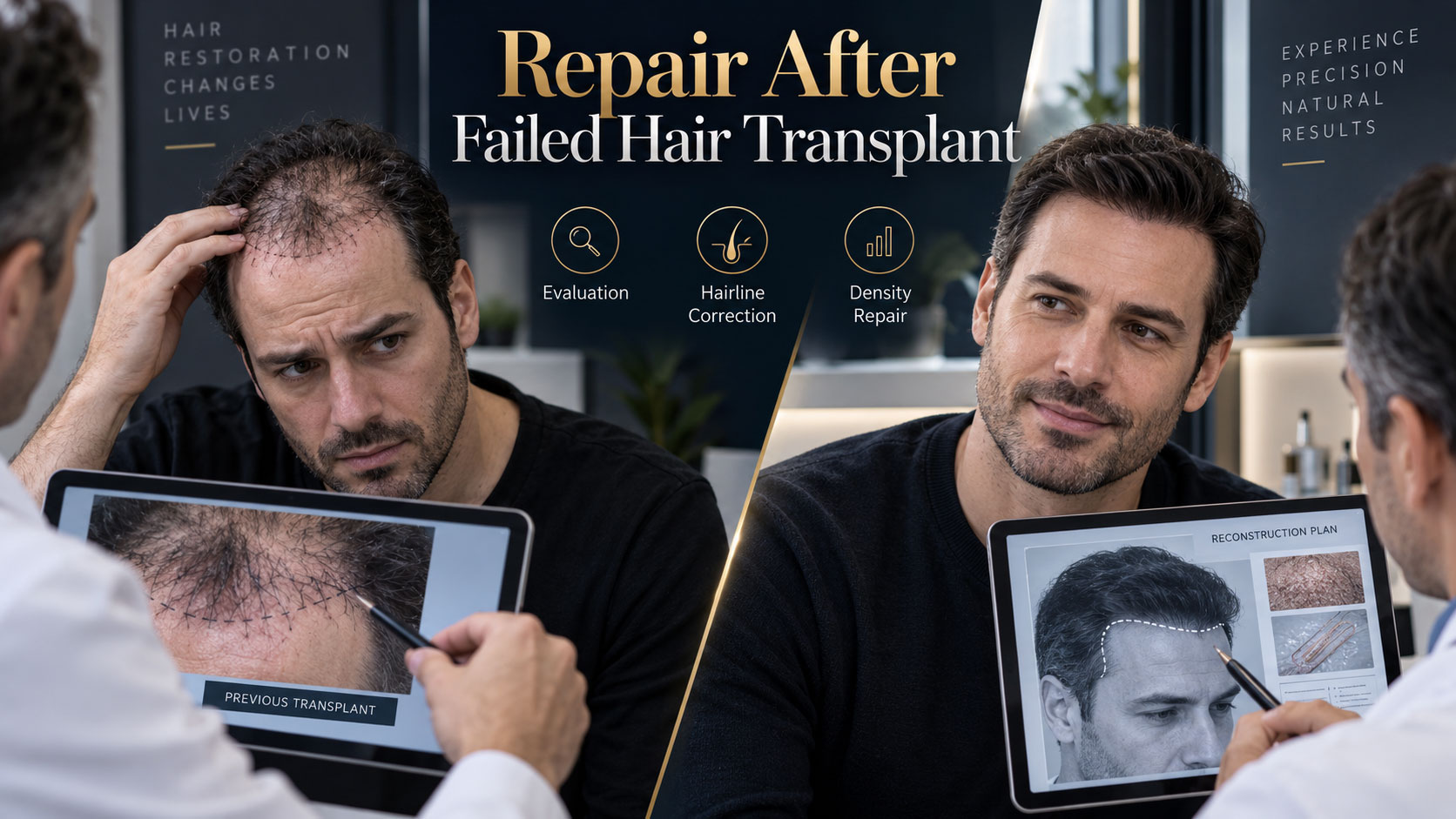
Correcting the Hair Appearance After a Botched Hair Transplant
An unnatural hairline, grafts growing in different directions, uneven density, visible scarring or thinning in the donor area after a failed hair transplant can significantly affect the aesthetic appearance. Rather than completely erasing the effects of the previous transplant, revision surgery aims to analyze the current situation and readjust the hairline, density, direction and tissue harmony.
Not every revision case is managed with the same method. In some cases, removing and repositioning incorrectly placed grafts may be sufficient, while in others, the repair is divided into several stages. Planning becomes more limited and cautious, particularly when the donor area has been overharvested.
Safety Framework in Turkey for Incorrect Graft Direction and Donor Area Issues
When choosing a provider in Turkey, you should verify that it holds a Health Tourism Authorization Certificate issued by the Ministry of Health, check the operating physician’s area of expertise and confirm the clinic’s legal scope of practice. An authorization certificate shows that health tourism services are provided under specific administrative conditions; it does not, on its own, guarantee a particular aesthetic result.
Assessment for revision surgery is based on the previously used FUE or FUT technique, the number of grafts harvested, current donor density, scar tissue and the vascular structure of the recipient area. Turkish physicians experienced in hair transplantation and repair should assess technical details on a case-by-case basis, including removing incorrectly angled grafts with a micropunch, camouflaging a FUT scar with FUE and redesigning an irregular hairline.
Records Reviewed During the Initial Assessment
- Date of the previous procedure, technique used and approximate number of grafts
- Before-and-after photographs and any available clinical reports
- Density in the nape and temple areas of the donor region
- Signs of scarring, redness, ingrown hairs or persistent sensitivity in the recipient area
- Hairline height, graft directions and density distribution
What Is Included in a Failed Hair Transplant Revision Package?
The package may include VIP transfer between the airport and clinic, accommodation, interpreter support and initial aftercare products or necessary medication arrangements. As the scope varies by clinic, it should be confirmed in writing before traveling.
The length of stay in Turkey for revision surgery is often planned at between 5 and 10 days; however, a shorter visit may be possible for assessment and a second opinion only. During the initial consultation, trichoscopic examination, donor area density measurement and analysis of the position of grafts remaining from the previous procedure may be performed. Extensive repairs may require two separate sessions depending on the available capacity, so the total duration should not be confused with a single procedure.
Key Stages of the Revision Process
- The technical and aesthetic results of the previous transplant are assessed.
- The donor reserve and the number of grafts that can be safely harvested are calculated.
- If necessary, removal of incorrectly angled grafts, scar correction or recipient-area revision is planned.
- The new hairline is designed to harmonize with facial proportions and the direction of the existing hair.
- A written schedule is created for progress photographs and follow-up appointments.
Revision Surgery Prices in Turkey and International Comparison
The average price of revision surgery after a failed hair transplant in Turkey is approximately €2,500–€7,000. The price may exceed this range when there is extensive scarring, a need for graft extraction, multiple sessions, limited donor capacity or an additional reconstructive procedure.
The figures below are approximate market ranges and may vary according to current exchange rates, the clinic package, graft number, the surgeon’s role and accommodation services. A precise quotation requires photographs, details of the previous procedure and an in-person examination.
| Country | Approximate revision price | Common inclusions |
|---|---|---|
| Turkey | €2,500–€7,000 | Consultation, surgery and basic follow-up; transfers and accommodation depending on the package |
| United Kingdom | £6,000–£15,000 | Physician assessment, surgical procedure and clinical follow-up |
| Germany | €5,000–€12,000 | Consultation, procedure and standard follow-up protocol |
| United States | $7,000–$20,000 | Physician fees, surgical facility and follow-up; additional procedures may be charged separately |
When comparing prices, do not focus only on the cost per graft. Check who will perform the procedure, whether graft extraction and placement will be carried out by the physician, whether non-medication aftercare products are included, the clinic’s revision policy and follow-up visits. Flights, additional accommodation and the cost of an unexpected second session may not be included in most quotations.
Factors Determining the Price and Outcome of Revision Surgery
- Physician’s expertise and experience: Managing several issues at once—such as an incorrectly designed hairline, grafts placed at a high angle, overharvesting of the donor area and a FUT scar—requires a more comprehensive surgical assessment than standard hair transplant experience alone. The physician’s approach to revision cases and previous results should be reviewed.
- Technique and method: Individual graft extraction with FUE, the use of a micropunch, repositioning existing grafts, camouflaging a FUT scar with FUE or, when necessary, scalp micropigmentation serve different purposes. DHI is not automatically considered more suitable for every revision case; channel creation, graft direction and existing tissue characteristics are the determining factors.
- Clinic location: In centers with high levels of international medical tourism, such as Istanbul, the range of clinic options and package inclusions may be broader. In cities such as Ankara, Izmir or Antalya, the surgeon’s expertise, hospital infrastructure, length of accommodation and transportation plan may affect the total cost; the city name alone is not an indicator of quality.
Why Is a One-Session Expectation Not Always Realistic?
If there is not enough reserve in the donor area, correcting all aesthetic issues in a single procedure may not be safe. It may be necessary to first remove incorrectly placed grafts, allow the healing period to finish and then increase density at a later stage. Hair growth is generally assessed over several months; early crusting or temporary shedding does not represent the final result.
Three Specific Questions to Ask Before Traveling to Turkey
- Will incorrectly angled grafts be removed, or will the existing hairline be camouflaged with new grafts? The answer directly affects the scope of the procedure and how much of the donor reserve will be used.
- How many grafts can be safely harvested from the donor area, and will this calculation be documented through trichoscopic measurement? After previous FUE procedures, density in the nape and side areas is particularly important.
- For a FUT scar, irregularities in the recipient area or sparse density, is a single session or staged revision recommended? The written plan should clearly specify the procedure sequence, estimated length of stay, follow-up appointments and additional costs.
Although a preliminary assessment based on photographs can be helpful, the final decision should not be based solely on remote images. Sharing previous procedure reports, the technique used and current photographs, and verifying the Health Tourism Authorization Certificate, the role of the physician responsible for the procedure and the revision plan in writing can help you make a more informed comparison.