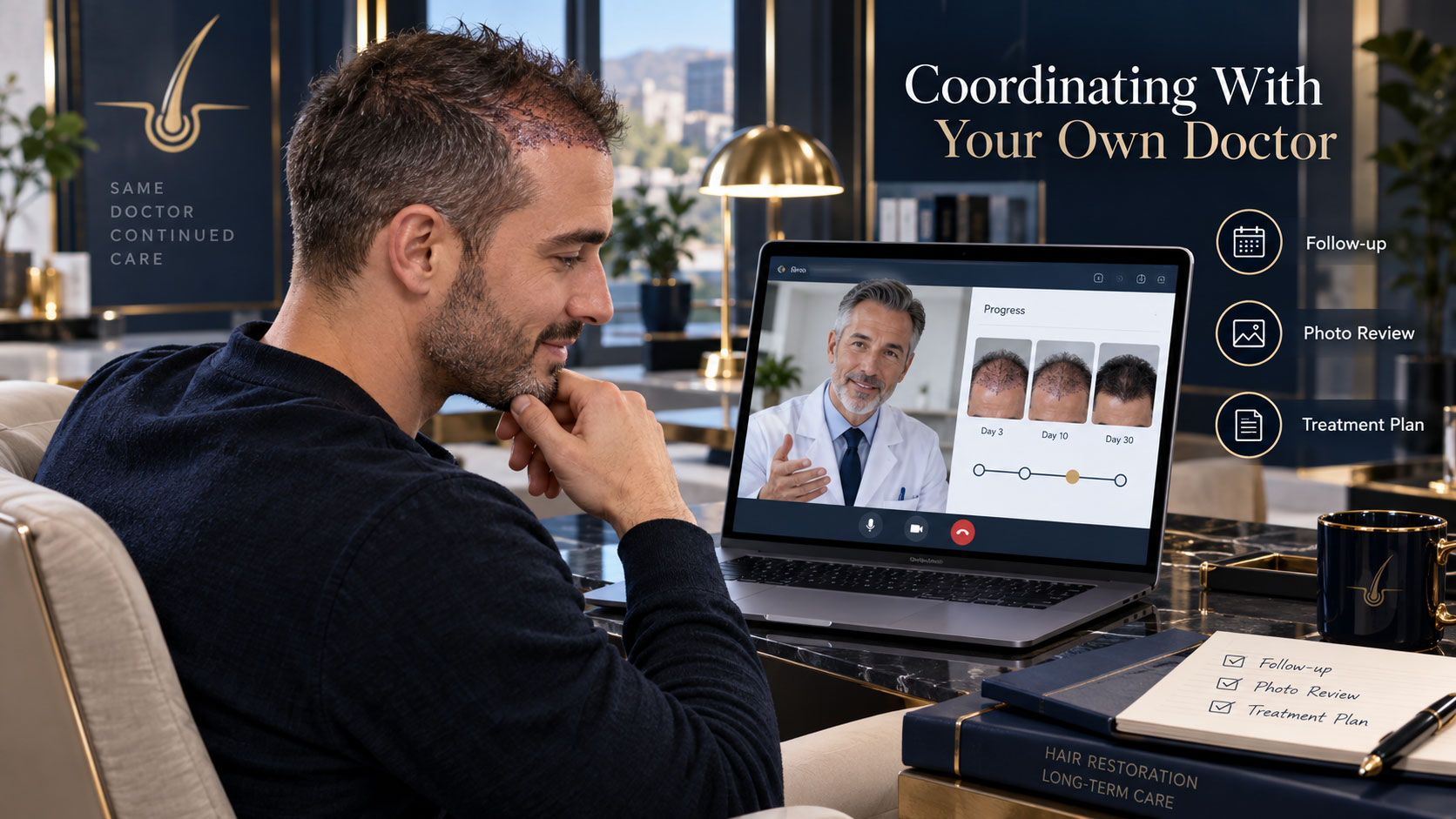
Communication Between Doctors During Follow-Up After Hair Transplantation
After undergoing a hair transplant in Turkey, it is possible to continue part of your care and follow-up in your home country. To support a safe recovery, request a detailed medical file, written aftercare instructions, and contact details for use when necessary before leaving the clinic.
After procedures such as FUE, DHI, or sapphire-tipped implantation, redness, scabbing, swelling, and temporary tenderness may occur on the scalp. Clarify in advance when these findings are part of the expected healing process and when you should contact your local doctor or the team in Turkey.
Coordination does not mean that your doctor in your home country will take over management of the procedure performed in Turkey. Each doctor evaluates you based on their own examination findings and within the limits of their authority. Care decisions should be planned by considering the procedure records, current examination findings, and communication between the clinics together.
Safe Coordination Standards After FUE and DHI
Verify whether the provider you choose is a healthcare organization holding a Health Tourism Authorization Certificate issued under the regulations of the Ministry of Health of the Republic of Türkiye. This certificate indicates that services provided within the scope of health tourism are subject to certain administrative and operational requirements; by itself, it does not guarantee a specific aesthetic result.
When Turkish doctors assess a hair transplant, it is important to document specific factors such as the number of grafts, donor-area density, hairline design, implantation angle, and preservation of existing hair. The file should clearly state that FUE involves extracting follicular units individually, that DHI involves placement with an implanter pen, and the role of sapphire tips during channel opening.
Required File for Information Sharing Between Doctors
- Procedure date, technique used, and estimated graft count
- Pre- and post-procedure scalp photographs
- Clinical assessment of the donor and recipient areas
- Aftercare protocol and follow-up schedule
- Notes on any bleeding, blood-pressure changes, or unexpected findings during the procedure, if applicable
- Purpose and duration of use of recommended products, as well as precautions
Provide explicit consent for photographs and medical documents to be shared with your doctor in your home country. The clinic should explain which channel will be used to send your health information and how your data will be protected.
Follow-Up and Preparation Steps Included in a Hair Transplant Package
The package may include airport or hotel transfers, accommodation, interpreter support, initial aftercare, and post-procedure clinical guidance. Check the scope in writing; in particular, ask separately whether online communication with your local doctor, additional follow-up appointments, dressing changes, and emergency contact services are included in the package.
The length of stay in Turkey for a hair transplant varies according to the technique used and the clinic’s protocol. In many plans, approximately 3 to 5 days are allowed for the initial assessment, procedure, and first wash. Before returning to your country, photographs of the scalp should be taken, the first wash should be demonstrated, and a summary report should be prepared for your own doctor.
Follow-Up Plan to Prepare Before Returning Home
- Instructions for head position, sleeping, and physical activity during the first 48 hours
- The day and method for the first wash
- Instructions not to remove scabs and limits on touching the recipient area
- Protection of the head during hat use, sun exposure, sweating, and travel
- Dates for sending photographs during the first week, first month, and subsequent months
- The appropriate contact pathway in case of severe pain, increasing swelling, heavy discharge, fever, or widespread redness
Obtain written confirmation from the clinical team that you are fit to travel before your flight. Also ask for information about long journeys, contact with the head area, dry air, and the conditions for carrying aftercare products.
Comparing Hair Transplantation and Follow-Up Costs in Turkey
The price of a hair transplant in Turkey varies according to the number of grafts, the choice of FUE or DHI, the scope of the clinic’s services, and accommodation arrangements. For 2026, the ranges below are approximate figures provided solely for international market comparison; the exact quotation is determined after photographic assessment and a doctor’s examination.
- Turkey: Approximately €1,800–€4,000; many packages may combine the procedure, initial aftercare, and certain logistical services.
- United Kingdom: Approximately £4,000–£10,000; hotel accommodation, transfers, and follow-up services outside the country are generally assessed separately.
- Germany: Approximately €4,000–€8,000; the city, doctor’s expertise, and graft count can significantly affect the price.
- United States: Approximately $8,000–$15,000; the procedure technique, surgeon’s location, and follow-up appointments affect the total cost.
If coordination with your local doctor is not included in the package in Turkey, set aside an additional budget for examinations and photographic assessments after returning home. When comparing prices, check not only the cost per graft but also whether a written report, first wash, revision assessment, and emergency communication support are included.
How Doctor, Graft Technique, and City Choice Affect the Process
Assess pricing and organizational details based on the following three key factors:
- Doctor’s expertise and experience: Review the doctor’s scope of practice in hairline design, planning for a limited donor area, corrective procedures after previous transplants, and preservation of follicular units when using a high number of grafts. Rather than focusing only on the number of procedures performed, ask which stages of the FUE or DHI process are directly overseen by the doctor.
- Technology, method, and materials: FUE, DHI, sapphire-tipped channel opening, motorized or manual extraction, and the type of implanter pen used do not represent the same treatment plan. Channel direction, the time grafts are kept outside the body, and the approach to avoiding damage to existing hair may affect the follow-up plan as well as the price.
- Clinic location: Travel time, airport connections, accommodation costs, and ease of returning to the clinic after the procedure may differ in Istanbul, Ankara, İzmir, or other cities. Since an additional check-up may be needed before you return home, also consider the distance between the clinic and your accommodation.
Request a written quotation when assessing these factors. It should clearly state the estimated graft count, technique, doctor’s responsibilities, number of post-procedure check-ups, photographic follow-up method, and communication sequence to follow in the event of an unexpected situation.
Three Practical Steps to Take After Returning Home
Before leaving Turkey, have the answers to the following questions added to your file. This information can help you maintain more consistent and safer communication with your own doctor.
- When should the first check-up take place? Clarify which day the first local examination after FUE or DHI should be scheduled, which findings your doctor will assess on the scalp, and from which angles the photographs should be taken.
- For which symptoms should you contact the clinic in Turkey? Expected scabbing and tenderness should be distinguished from severe pain, progressive redness, discharge, fever, or swelling spreading around the eyes, which require prompt assessment.
- How will hair growth be monitored? Document in writing how shedding or an uneven appearance during the first months will be recorded, who will assess the monthly photographic schedule, and in which month the results will be evaluated.
When attending your first appointment with your local doctor, bring the procedure report, photographs, aftercare instructions, and the contact details of the clinic in Turkey. Before deciding on a new treatment or product, it is safer to consider both the current examination findings and the records of the team that performed the hair transplant.