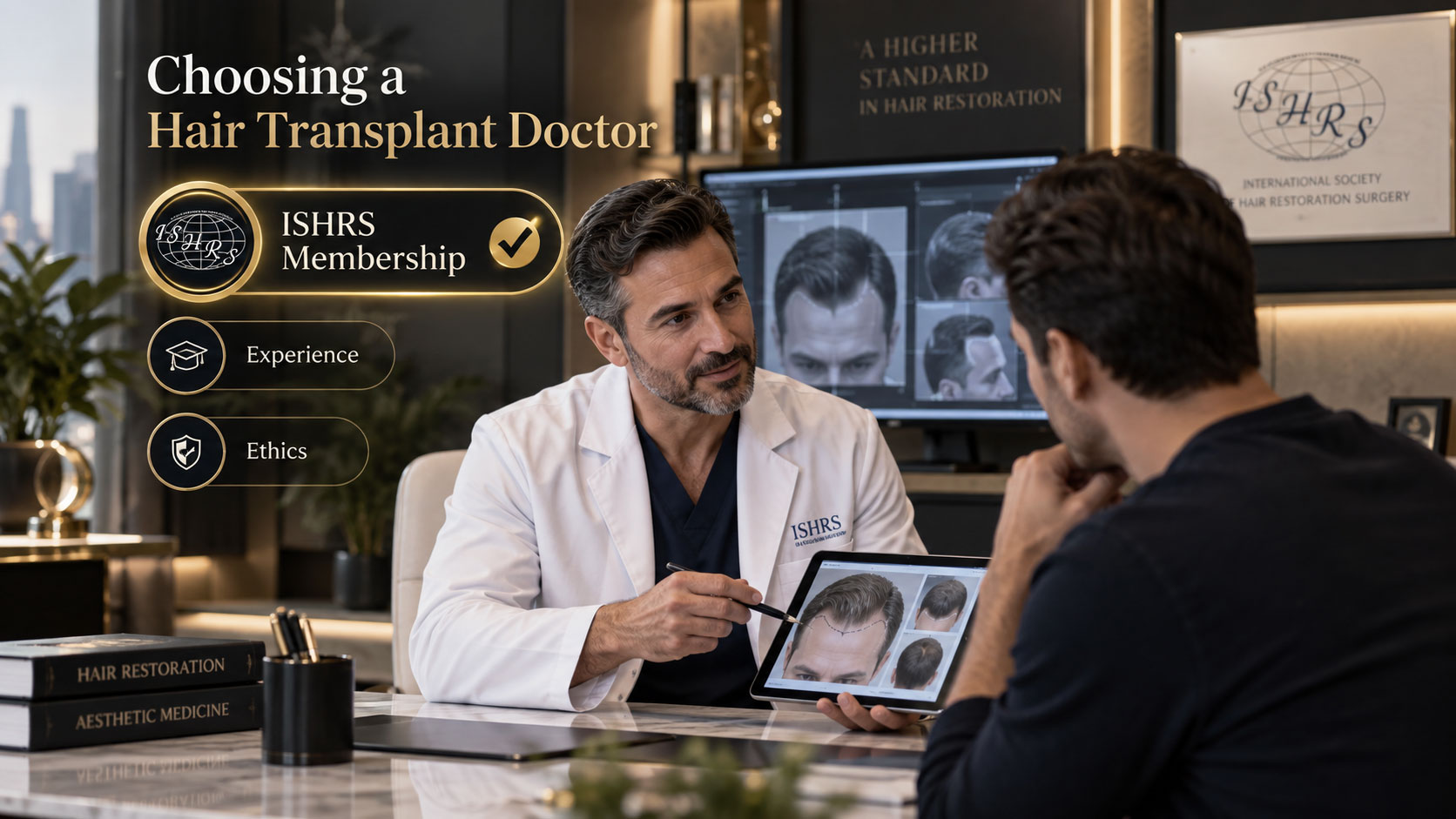
What Does the ISHRS Criterion Mean When Choosing a Hair Transplant Doctor?
Hair loss, a receding hairline, or thinning at the crown can affect your appearance and social comfort. Hair transplantation aims to place follicular units taken from the nape or another suitable donor area into areas with reduced hair density in a planned manner.
When researching doctors in Türkiye, do not focus only on clinic reviews or package prices. You should verify who plans the procedure and at which stages the physician is present. The ISHRS is an international professional organization in the field of hair restoration; however, ISHRS membership alone does not constitute a medical license in Türkiye or an independent guarantee of quality.
The Difference Between ISHRS Membership and Certification
- ISHRS membership: This indicates that the physician participates in an international professional community focused on hair restoration. Check the membership type and current status in the official ISHRS directory.
- FISHRS designation: The expression “Fellow of the ISHRS” may be used by physicians who meet the organization’s relevant professional assessment and membership requirements. Verify that the credential is current and genuinely belongs to that physician.
- ABHRS certification: This should not be confused with the American Board of Hair Restoration Surgery, a separate organization that assesses physician competence in hair restoration.
- Authorization to practice in Türkiye: Independently of ISHRS status, the physician must hold a valid professional license in Türkiye, and the facility where the procedure is performed must have the required healthcare authorizations.
Safety Standards in FUE and DHI Planning in Türkiye
When choosing a procedure as part of medical tourism in Türkiye, check whether the facility holds a Health Tourism Authorization Certificate issued by the Republic of Türkiye Ministry of Health. This certificate concerns the administrative and operational requirements defined for the clinic or relevant healthcare facility to provide international healthcare services; on its own, it does not prove that a particular doctor is “the best.”
Safe hair transplant planning begins with microscopic assessment of the donor area, examination of the scalp, protection of existing hair, and distribution of follicular units according to the limited donor reserve. Turkish dermatologists and specialists in plastic, reconstructive, and aesthetic surgery may have different levels of clinical experience in stages such as FUE, motorized punch extraction, channel creation, and graft placement.
How Can You Verify the Doctor’s Actual Involvement?
- During the consultation, ask who assesses the hairline, graft requirements, and donor capacity.
- Clarify in writing which parts of the extraction, channel creation, and implantation stages the doctor personally performs.
- Check whether the photographs were taken under the same lighting, from the same angle, and after comparable follow-up periods; do not rely solely on selected early-stage images.
- Find out in advance about the clinic’s medical assessment and follow-up procedures in cases requiring revision.
- Independently verify the Health Tourism Authorization Certificate of the center where the procedure will be performed and the physician’s official registration details.
Hair Transplant Packages: Logistics and Procedure-Specific Preparation
A package may include VIP transfers, hotel accommodation, interpreter support, and initial aftercare products or necessary post-procedure support. Check the inclusions, number of days, and additional fees in the written quotation.
Before a hair transplant, a scalp examination, donor density measurement, and hairline design are performed. In some cases, the type of hair loss, current health status, and products being used are also assessed. The stay in Türkiye can often be planned for 3 to 5 days to cover the consultation, procedure, and initial check-up.
Information to Prepare Before Traveling from Abroad
- Send recent, unfiltered photographs showing your hairline and crown.
- Report any previous hair transplant, scalp procedure, or significant dermatological concerns.
- Tell the physician about regular medications, any known bleeding tendency, and chronic conditions; consider changing medication only on a doctor’s advice.
- Include instructions for the first wash, returning to work, exercise, and sun protection in your travel plan.
Hair Transplant Prices in Türkiye and International Comparison
The total quoted price for a hair transplant in Türkiye varies according to the number of grafts, the scope of the procedure, and the services provided by the clinic. The ranges below are general market indicators for 2026; they are not a substitute for a personal quotation and may not always include travel expenses.
| Country | Approximate price range | Typical inclusions considered |
|---|---|---|
| Türkiye | €1,800–€3,500 | FUE or DHI planning, procedure, initial check-up; some packages include accommodation and transfers |
| United Kingdom | £5,000–£12,000 | Consultation, surgical team, clinic services; accommodation is usually separate |
| Germany | €4,500–€9,000 | Clinical procedure scope varying according to graft number and physician involvement |
| United States | $7,000–$18,000 | Services depending on session scope, graft number, and the doctor’s involvement in the procedure |
A very low price may indicate a higher graft count, limited physician involvement, or the exclusion of services such as accommodation and follow-up. When comparing quotations, assess not only the total figure but also the medical scope of the procedure and the written list of inclusions and exclusions.
Criteria That Affect the Price and Hair Transplant Process When Choosing a Doctor
- Physician’s specialty and experience: Specialization in dermatology or plastic, reconstructive, and aesthetic surgery is important for hairline design, donor management, and complication assessment. Also review the physician’s verifiable experience with FUE, DHI, or revision cases.
- Technology, technique, and materials: Details such as the punch diameter used in FUE, manual or motorized extraction, implantation with a DHI pen, channel creation with a sapphire tip, and the solution used to store grafts may affect the process. Remember that “sapphire” is not a separate hair transplant method; it may describe the tip material used for channel creation.
- Clinic location: Whether the center is in Istanbul, Ankara, Izmir, or another city, its operating-room infrastructure, transportation plan, accommodation arrangements, and accessibility for follow-up visits can affect the overall experience. The distance from the airport and the city transfer plan should also be included in the quotation.
Checklist for Comparing Quotations
- The estimated graft number and the examination on which it is based
- Who designs the hairline
- Which stages of the procedure the doctor personally attends
- Why an FUE, DHI, or combined approach was selected
- When the initial check-up will take place and how communication will be handled after you return abroad
Next Steps: Three Critical Questions About ISHRS and Hair Transplantation
Before making a decision, requesting written answers to the questions below can help you compare different clinic quotations more rationally:
- What is the difference between ISHRS membership and the FISHRS designation, and how can I verify my chosen doctor’s current status in the official ISHRS directory?
- Would FUE or DHI be more suitable for my donor density and hairline goals, and which measurements will determine the graft number?
- How will the first wash, scabbing period, and 6–12-month follow-up process be managed after I return abroad?
After receiving answers to these questions, assess the doctor’s official authorization, the clinic’s Health Tourism Authorization Certificate, the currency of the ISHRS information, and the detailed scope of the quotation together. This allows you to make a choice based on verifiable criteria suited to your hair characteristics and safety expectations, rather than relying on a difficult-to-measure phrase such as “the best doctor.”