How Does the Graft Survival Rate Determine Hair Transplant Results?
In hair transplantation, a graft is a small tissue unit containing hair follicles. Grafts extracted from the donor area using techniques such as FUE or DHI are placed in areas affected by hair thinning. The goal is for these follicles to remain viable in their new location and continue producing hair.
The graft survival rate refers to the proportion of transplanted follicles that remain viable in the long term. Suitable patient selection, natural hairline planning, the time grafts spend outside the body, the channel-opening method, placement angle, and post-procedure care all influence this rate.
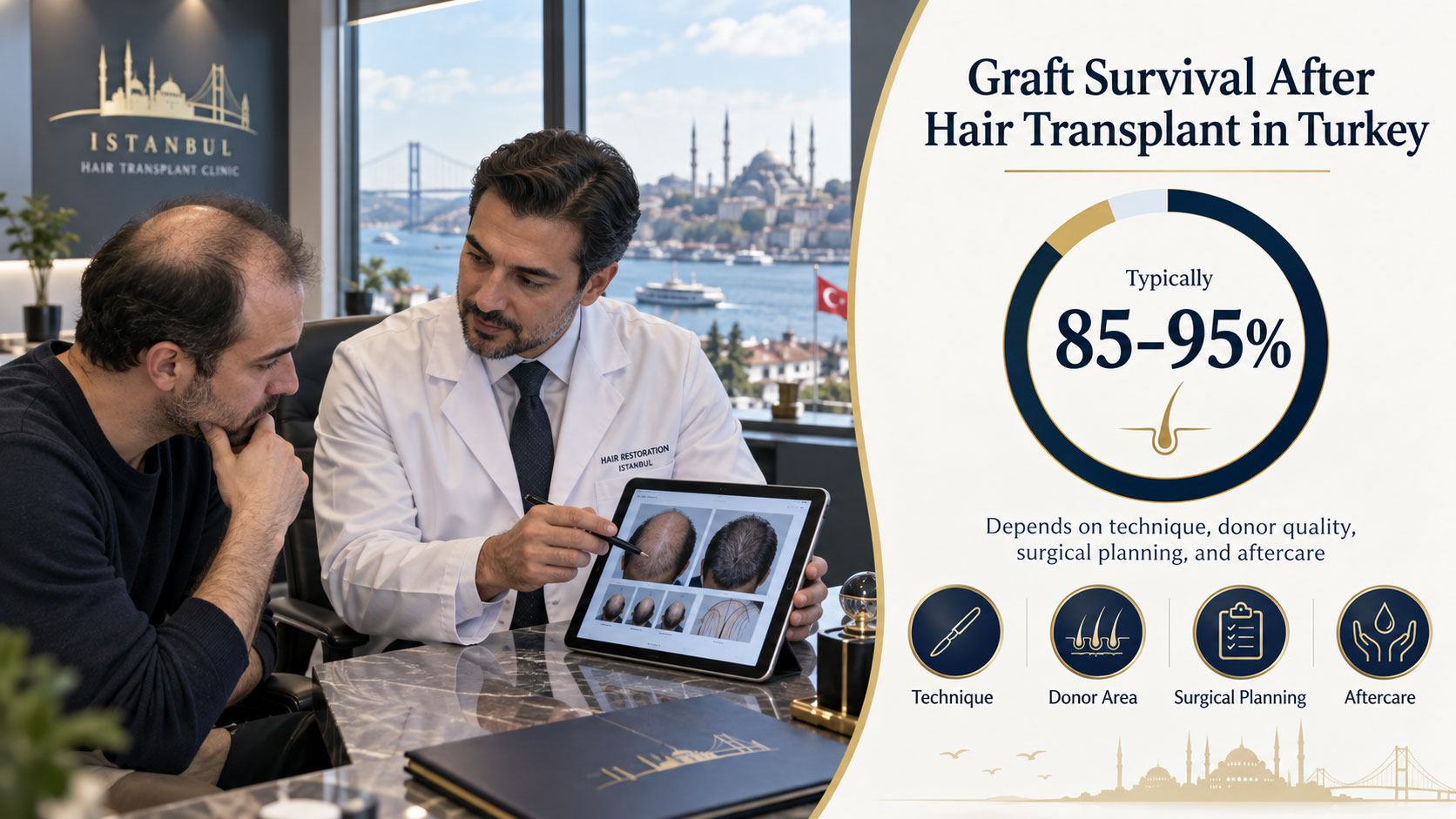
For a well-planned hair transplant, a range of approximately 85–95% is a commonly used clinical expectation; however, this rate cannot be guaranteed for every procedure. Results are generally assessed not by their appearance in the first few weeks, but after the hair growth cycle has progressed, usually within 9–12 months.
Safety Standards for FUE and DHI in Turkey
If you are considering hair transplantation in Turkey, check whether the clinic holds a Health Tourism Authorization Certificate issued by the Republic of Türkiye Ministry of Health. This certificate provides institutional and administrative authorization for delivering international healthcare services; on its own, it does not guarantee a specific survival rate or individual result.
At an authorized center, the process should include a pre-procedure examination, scalp assessment, donor capacity analysis, and medical history review. In FUE, follicular units are extracted using a motorized or manual punch, while DHI may involve placement with an implanter pen. The most suitable approach is determined by hair thickness, the condition of the donor area, and the desired density.
In the clinical practice of Turkish hair transplant teams, single-session plans involving approximately 2,000–4,500 grafts may cover various scenarios, including frontal hairline design, crown thickening, and staged transplantation when donor reserves are limited. However, when assessing claims of experience, look beyond promotional statements. Check who performs the procedure, the level of physician supervision, the sterilization protocols, and whether the follow-up plan is provided in writing.
Hair Transplant Packages and Graft Follow-Up in Turkey
A hair transplant package may include VIP transfers, accommodation, interpreter support, and initial post-procedure care products or other support deemed appropriate by the clinic. Confirm the scope and any additional charges in the written quotation. Since package contents vary between clinics, clarify flights, hotel category, companions, and follow-up visits in advance.
For most FUE or DHI plans, the stay in Turkey may last approximately 3–5 days. The first day may include an examination and hairline planning, the procedure may take place on the following day, and the initial wash and aftercare training may be scheduled afterward. Before the procedure, the scalp, donor area density, degree of miniaturization in existing hair, and, where considered necessary, blood tests are evaluated.
Crusting, redness, tightness, and swelling may occur during the first few days. Shedding of some transplanted hairs within a few weeks does not necessarily mean that the follicles have been completely lost; the follicles may remain under the skin and enter a new growth cycle. Follow your doctor’s instructions on washing, physical activity, sun protection, and follow-up appointments according to your individual plan.
Hair Transplant Costs in Turkey and International Comparison
The approximate total cost of hair transplantation in Turkey generally ranges from €2,000 to €4,500, depending on the technique used and the number of grafts. The figures below are indicative market ranges for a standard plan involving 2,500–4,000 grafts; the examination, travel date, clinic package, and treatment plan may change the final price.
| Country | Approximate cost | Currency |
|---|---|---|
| Turkey | €2,000–€4,500 | Euro |
| United Kingdom | £4,000–£10,000 | British pound |
| Germany | €4,000–€9,000 | Euro |
| United States | $7,000–$18,000 | US dollar |
When comparing quotations, do not focus only on the total amount. Review in writing how the graft count is calculated, which stages are performed by the physician, whether accommodation and transfers are included, any additional follow-up fees, and the conditions for revision procedures.
Factors Affecting the Graft Survival Rate and Cost
- Physician expertise and experience: Designing the hairline according to facial proportions, preserving the emergence angle of the grafts, and avoiding excessive thinning of the donor area are fundamental parts of surgical planning. Ask which stages the physician performs directly, the annual procedure volume, and to see examples involving similar hair characteristics.
- Techniques and devices used: Manual FUE, motorized FUE, Sapphire FUE, and DHI are not the same procedure. A sapphire tip is a material option used during the channel-opening stage, while DHI refers to a placement approach using an implanter pen. The time grafts remain outside the body, the storage solution, punch diameter, and channel-opening method may affect graft viability.
- Graft count and donor area: A plan involving 2,000 grafts does not have the same surgical scope as one involving 4,500 grafts. Donor density at the back and between the ears, hair shaft thickness, degree of curl, and the need to preserve existing hair all affect both the plan and the cost.
- Clinic location: Clinic expenses, operating room infrastructure, accommodation standards, and the scope of health tourism services may vary between cities such as Istanbul, Ankara, Izmir, and Antalya. Location alone is not an indicator of quality; sterilization, emergency planning, and physician accessibility should also be verified.
- Progression of hair loss: Ongoing hair loss may affect the future density of existing hair. For this reason, treatment planning considers not only covering empty areas but also preserving long-term donor reserves and, where necessary, using a staged approach.
Next Steps and Frequently Asked Questions After Hair Transplantation
- Does a 90% graft survival rate mean a guaranteed result?
No. The survival rate is a clinical estimate; the measurement method, follow-up period, and individual differences in hair density may affect the outcome. Instead of relying on a written guarantee, ask which criteria will be used and in which month the assessment will be performed. - Is either FUE or DHI definitively superior in terms of graft survival?
Both techniques can produce successful results when correctly indicated. The choice should be based on graft characteristics, the hairline, target density, donor area, and the team’s practical experience. The plan suited to your hair characteristics is more important than the name of the technique. - When should I assess the initial results?
The first 3 months are generally too early for assessment. New hair growth usually begins between months 3 and 6; density becomes more apparent around month 9, and the final assessment may extend to 12–18 months in some cases.
When planning from abroad, send photographs from different angles and in natural light, and provide complete information about your medical conditions and any previous hair transplant procedures. Do not make a decision unless the quotation specifies the graft count, technique, physician responsibilities, follow-up date, package inclusions, and any possible additional fees.