What Is Shock Hair Loss After a Hair Transplant?
The temporary shedding of some transplanted hairs after a hair transplant is a common stage of the healing process. This does not mean that the hair follicles have been lost; in most cases, the hair shaft sheds while the follicle remains alive beneath the skin.
Shock hair loss may occur in the transplanted area as well as in areas containing existing hair. When assessed together with redness, scabbing, and sensitivity during the first few weeks, the appearance may be concerning. However, an accurate interpretation requires consideration of the transplantation technique, hair density, skin structure, and examination findings.
During this period, the aim is to distinguish temporary changes in daily appearance from the growth timeline of new hair. Photographic follow-up, the check-ups recommended by the hair transplant center, and the individual's healing progress can help make this distinction more accurately.
The Difference Between Shock Hair Loss and Permanent Hair Loss
With shock hair loss, the hair shaft may shed, but the follicle usually enters a resting phase and later continues producing a new hair shaft. If permanent hair loss is suspected, different findings are assessed, such as progressive thinning of existing hair, a receding hairline, or clearly visible areas of loss that become permanent.
When Does Shock Hair Loss Start and End?
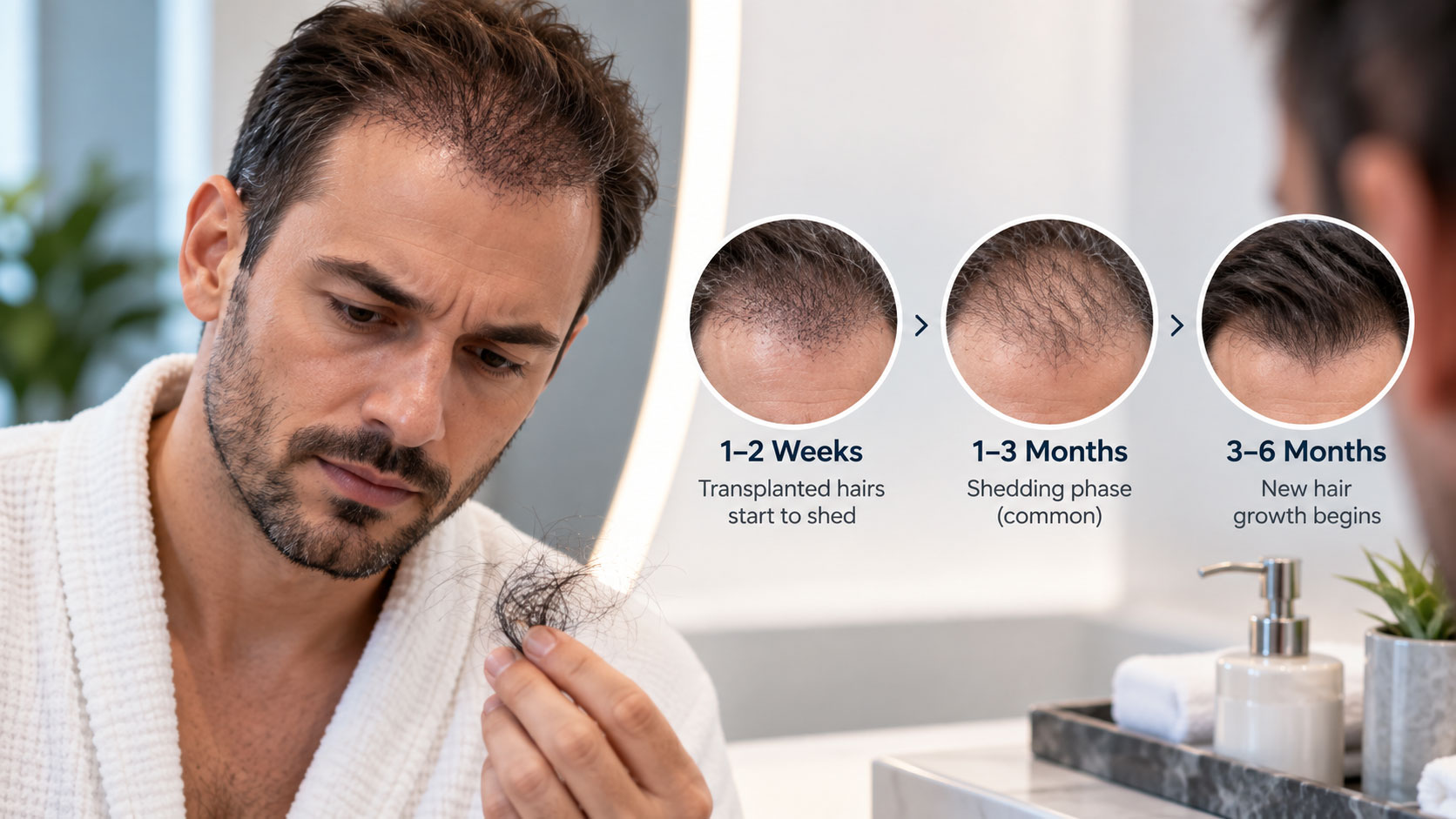
Shock hair loss after a hair transplant most often begins between the second and eighth weeks after the procedure. It becomes noticeable between the second and sixth weeks for many people; in some cases, transplanted hairs may shed earlier, or shedding may be delayed until the eighth week.
The active shedding phase usually lasts for several weeks. In most cases, it decreases around the third or fourth month. However, the timeline may vary from person to person depending on the rate of hair growth, the size of the transplanted area, the number of grafts, and the condition of the existing hair.
- First 1–2 weeks: Scabbing, redness, and sensitivity are monitored. The transplanted hairs may not yet have entered the typical phase of shock hair loss.
- Weeks 2–8: Temporary shedding may occur in the transplanted hairs and, in some cases, in existing hair.
- Months 3–4: Shedding may decrease, and the first fine new hairs may become noticeable.
- Months 4–6: The growth and thickening of new hair become more visible.
- Months 9–12: The overall result can be assessed more accurately; maturation in the crown area may take longer.
These dates should be regarded as a general framework rather than a fixed schedule. Shock hair loss may not occur at all; this alone does not indicate that the procedure was successful or unsuccessful.
At What Stage Does New Hair Growth Become Visible?
The first new hairs may appear between the third and fourth months and can initially look fine, light-colored, or uneven. The hair shafts thicken over time, and density gradually increases. The frontal hairline is generally noticed earlier, while the result in the crown area may take longer to become apparent.
Safety and Follow-Up Standards for Hair Transplants in Turkey
When traveling from abroad to Turkey for a hair transplant, an important first step is checking whether the clinic holds a Health Tourism Authorization Certificate issued under the regulations of the Republic of Türkiye Ministry of Health. This certificate is one of the factors that should be reviewed in terms of authorization to provide services within health tourism, institutional information, and the conduct of procedures in accordance with applicable legislation.
Safe hair transplant planning depends on more than the number of grafts. The capacity of the donor area, hair thickness, type of hair loss, design of the frontal hairline, local anesthesia process, and post-procedure check-ups should all be assessed together.
Doctors and teams working in hair transplantation in Turkey may use techniques such as FUE, DHI, and, where appropriate, sapphire-tipped channel opening. However, the name of the technique alone is not an indicator of quality. Patients should ask specifically about stages such as graft separation, how long the follicles are kept outside the body, the determination of channel directions, and protection of the donor area.
Hair Transplant Details Reviewed During the Follow-Up Plan
- Instructions for the first wash and removal of scabs
- Assessment of the transplanted area for redness, discharge, and sensitivity
- Density and healing appearance of the donor area
- Comparison of photographs taken at the 2nd, 3rd, 6th, and 12th months
- Monitoring for thinning or accompanying shedding in existing hair
If severe pain, increasing redness, foul-smelling discharge, fever, widespread swelling, or unexpected bleeding occurs after the procedure, contact the treating team without waiting for the scheduled check-up. These symptoms do not establish a diagnosis; clinical assessment is required.
What Is Included in a Hair Transplant Package in Turkey?
A hair transplant package may include VIP transfers between the airport and clinic, hotel accommodation, interpreter support for necessary communication, and initial post-procedure care products or products deemed appropriate by the clinic. The package contents, number of nights of accommodation, follow-up visits, and items that may incur additional charges should be clarified in writing.
In terms of shock hair loss, the process begins with an analysis of the hair and donor area before the procedure. Depending on the procedure type, planning may require an average stay of approximately 3–5 nights in Turkey. The initial assessment may include hair-density measurement, photographic analysis, medical history, existing health conditions, and blood tests when necessary.
The first wash after the procedure is generally performed at a time specified by the clinic. During the first few weeks, avoiding pressure on the transplanted area, not forcibly removing scabs, and following instructions regarding sun exposure and intense physical activity are all part of the healing process.
Hair Transplant Costs in Turkey and Country Comparison
The total package cost of an FUE or DHI hair transplant in Turkey varies according to the number of grafts, the scope of the procedure, and the accommodation package. The ranges below are general market estimates; shock hair loss is not a separate procedure for which an additional charge would normally be expected, and a definitive quotation is determined after an examination or remote assessment.
| Country | Approximate hair transplant cost | Currency | General coverage |
|---|---|---|---|
| Turkey | €1,500–€4,000 | EUR | Procedure, basic check-ups, and accommodation depending on the package |
| United Kingdom | £4,000–£12,000 | GBP | Usually the procedure and clinic follow-up |
| Germany | €4,000–€10,000 | EUR | Procedure and follow-up according to the center's policy |
| United States | $6,000–$15,000 | USD | Procedure; travel and accommodation are usually additional |
Looking only at the starting price can be misleading when comparing costs. The way the number of grafts is calculated, who performs the procedure, the duration of follow-up consultations, revision terms, and communication options from abroad should all be reviewed together.
Factors Affecting Hair Transplant Cost and the Shock Hair Loss Process
- The doctor's expertise and experience: Hairline design, protection of the donor area, planning for high graft numbers, and assessment of the risk of thinning in existing hair may affect the price. Patients should clearly ask which stages of the procedure the doctor will perform personally.
- Technology, technique, and materials: Motorized or manual graft extraction in FUE, use of an implanter pen in DHI, sapphire-tipped channel opening, graft storage conditions, and the planned implantation density may change the total cost. The terms DHI or sapphire do not automatically mean that an option is more suitable; compatibility with the hair structure and target area should be assessed.
- Clinic location: Rent, team structure, accommodation, and transfer costs may differ between Istanbul, Antalya, Ankara, and other cities. In addition to city-related differences, the center's hospital affiliation, emergency plan, and follow-up arrangements should also be reviewed.
These factors may also affect the quality of follow-up during the shock hair loss period. When creating the treatment plan, request written details not only about how many grafts will be transplanted, but also about how the 3rd-, 6th-, and 12th-month check-ups will be conducted.
Next Steps and Frequently Asked Questions After a Hair Transplant
- Is it considered normal if shock hair loss starts after the eighth week? The starting time may vary from person to person. The nature of the shedding and the condition of the transplanted and existing hair should be assessed through photographic follow-up.
- What should be done if existing hair sheds along with the transplanted hair? Temporary shock hair loss should be distinguished from ongoing thinning in existing hair. Comparative photographs of the donor and transplanted areas, the course of hair loss, and a clinical examination can help guide the assessment.
- If the new hair is still very fine at the fourth month, does that mean the result has failed? The fourth month is often an early stage for evaluation. Thickening and increased density may continue after the sixth month; the final assessment is generally made between the ninth and twelfth months.
If you are planning a procedure from abroad, provide the clinic with complete information about your current hair photographs, previous treatments, products you use, and known health conditions. This can help establish more realistic expectations regarding the graft plan, length of stay, follow-up schedule, and shock hair loss.