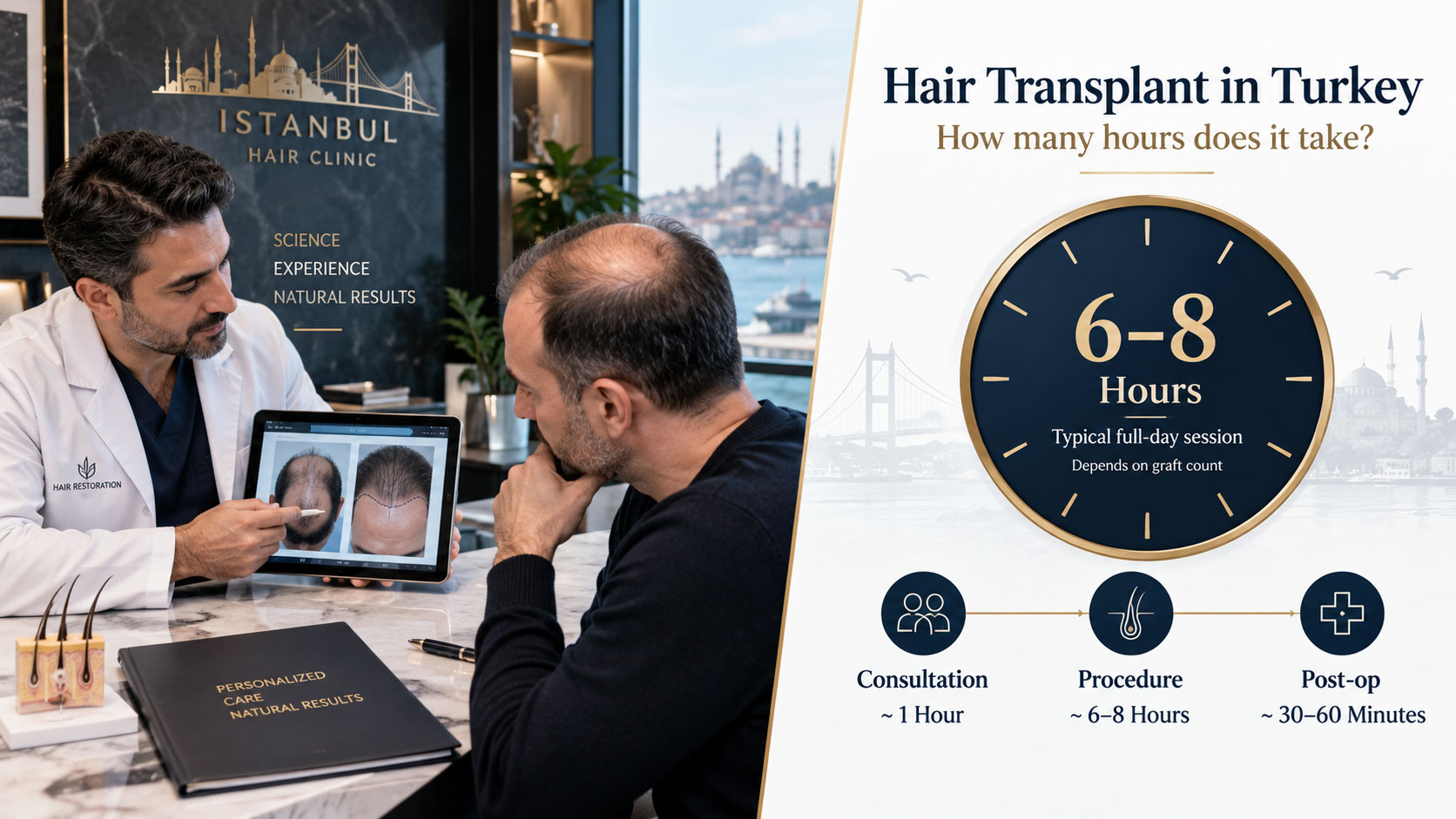
What Is Your Hair Transplantation Day Like?
Hair transplantation in Turkey is a planned procedure that involves removing hair follicles from the donor area and transferring them to thinning or bald areas. From a daily-life perspective, the most common questions concern how many hours the procedure takes, how comfortable it is during treatment, and how much time is needed for rest afterward.
A single session is usually completed within 4–8 hours. Limited procedures requiring fewer grafts may take 3–4 hours, while treatments covering larger areas or requiring a high number of grafts may approach 8–10 hours. The exact duration is determined after assessing hair density, the extent of hair loss, the technique selected, and the team’s treatment plan.
Whether the procedure is tiring cannot be explained by the number of hours alone. Thanks to local anesthesia, sharp pain is generally not felt during the procedure; however, sitting in the same position for an extended period, keeping the head and neck still, and spending the day at the clinic can be physically tiring.
Stages That Determine the Duration of FUE and DHI Procedures
Examination and Hairline Planning
The day begins with an assessment of the scalp and donor area. The hairline, forehead proportions, existing hair density, follicle capacity in the donor area, and desired appearance are evaluated together. Photographs, hair analysis, and, where necessary, basic health assessments may be part of the planning process.
Designing the hairline is not simply an aesthetic drawing. A long-term plan should take age, facial proportions, the natural direction of hair growth, and the possibility of future thinning into account.
Graft Extraction and Placement with FUE
With the FUE technique, hair follicles are individually extracted from the donor area using a small-diameter punch device. They are then placed into channels or micro-incisions created in the recipient area. Preparing and counting the grafts and preserving their direction are important stages that affect the duration of the procedure.
FUE procedures often take several hours. As the number of grafts increases, the extraction and placement stages take longer. To avoid damaging the hair follicles, it is more important for the procedure to be controlled and aligned with the anatomical direction of hair growth than simply to be completed quickly.
Implantation with an Implanter Pen in DHI
With the DHI technique, where considered appropriate, hair follicles are transferred to the recipient area using a special placement tool similar to a Choi implanter pen. In this technique, the organization of the channel-opening and implantation steps may differ; therefore, the total duration cannot be estimated based solely on the device used.
DHI is not automatically more suitable for every hair-loss pattern. The technique is selected after assessing the donor area’s capacity, the size of the thinning or bald area, whether implantation between existing hairs is required, and the physician’s treatment plan.
Hair Transplantation Safety and Authorization Certificates in Turkey
When traveling to Turkey from abroad, you should check whether the clinic operates within the scope of the Health Tourism Authorization Certificate issued by the Ministry of Health of the Republic of Türkiye, as well as the roles and responsibilities of the physician and team performing the procedure. An authorization certificate is an important indicator that health tourism services are being provided in compliance with regulations; by itself, it does not guarantee a specific outcome.
Safe planning in hair transplantation is associated with sterile working conditions, protection of the donor area, storing grafts in an appropriate solution and at a suitable temperature, correctly determining channel directions, and maintaining an organized postoperative follow-up process. The experience of Turkish physicians in different procedures, such as FUE, DHI, sapphire-blade channel opening, and revision hair transplantation, allows assessments to be made according to the patient’s hair characteristics and graft capacity.
When choosing a clinic, do not focus solely on before-and-after photographs. Find out who plans the procedure, what role the physician plays during graft extraction and implantation, what emergency protocol is in place, how follow-up communication is handled, and whether the procedure is performed in a hospital or licensed medical center.
The Procedure Day and Your Stay in Turkey as Part of a Hair Transplant Package
A hair transplant package may typically include VIP transfers, hotel accommodation, interpreter support, and initial care products or postoperative recommendations. You should confirm in writing exactly which services the package covers, the number of hotel nights, the scope of transfers, and any circumstances that may result in additional charges.
Before the procedure, it is important to examine the scalp, assess graft capacity, and share your medical history. Any tendency to bleed, chronic conditions, previous hair transplantation, products or medications being used, and instructions to follow before the procedure must be fully communicated to the healthcare team; do not start or stop any product or medication on your own decision.
A stay of approximately 3–5 nights may be sufficient in many treatment plans in Turkey. This period varies depending on the arrival examination, procedure, first wash, check-up, travel plans, and the clinic’s follow-up protocol. Before a long flight, clarify with the clinic whether the initial check-up has been completed.
Hair Transplantation Costs in Turkey and International Comparison
Hair transplantation prices in Turkey may vary widely in the international health tourism market in 2026. Depending on factors such as FUE or DHI, the number of grafts, physician involvement, accommodation, and transfer coverage, the average package price may be approximately €2,000–€4,500. The figures below are approximate market ranges and should not be considered a personal quotation or a guarantee of results.
| Country | Common price range | General coverage |
|---|---|---|
| Turkey | €2,000–€4,500 | Procedure, and in some packages, transfers, hotel accommodation, and follow-up |
| United Kingdom | £4,000–£10,000 | Generally the procedure and clinic services |
| Germany | €4,000–€9,000 | Procedure and follow-up according to the center’s protocol |
| United States | $8,000–$18,000 | Procedure; travel and accommodation are generally excluded |
When comparing prices, do not look only at the total amount. Check whether the package includes the number of grafts, the team performing the procedure, the check-up and first wash, the accommodation standard, and any potential additional charges. A very low price may raise questions such as whether the number of grafts is unclear or whether the physician’s role is limited.
Hair Transplantation Factors Affecting Procedure Duration and Cost
- The physician’s expertise and role in the procedure: Hairline design, graft distribution, channel directions, and protection of the donor area require experience. The extent to which the physician participates in planning, channel opening, or implantation may affect both the process and the price.
- Technique and instruments used: FUE, DHI, sapphire-blade channel opening, and the use of a motorized punch create different workflows. Technical details such as the Choi implanter pen, punch diameter, and whether the grafts are single or multiple are taken into account when estimating the procedure duration.
- Number of grafts and extent of the thinning or bald area: A procedure limited to the frontal hairline cannot be completed in the same amount of time as an extensive treatment covering the frontal, mid-scalp, and crown areas. As the number of grafts increases, the extraction, separation, and placement stages take longer.
- Clinic location: In cities such as Istanbul, Ankara, Izmir, and Antalya, the distances between the clinic, hospital, hotel, and airport may affect the package plan. Travel time within the city center, accommodation standard, and transfer coverage may be reflected in the total cost.
Rest After the Procedure and Next Steps
Once the procedure is complete, avoid planning intense physical activity on the same day, protect the head, and follow the care instructions provided by the clinic. Tightness, sensitivity, or swelling may occur during the first few days; since the severity and duration of symptoms can vary from person to person, you should contact the healthcare team if anything unexpected occurs.
Rather than scheduling your flight immediately after the procedure, allow time for the initial check-up and wash. The time needed to return to work may differ between desk-based jobs and work requiring physical exertion; it may be necessary to protect the scalp from sunlight, impacts, and excessive sweating.
- Which takes less time, FUE or DHI, and which method may be considered for my donor area?
- How is the number of grafts calculated, and how many hours are planned for the frontal hairline, crown, and mid-scalp areas?
- In what order should the first wash, check-up, and flight day be scheduled after hair transplantation in Turkey?