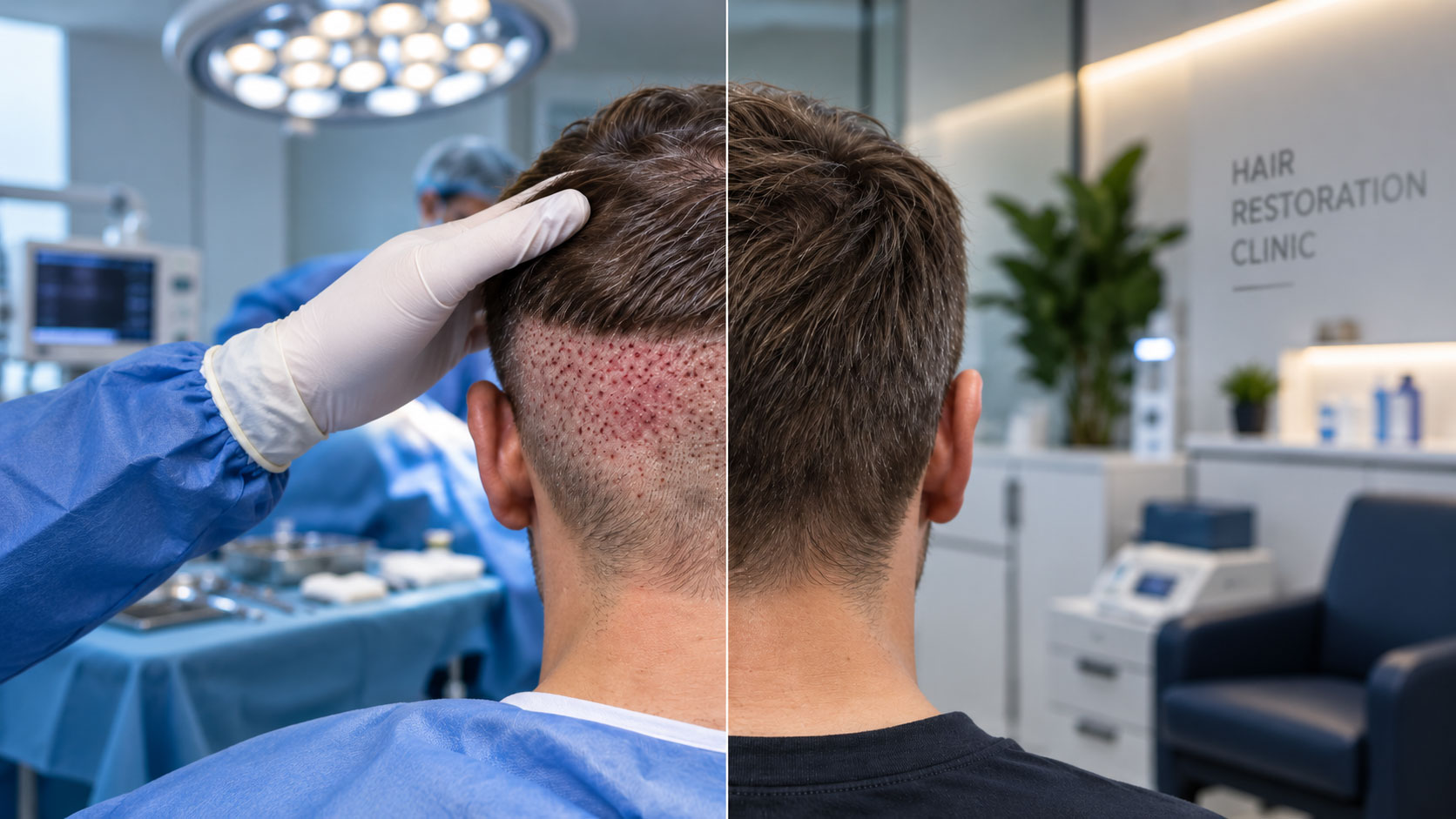
How Does the Appearance Change When Hair Is Removed from the Nape?
During hair transplantation, follicular units are taken from the donor area at the nape and the back and sides of the head, then placed in thinning areas. Each follicular unit in this region can be extracted only once; a removed follicle does not grow back in the same location.
Nevertheless, when the procedure is planned using accurate density calculations, the nape usually retains a natural appearance. The key issue is not simply how many grafts are removed, but how the extracted grafts compare with the donor area's overall density and the boundaries of the safe donor zone.
Permanent Follicle Loss Versus Temporary Changes in Appearance
With FUE or DHI, follicular units are extracted using micro-instruments called punches. Small scabs, redness, and short-term irregularities may develop at the extraction points; these findings generally diminish during the healing process. However, if density permanently decreases because of overharvesting, the area may not return to its previous level simply with time.
Donor-area deterioration may appear as visible thinning, moth-eaten patches, noticeable marks with short haircuts, or irregular hair direction. The risk increases when the extraction area is made too broad, grafts are concentrated in one region, or planning does not account for future hair loss.
Donor Safety in FUE and DHI Planning
At clinics in Turkey that hold a Ministry of Health-approved Health Tourism Authorization Certificate and provide hair transplantation through an authorized healthcare facility, the process begins with an examination, photographic assessment, hair-density measurement, and review of medical history. The certificate indicates the administrative authorization required for the healthcare facility to operate within health tourism; by itself, it does not guarantee a specific outcome.
Turkish dermatologists and plastic, reconstructive, and aesthetic surgeons plan FUE, DHI, motorized punch, and, when necessary, manual punch procedures according to the number of grafts, follicle characteristics, and donor density. A personalized density map rather than a standard graft count is particularly important for curly or fine hair, previous hair transplantation, or limited donor reserves.
Specific Criteria Reviewed During the Assessment
- Approximate follicular-unit density per square centimeter in the nape and temporal regions
- The distribution of single, double, and multiple grafts
- Hair-shaft thickness, curl pattern, and the existing pattern of hair loss
- The boundaries of the safe donor area and the possibility of future hair loss
- Scars, pigment changes, or irregular extraction areas remaining from previous procedures
The physician should assess not only the current appearance but also how the hairline may change over the coming years. This approach helps prevent the use of more grafts than necessary during the first procedure and preserves future options for corrective treatment.
Hair Transplant Package and Preparation for the Nape
A hair transplant package may include VIP airport-hotel-clinic transfers, accommodation, interpreter support, and initial post-procedure care supplies. The inclusions should be confirmed in writing according to the clinic and length of stay. To protect the donor area, hair density is photographed before the procedure, the graft target is determined, and the extraction area is marked.
FUE or DHI is usually performed in a single session; depending on the graft count and scope of the procedure, time spent at the clinic may be approximately 6 to 9 hours. In Turkey, the stay is commonly planned for 3 to 5 days; this may include the first check-up, washing instruction, and dressing assessment.
Monitoring the Donor Area During Recovery
Scabbing and tenderness can be expected during the first few days. The washing method provided by the clinic should be followed, the nape should not be scratched, and friction, tight headwear, or direct intense sun exposure should be avoided during the initial period.
If pronounced gaps, increasing redness, discharge, severe pain, or scabbing that does not heal is noticed in the donor area, the treatment team should be contacted promptly. Although photographs can be useful for remote follow-up, a physician's examination may be necessary for a definitive assessment.
Hair Transplant Costs in Turkey and International Comparison
The total cost of FUE or DHI hair transplantation in Turkey may range from approximately €1,800 to €4,500, depending on the graft count and package inclusions. A limited donor area, correction of a previous transplant, or the need for advanced surgical planning may increase the price; the figures below are general market ranges and do not replace an individual quotation.
| Country | Approximate price range | Note on pricing |
|---|---|---|
| Turkey | €1,800-€4,500 | The procedure, basic check-ups, and accommodation/transport may be included depending on the package |
| United Kingdom | £4,000-£12,000 | Varies according to graft count, clinic, and the surgeon's role |
| Germany | €4,000-€10,000 | City, physician expertise, and clinic infrastructure are determining factors |
| United States | $8,000-$20,000 | Procedure scope, surgeon involvement, and regional fees affect the price |
When comparing quotations, it is important to consider not only the total price but also how the graft count is determined, who performs the procedure, what the physician's examination includes, and how post-procedure follow-up is provided. An unusually low price may indicate that the planning and monitoring required to protect the donor area in the long term are not included.
Factors Affecting Permanent Deterioration of the Nape
- Physician expertise and experience: In hair transplant planning, documented clinical experience with limited donor areas, corrective procedures, and high graft density is important—not just the total number of procedures performed. The physician's responsibilities during extraction and implantation, the team's division of duties, and the complication-management plan should be discussed in advance.
- Technique and materials used: In FUE, punch diameter, use of a motorized or manual punch, the time grafts remain outside the body, and the extraction angle may affect donor trauma. In DHI, placement with an implanter pen does not by itself prevent excessive damage during extraction; the key factors are homogeneous graft distribution and a safe extraction rate.
- Clinic location: Although there are many options in major health tourism centers such as Istanbul, price and quality are not the same everywhere. When considering a facility in Ankara, Izmir, Antalya, or another city, verify not the city name but the Health Tourism Authorization Certificate, the healthcare facility where the procedure will be performed, physician information, and the follow-up arrangements.
Signs of Donor Overharvesting
Persistent pinpoint gaps after the procedure, a marked difference in density across the donor area, white marks that are easily visible with short hair, or irregular extraction spread across a broad area may suggest overharvesting. Photographs taken in the same lighting before and after the procedure can help assess these findings.
Before hair transplantation, the written graft plan, estimated donor density, safe extraction limit, and the reserve to be left for any additional session that may be needed in the future should be clearly discussed. This helps preserve both the current appearance of the nape and long-term treatment options.
Next Steps and Frequently Asked Questions About the Nape Donor Area
- Do hair follicles extracted with FUE grow back in the same location? No. An extracted follicular unit does not form again in the same location; a natural appearance depends on distributing the extraction evenly in proportion to donor density. The punch diameter and extraction plan should also be reviewed during the FUE hair transplant process.
- Does the DHI method protect the nape better than FUE? DHI refers to placing grafts with an implanter pen and does not automatically guarantee donor-area safety. When evaluating a DHI hair transplant, the extraction technique, graft count, and distribution plan should be considered together.
- Can an overharvested nape be corrected? The available options vary according to the remaining density; camouflage, scalp micropigmentation, or limited corrective procedures may be considered. Before a revision hair transplant, the donor reserve and existing scars should be examined in detail.
At the initial assessment, sharing your pre-procedure photographs, records from any previous hair transplant, and a list of the medical products you use can facilitate planning. The final decision should be made after evaluating the examination, donor-density measurement, and progression of hair loss together.