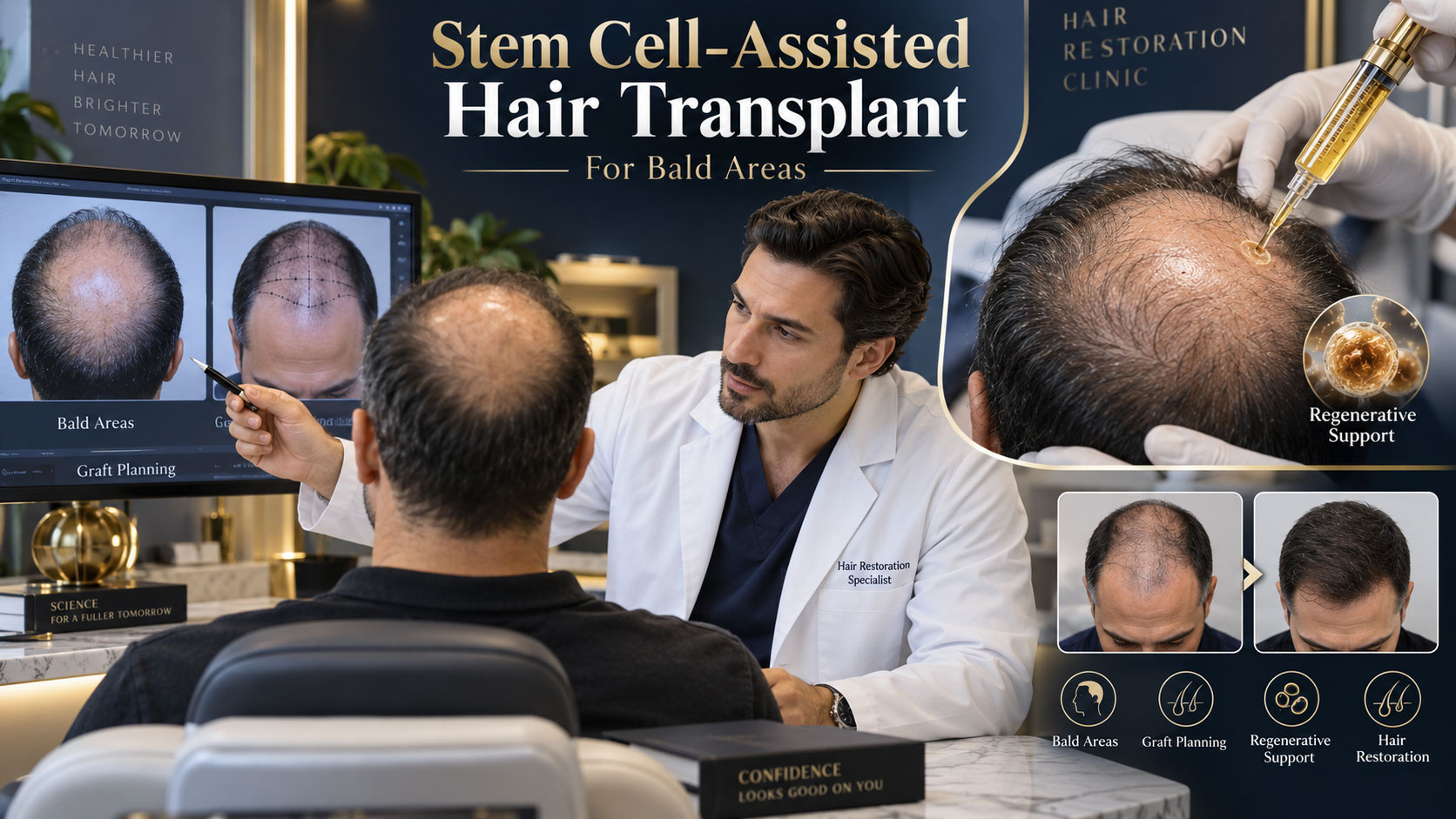
What Does Stem Cell-Supported Hair Transplantation for Bald Areas Mean?
Hair transplantation for bald areas aims to transfer permanent hair follicles from the nape and above the ears to thinning or empty areas. A stem cell-supported approach may refer to using a cellular or biological product prepared from the patient’s own tissue in addition to the transplant, with the aim of supporting scalp healing or improving the surrounding environment of existing hair follicles.
This term does not describe the same procedure at every clinic. Some centers may offer stromal vascular fraction derived from adipose tissue, micro-fragmented adipose tissue, autologous cellular suspensions, PRP, or similar biological support under the heading of “stem cells.” Therefore, you should ask in writing about the source of the material used, how it is prepared, where it is applied, and the level of supporting evidence, in addition to the name of the procedure.
Even in an area that appears shiny and completely empty, the possibility of transplantation is assessed together with scalp blood supply, the presence or absence of scar tissue, the size of the recipient area, and the number of follicles in the donor area. A single photograph cannot establish suitability; an examination, dermoscopic assessment, and, when necessary, laboratory evaluation form the basis of treatment planning.
Safety Checklist for FUE and Cellular Support in Turkey
When researching treatment in Turkey, use healthcare providers that hold a Health Tourism Authorization Certificate issued by the Ministry of Health. Verify in advance that the certificate was issued for the relevant provider, which physician will perform the procedure, and whether the operation will take place in a hospital or licensed medical center.
Turkish dermatology and plastic, reconstructive, and aesthetic surgery teams may have experience in different stages, including FUE, DHI, graft separation, recipient-area design, and approaches to scarred scalps. However, the effectiveness of every application described as a stem cell treatment in hair transplantation has not been demonstrated to the same degree. When assessing clinical experience, review not only the number of procedures performed but also examples involving bald areas of similar size, previously transplanted regions, and scar tissue.
Points to Document Before the Procedure
- Exact name of the procedure: FUE, DHI, sapphire-blade channel opening, or a combination protocol.
- Source of the cellular product: blood, adipose tissue, or another autologous tissue.
- How the product is prepared in the clinical setting and where it is applied.
- The treating physician’s specialty and responsibilities during the operation.
- A written plan for complications, revision procedures, and follow-up.
What Is Included in a Stem Cell-Supported Hair Transplant Package?
A medical tourism package may include airport or hotel transfers, accommodation, interpreter support, and initial post-procedure care products or necessary prescriptions. Compare the scope, number of nights, transfer limitations, and conditions for accompanying persons using a written quote before making payment.
Preparation specific to this treatment commonly includes scalp photo analysis, measurement of donor-area density, dermoscopy, and hairline design. If the bald area is extensive or there has been a previous hair transplant or scar formation, planning may not be completed in a single session. Staying in Turkey for approximately 3–5 days after the procedure may be practical for the first wash and early follow-up according to the clinic’s protocol; the exact duration is determined by your flight schedule and medical assessment.
It is important to understand that a stem cell-supported product does not replace transplanted grafts. The fundamental procedure that provides new hair follicles is the placement of grafts taken from the donor area into the recipient area; cellular support may be considered an additional treatment only in selected protocols.
Cost of Hair Transplantation for Bald Areas in Turkey and Country Comparison
In Turkey, the total price of FUE- or DHI-based hair transplantation combined with an additional cellular support treatment may typically range from €2,500 to €5,000, depending on the number of grafts required for the extensive area and the protocol used. The figures below are approximate ranges for market research; they should not be considered a definitive quote without an examination, graft calculation, and details of the cellular treatment.
| Country | Approximate price | Price note |
|---|---|---|
| Turkey | €2,500–€5,000 | Hair transplantation and a selected cellular support protocol |
| United Kingdom | £6,000–£12,000 | Graft number, physician, and clinic location are key factors |
| Germany | €5,000–€10,000 | FUE or DHI, session scope, and follow-up plan affect the price |
| United States | $8,000–$18,000 | City, surgeon’s fee structure, and additional biological treatments vary |
When requesting a quote, look beyond the total price and check how many grafts are planned and whether the treatment described as stem cell therapy is itemized separately. Flights, additional accommodation, laboratory tests, revision procedures, long-term follow-up, and complication management may not be included in the package.
Factors Affecting Graft Numbers, FUE Technique, and Price
- Physician’s specialty and experience: Natural hairline design for extensive bald areas, control of graft direction and angle, management of high-graft-count sessions, and approaches to scarred areas may affect the physician’s fee and the scope of the plan. Clarify the physician’s role during implantation, channel opening, and the cellular treatment stages.
- Technology, method, and materials: The use of a motorized or manual punch in FUE, direct placement with a DHI implanter, sapphire-blade channel opening, graft storage conditions, and the preparation method used for the cellular product may affect the price. The term “stem cells” alone is insufficient; stromal vascular fraction derived from adipose tissue and PRP are not the same product and may not have the same level of evidence.
- Clinic location: Central areas of Istanbul, proximity to the airport, clinics outside the city, and hospital infrastructure may affect the total cost differently. When comparing locations, consider not only the distance from the hotel but also access to urgent assessment and post-procedure follow-up.
Another key factor affecting the price is the size of the recipient area and the number of grafts required. If the donor area is limited, the target density may be reduced for a single session or a staged plan may be recommended; this decision should not be finalized based solely on online photographs.
Three Questions to Answer Before Traveling to Turkey
- How many grafts are needed for my bald area, and can natural density be targeted in a single session? Assess this together with donor density, the recipient area measured in square centimeters, and hairline design.
- Which autologous product will be used in the “stem cell-supported” treatment, and what evidence supports its additional benefit for hair transplantation? Request written information about the product’s source, preparation method, possible risks, and differences from standard hair transplantation.
- For an extensive bald area or scarred scalp, which option is being considered: FUE, DHI, or staged transplantation? If there has been a previous transplant, burn, surgical scar, or skin disease, the suitability of the recipient area should be assessed separately.
The quotation should include the procedure name, physician information, estimated graft number, technique used, scope of the cellular support, follow-up appointments, and additional fees. This allows you to compare options in Turkey not only by price but also by medical scope and quality of follow-up care.