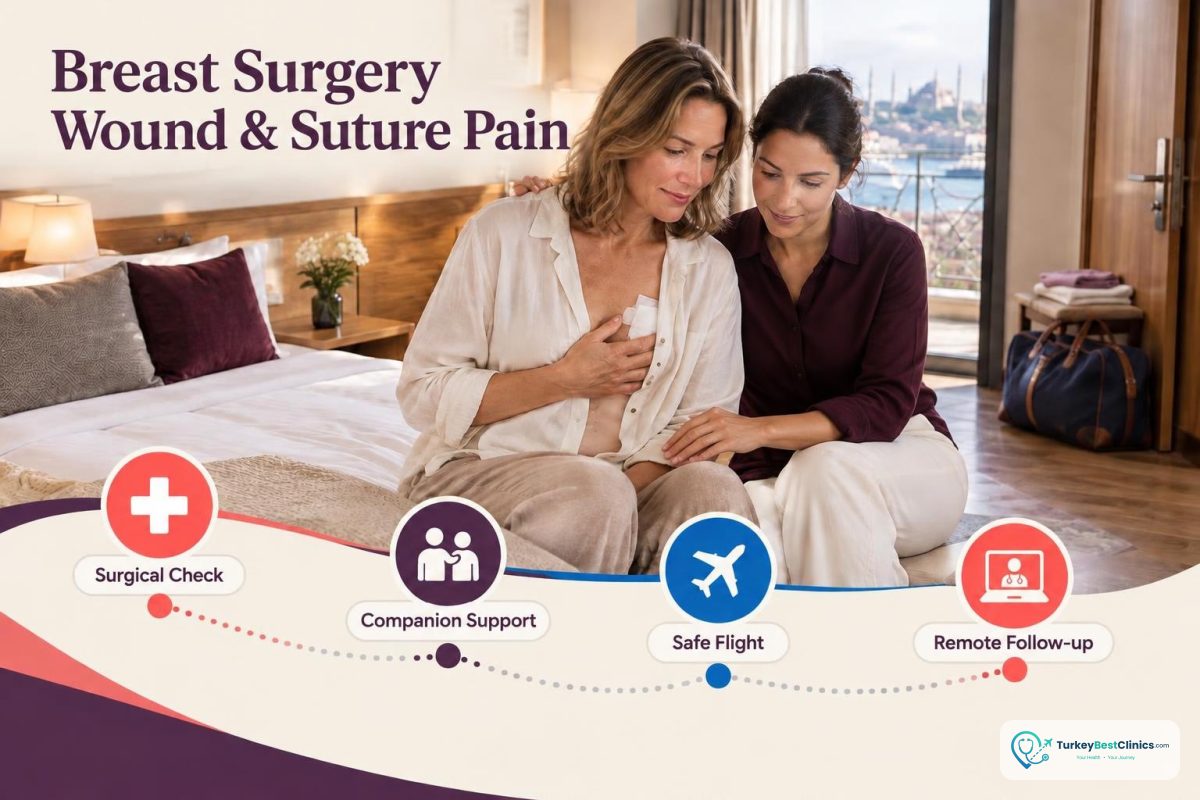
Daily Comfort and Safe Recovery After Breast Biopsy
Tenderness around the incision, a pulling sensation, mild swelling, and pain along the suture line may be expected during the early recovery period after breast lump removal or a surgical biopsy. Hotel accommodation and the return journey can be planned more safely by assessing the course of the pain, the appearance of the wound, and your overall condition together.
The aim during this period is not only to reduce pain, but also to protect the wound from impact, follow dressing instructions correctly, monitor the pathology result, and ensure rapid access to care if problems arise during travel. Your surgeon’s personalized recommendations should always take priority over general information.
Hospital Safety and Follow-Up Protocol for Breast Surgery
Planning the procedure at a fully equipped hospital and a healthcare facility holding a Ministry of Health-approved Health Tourism Authorization Certificate can help ensure that the preoperative assessment and postoperative observation process are carried out systematically. Sterilization protocols, operating-room air and surface checks, the management of single-use materials, and emergency response capabilities should be verified in advance.
Turkish surgeons working in breast surgery can assess the indications for different methods, including ultrasound-guided core needle biopsy, wire- or imaging-guided lump removal, vacuum-assisted biopsy, and open excision. Surgical experience should be evaluated specifically in relation to the lump’s location and size, imaging findings, any previous biopsy results, and the need for pathological assessment.
Areas Assessed Before Surgery
- Breast ultrasonography and, where appropriate for the patient’s age or risk group, mammography or breast MRI
- Review of previous imaging reports, biopsy results, and pathology slides if available
- Blood count, coagulation assessment, and additional tests according to the scope of surgery
- Informing the surgical team about previous operations, known allergies, bleeding tendencies, and products or medications being used
- Explanation before the procedure of the incision site, suture type, and when the pathology report will be shared
Wound-site assessment and discharge education should be completed before leaving the hospital. You should receive written information confirming whether the sutures are dissolvable or need to be removed, when the dressing should be changed, and when showering is permitted.
Breast Lump Removal Package and Accommodation Planning in Turkey
The planned health tourism service may include VIP airport-hospital-hotel transfers, accommodation at the selected hotel, medical interpreter support, and essential guidance during the initial care period. The scope should be clearly checked in the written quotation and the contract with the healthcare facility. Before breast surgery, imaging and blood tests should generally be completed; after the procedure, most plans require staying in Turkey for at least one wound check. The exact duration depends on the type of biopsy and your surgeon’s approval for air travel.
Confirm in advance whether your companion can stay with you at the hospital, what companion arrangements are available in the room, and how long it takes to reach the hospital from the hotel. While you rest, your companion may prefer a quiet walk in a park suitable for your surgical restrictions, time in the hotel’s relaxation areas, or short cultural visits rather than using the hotel wellness facilities. Activities that may create an infection or overheating risk, such as swimming pools and saunas, should be avoided.
Protecting the Wound Site in the Hotel Room
- Choose a room close to the hospital, with elevator access and a location that allows rapid transportation if needed.
- Keep the wound line away from hotel pools, saunas, Turkish baths, the sea, and shared hot-tub water until your surgeon gives permission.
- Wear supportive garments approved by your surgeon that do not rub against the incision or compress the chest area.
- If you are changing the adhesive dressing or wound dressing yourself, follow the cleaning and covering sequence provided by the healthcare facility.
- Taking a daily photograph of the wound site in the same lighting may make it easier to communicate changes to the healthcare team during online follow-up.
Comparison of Approaches for Recovery and Travel
| Methods Being Compared for You | Most Important Potential Benefit for You | Your Recovery and Hospital Stay |
|---|---|---|
| Ultrasound-guided core needle or vacuum-assisted biopsy | A smaller entry site and, in many cases, more limited tissue trauma | Same-day observation may be possible; the travel decision is made after bleeding control and a medical examination. |
| Open surgical lump removal | May allow removal of the entire lump and pathological assessment of the surgical margins | The observation period may be longer; additional checks may be needed for the incision, sutures, and flight timing. |
These two options are not automatic alternatives to one another. Imaging findings, previous sampling results, the depth of the lump, and the surgeon’s clinical assessment determine which approach is appropriate.
Cost Comparison After Breast Biopsy in Turkey
For breast lump removal or surgical biopsy in Turkey, the total cost may typically range from approximately €1,500 to €3,500 in international planning. This estimate varies depending on whether the surgeon’s consultation, imaging, anesthesia, operating room, pathology, hospital observation, and certain accommodation services are included.
| Country | Approximate Procedure Cost | Currency | Scope to Confirm |
|---|---|---|---|
| Turkey | 1,500–3,500 | € | Whether pathology, anesthesia, hospital observation, and wound checks are included |
| United Kingdom | 4,000–8,000 | £ | Whether private hospital, surgeon, and pathology fees are itemized separately in writing |
| Germany | 3,000–6,000 | € | Whether imaging, surgery, and follow-up appointments are included in the package |
| United States | 6,000–12,000 | $ | Whether anesthesia, facility, surgeon, and laboratory bills are separate |
The figures in the table are not fixed quotations and are approximate international ranges that may vary from clinic to clinic in 2026. The written quotation should separately specify the language of the pathology report, additional imaging, the possibility of revision, transfers, hotel nights, companion services, and the facility to contact in the event of complications.
Factors Affecting Wound Pain, Suture Follow-Up, and Travel Timing
Key Variables Determining Cost and the Surgical Process
- The surgeon’s expertise and experience: Experience in breast surgery, general surgery, or oncoplastic surgery may affect steps such as imaging-guided localization, cosmetic incision planning, and coordination with pathology.
- Method and technical infrastructure: Ultrasound-guided core needle biopsy, vacuum-assisted biopsy, wire-localized excision, and open surgery differ in operating time, wound size, and follow-up requirements.
- Clinic location: In major centers such as Istanbul, Ankara, or Izmir, hospital accessibility, hotel standards, transfer distance, and international patient coordination may affect the overall plan.
Daily Management of Wound and Suture Pain
Scoring your pain from 0 to 10 and recording it in the morning and evening can make it easier to distinguish expected healing from a worsening condition. Follow your surgeon’s recommended pain-control plan according to the instructions on your prescription or discharge document; do not decide on your own to change the dose, use additional products, or consume them with alcohol.
During the initial period, a cold application wrapped in fabric may be used for short intervals; ice should not come into direct contact with the skin or suture line. Keep arm and torso movements within a range that does not significantly increase pain, and avoid heavy lifting and strenuous exercise until your surgeon permits them.
The flight date is not determined solely by the number of days since the procedure. The absence of active bleeding at the wound site, no dizziness, controlled pain, the ability to manage the dressing safely, and the surgeon’s travel clearance are key criteria.
Protective Steps Before and During the Flight
- Before the flight, request a written plan for wound assessment, the pathology process, and the healthcare facility to contact in an emergency.
- Keep reports, discharge documents, clean dressing supplies, and the healthcare team’s contact details in your carry-on luggage.
- Position the seat belt so that it does not apply direct pressure to the incision line; ask the cabin crew for assistance with any necessary adjustment.
- On a long journey, an aisle seat, short walks at safe intervals, and adequate fluid intake may be appropriate; consult your surgeon if your movement is restricted.
- If the dressing becomes wet or you notice sudden swelling or bleeding, seek care at the nearest healthcare facility rather than continuing the journey.
Seeking Prompt Care for Unexpected Signs
Do not wait at the hotel if you develop increasing pain that does not improve with rest, rapidly enlarging breast swelling, spreading redness or increased warmth around the wound, foul-smelling discharge, ongoing bleeding, fever, a feeling of faintness, or shortness of breath. Contact Turkey’s 112 Emergency Call Center or the emergency department of the hospital monitoring you; after returning home, use your local emergency medical services for similar symptoms.
After returning abroad, the wound photograph, pain score, temperature reading, dressing status, and pathology result may be assessed together during online follow-up. Online review does not replace a physical examination when bleeding, infection, or a hematoma is suspected.
Next Steps and Frequently Asked Questions After Breast Surgery
- What wound check and medical documents are required for flying? The suture type, bleeding control, pain level, and the surgeon’s flight clearance determine which documents should be prepared; the delivery and translation process for the pathology report should also be clarified in advance.
- How can a hematoma be distinguished from normal postoperative swelling? Rapidly increasing swelling, one-sided tightness, bruising, and a marked increase in pain indicate when an urgent examination may be needed; this distinction should not be confirmed remotely.
- How should suture removal or a wound check be planned after returning home? Depending on the suture type, an additional check in Turkey, a local surgical examination, or a safe online follow-up plan may be arranged; the dates and responsibilities should be obtained in writing before discharge.
Before the procedure, compiling the surgical method, pathology scope, planned stay in Turkey, flight clearance, and emergency contact plan in a single document can reduce uncertainty during the hotel stay and travel process. Without your medical history, current reports, and an examination by your surgeon, no definitive recovery time or pain level can be guaranteed.