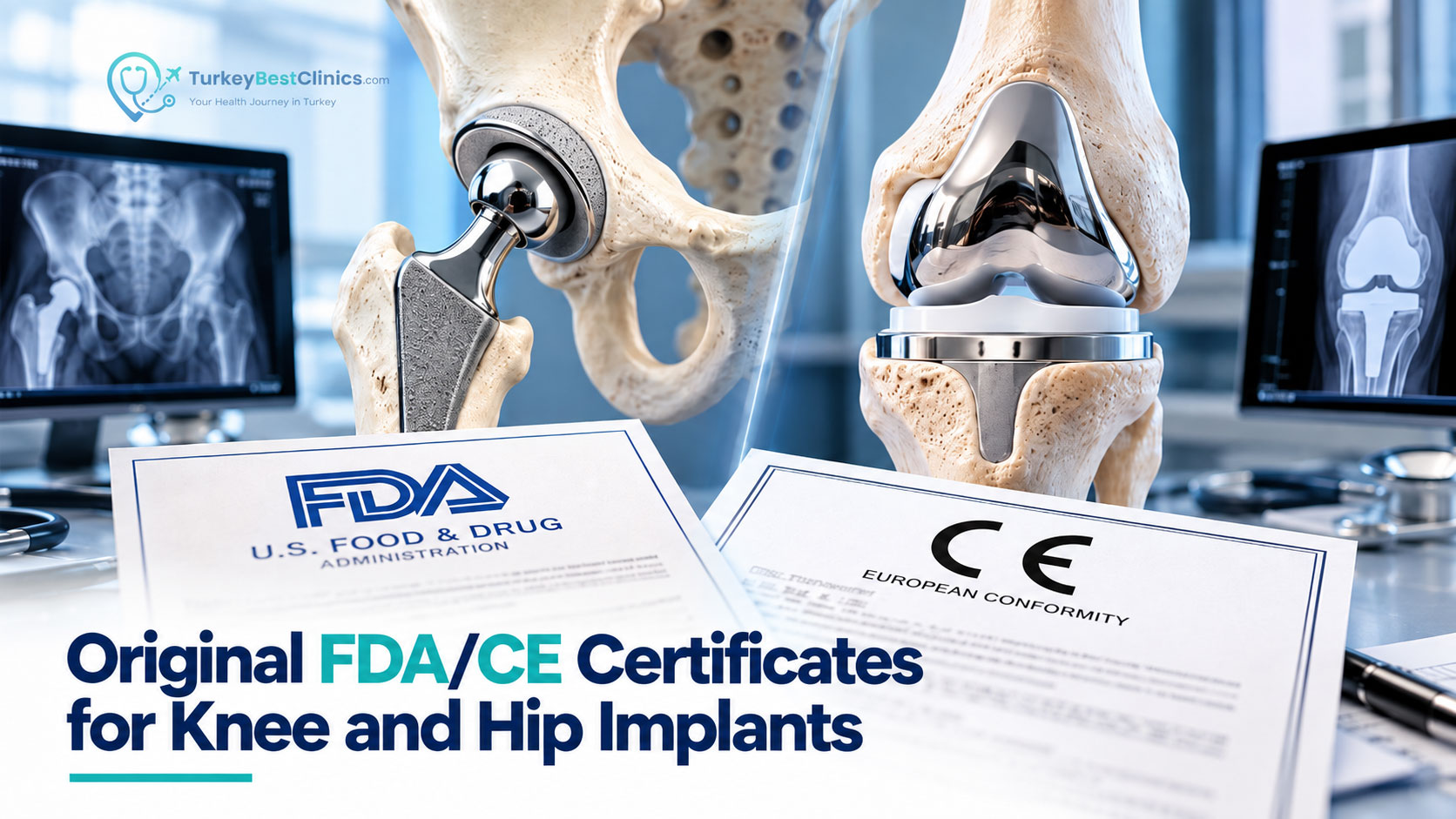
What does document delivery mean for knee and hip replacements?
When planning knee or hip replacement surgery in Turkey, it is reasonable to request written information about the brand, model, manufacturer and traceability records of the implant being used. For products from manufacturers such as Zimmer Biomet, Stryker or Smith & Nephew, you will generally receive an implant card, product labels, lot or serial number, model information and implant records added to your discharge file after surgery.
By contrast, the product’s complete technical file, the manufacturer’s original FDA document or the original CE conformity assessment is not always documentation that is handed directly to the patient. These documents are generally retained among the manufacturer, authorized distributor, hospital and relevant regulatory records. However, copies of relevant documents, declarations or verifiable records demonstrating the product’s conformity may be shared upon request.
For this reason, rather than asking only whether an original certificate is provided, it is more appropriate to clarify the exact model of the product to be used during surgery and the traceability documents that will be delivered to you.
FDA, CE and ÜTS records: Differences for knee and hip implants
What does FDA approval indicate?
The FDA is the United States regulator for medicines and medical devices. FDA registration or approval of a knee or hip implant indicates that the product has been evaluated in terms of specific conditions of use and device classification in the US market; it does not, by itself, constitute sufficient documentation for surgery in Turkey.
FDA documents may relate to a product family, specific model combinations or the manufacturer’s application file. Therefore, the fact that a brand is listed with the FDA does not mean that every component used during surgery falls within the same scope. Verification should be carried out using the model or catalogue number.
CE marking and European conformity
The CE mark indicates that a product meets the relevant conformity requirements under European Union medical device legislation. For knee and hip replacements, CE conformity is associated with the manufacturer’s technical documentation, clinical evaluation and, where required, assessment by a notified body, depending on the device’s risk classification.
The CE mark is not a quality award or a guarantee of a successful outcome for a particular individual. Details such as the document’s validity date, scope, manufacturer name, device family and the organization that conducted the conformity assessment should be checked.
ÜTS and implant traceability in Turkey
Product Tracking System (ÜTS) records are important for the traceability of medical devices used in Turkey. Importer, distributor, hospital and product information can be tracked through the relevant system. However, ÜTS registration does not automatically mean that the manufacturer’s complete technical file will be provided to you.
Your surgical file should include the implant’s brand, model, catalogue number, lot or serial number and, where possible, barcode information. These records may be used later for checks, revision surgery, warranty assessments or consultations with an orthopedic specialist in another country.
How should the replacement documentation and support package be planned?
As part of a medical tourism arrangement, VIP transfers, hotel accommodation, interpreter support and guidance regarding initial care or prescription procedures may be planned. Options for your companion to stay with you in the hospital, selecting a hotel near the hospital and arranging quiet park walks or wellness areas suitable for your post-operative activity restrictions should also be evaluated separately.
The length of stay in Turkey for knee or hip replacement surgery is generally planned at approximately 7 to 14 days, depending on the clinical assessment and mobility; the surgeon determines the exact duration. Before surgery, blood tests, an electrocardiogram, a lung assessment, additional imaging when necessary, knee or hip X-rays and an anesthesia evaluation may be performed.
Essential records that should be provided to you
- An implant card or patient identification document for the implant.
- The manufacturer, brand, product family, model and catalogue number.
- The lot number, serial number, barcode or unique device identifier.
- The operative report and implant labels showing the components used.
- The discharge summary, radiology images and follow-up recommendations.
- Where available, the manufacturer’s declaration of conformity, CE information or a distributor verification letter.
An online follow-up plan may be created after you return to your country. This follow-up may assess wound appearance, range of motion, walking support, follow-up X-rays and possible warning signs; however, an online consultation does not replace a physical examination.
Prosthesis costs and document scope in Turkey
The total cost of a knee or hip replacement varies according to the scope of surgery, whether the procedure is unilateral or bilateral, the hospital stay, implant components and the surgeon’s plan. The figures below are only approximate ranges that may be seen in the international medical tourism market. Before receiving a quote, compare in writing which implant brand, number of hospital nights and follow-up checks are included.
| Country | Approximate range for a single knee or hip replacement | Point to consider regarding documentation and implant records |
|---|---|---|
| Turkey | €8,000–€15,000 | Implant card, model and lot/serial information, plus hospital records |
| United Kingdom | £14,000–£25,000 | NHS or private provider record policies and manufacturer traceability |
| Germany | €15,000–€25,000 | Implant identification document, operative report and product records |
| United States | $30,000–$60,000 | FDA scope, model verification and insurance/provider documentation |
If the phrase FDA/CE certificate appears in the price, ask which document or copy it refers to. Since the product label and implant card identify the components actually used in your surgery, they are often more useful records than a general certificate.
Key criteria affecting documentation and the surgical process
- Orthopedic surgeon’s expertise: Primary knee replacement, total hip replacement and revision surgery require different technical decisions. The surgeon’s experience with the implant system being used, as well as assessment of factors such as bone quality and ligament balance, is important.
- Implant technology and material type: In knee replacement, fixed-bearing or mobile-bearing platforms and posterior-stabilized or cruciate-retaining designs may be considered. In hip replacement, ceramic-polyethylene, metal-polyethylene or ceramic-ceramic bearing options may be relevant. The choice is determined not by the brand name alone, but by factors such as bone structure, age, activity level and surgical findings.
- Clinic and hospital location: Choosing a hospital in Istanbul, Ankara, Izmir or another city may affect access to the operating room, intensive care facilities, physical therapy services and the airport. Location can also affect transfer and accommodation costs, as well as the planning of follow-up visits.
- Document verification process: The phrase original implant alone in a quotation is not sufficient. The product catalogue number, manufacturer name, CE scope, authorized supply channel in Turkey and the implant labels to be provided after surgery should be clearly stated in writing.
Check whether the hospital has a Ministry of Health-approved Health Tourism Authorization Certificate and confirm that the surgery will take place in a fully equipped hospital setting. Sterilization procedures, operating room infrastructure, anesthesia assessment, blood management and infection control protocols are as important as the documentation itself in major joint surgery such as knee and hip replacement.
Further questions about document delivery
- Which implant model will be used before surgery, and will the catalogue number of the Zimmer Biomet, Stryker or Smith & Nephew product be stated in the written quotation? You may ask how the model selection is made according to your knee or hip anatomy and surgical plan.
- Will the implant card, barcoded product labels, lot/serial number and operative report be provided together in the same file after surgery? Clarify in advance whether these records can be prepared in English or in your country’s official language.
- Which verifiable copy will be shared for the CE conformity document, manufacturer’s declaration of conformity or FDA scope? Check whether the document covers the product family or the specific model and components used during your surgery.
The safest approach is to request a written list of the records to be provided after surgery, in addition to the brand and model. Instead of relying on a general promise of a certificate, request the implant card, product label, lot or serial number and operative report that definitively identify the implant belonging to you, and confirm any uncertainties about the document scope directly with the hospital and authorized distributor.