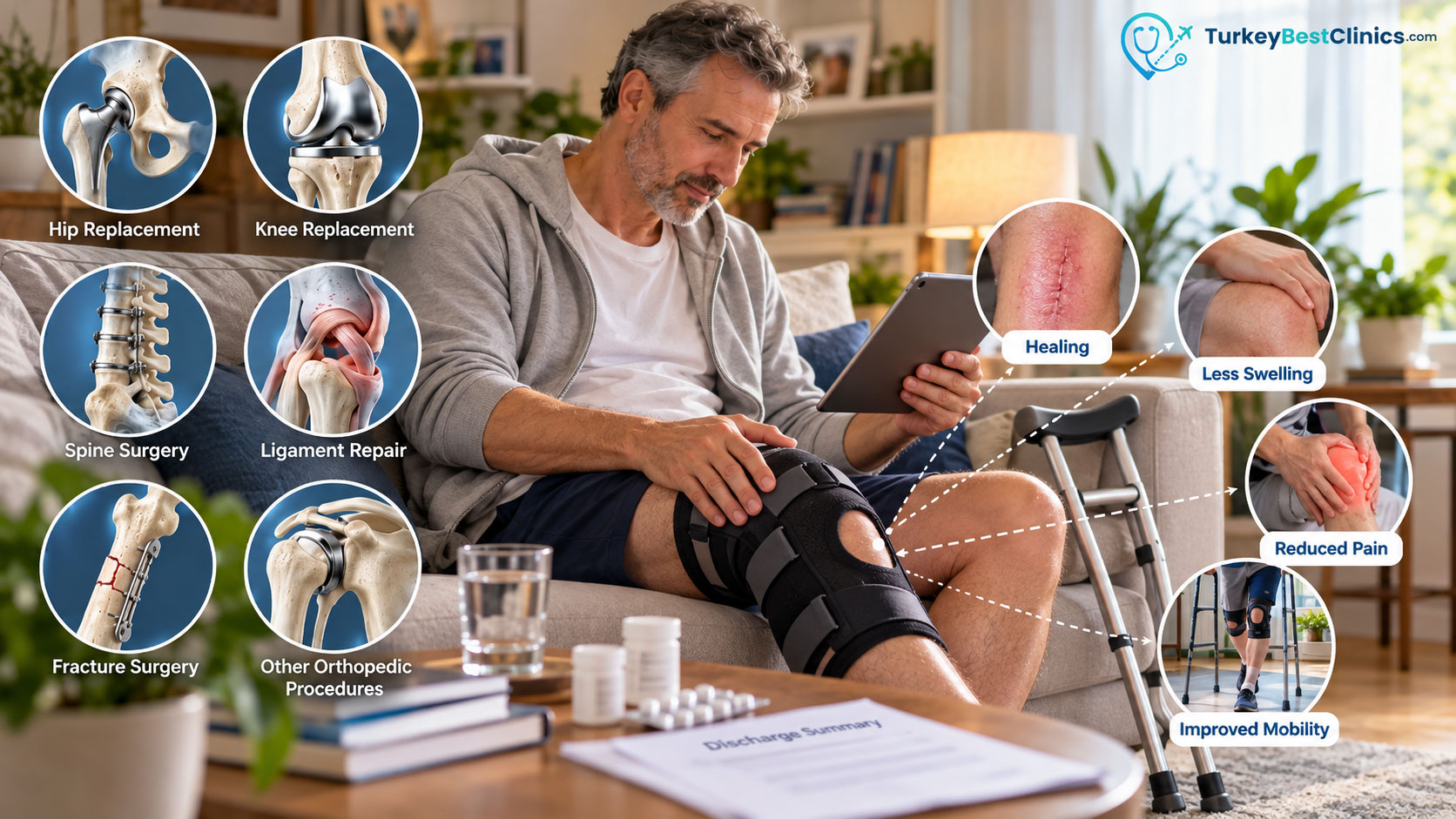
Safe Follow-Up in Your Home Country After Orthopedic Surgery
Being discharged after hip or knee replacement, spinal surgery, ligament repair, fracture surgery, or another orthopedic procedure does not mean that the recovery process is complete. Symptoms such as redness at the surgical site, fever, increasing pain, drainage, leg swelling, or restricted movement may still require assessment after you return home.
In a reliable medical tourism plan, the number for the 24/7 line connecting you with the surgical team in Turkey, the calling method, response time, referral procedure for a local healthcare facility, and channel for sharing medical records should be explained in writing before surgery. This line does not replace emergency services in your country; if you have serious symptoms, you should first contact your local emergency department.
The purpose of the communication plan is not to provide a definitive diagnosis remotely, but to quickly assess the level of risk, help you reach the appropriate healthcare facility, and ensure that the surgical team shares the necessary medical information in a timely manner.
Ministry of Health Authorization and Hospital Safety in Orthopedic Surgery
Verifying the certificate and surgical setting
When planning surgery in Turkey as part of medical tourism, check whether the healthcare facility holds the Health Tourism Authorization Certificate issued by the Ministry of Health of the Republic of Turkey. It is important that the procedure be planned in a fully equipped hospital with operating-room sterilization processes, intensive care support, a microbiology laboratory, and 24-hour imaging services.
Safety assessment in orthopedic surgery is not limited to the surgeon’s professional title. In knee or hip replacement surgery, implant records should be maintained, the serial details of the prosthesis used should be provided to you, an operative note should be prepared, antibiotic prophylaxis should be planned according to the clinical protocol, and post-discharge wound checks should be documented.
The Turkish orthopedic team’s relevant experience
When assessing a surgeon, the type of procedure planned is as important as the number of surgeries performed annually. For revision knee replacement, management of an infected prosthesis, spinal instrumentation, or complex fracture surgery, you can directly ask about the number of cases involving the relevant procedure and the complication-management protocol.
Accreditation or a general statement of experience alone does not provide sufficient assurance. The written documents should clearly state the surgical approach to be used, the implant brand and model, the postoperative physical therapy plan, the sampling method if an infection is suspected, and the process for sharing information with healthcare teams outside Turkey.
Emergency Communication and Companion Planning in an Orthopedic Surgery Package
The coordination plan may briefly cover airport or hotel transfers, suitable accommodation, interpreter support when needed, and initial care supplies. For orthopedic procedures, tests specific to your treatment, such as preoperative blood tests, electrocardiography, lung assessment, X-rays, or computed tomography, are also planned; the length of stay generally ranges from several days to several weeks depending on the type of surgery and your mobility.
Find out in advance whether your companion can stay with you at the hospital and what companion seating or accommodation arrangements are available; a hotel close to the hospital can reduce unnecessary transfers while your mobility is limited. As permitted by the surgical team, your companion may use quiet parks near the hospital, hotel wellness areas, or peaceful places to rest; however, wound care, weight-bearing, and movement restrictions must always follow the surgical team’s instructions.
Documents to receive before returning home
- Operative report, discharge summary, and the name, model, or serial details of the implant used.
- Laboratory, X-ray, magnetic resonance imaging, or computed tomography results.
- A written plan explaining wound care, weight-bearing, physical therapy, and the follow-up schedule.
- Telephone and email details for the surgeon in Turkey, the hospital, and the 24/7 coordination unit.
- A brief medical summary prepared for sharing with a local emergency department.
How Does the 24/7 Emergency Communication Line Work?
Initial call and risk classification
When you call the communication line, the team will first ask about your country and city, when the symptoms began, your temperature reading, pain level, wound appearance, any assistive device you are using, your mobility, and symptoms such as shortness of breath. Through a video call or secure file sharing, you may be asked to provide a wound photograph, temperature record, or local medical report; photo assessment does not replace an in-person examination.
Following triage, three main pathways are possible: immediate local emergency care, a same-day local orthopedic assessment, or planned online follow-up. The appropriate pathway depends on the severity of your symptoms and your general condition; the telephone team should not make a definitive diagnosis of infection remotely.
Emergency symptoms that should not be ignored
- Fever of 38°C or higher, chills, marked weakness, or rapid deterioration.
- Pus-filled or foul-smelling drainage from the surgical wound, separation of the wound edges, or rapidly spreading redness.
- Sudden swelling in one leg, calf pain, chest pain, shortness of breath, or fainting.
- New weakness, numbness, or changes in bladder or bowel control.
- Sudden severe pain, deformity, or inability to bear weight around a prosthesis or fixation material.
If you have any of these symptoms, call 112 or your local emergency number in the country where you are located. For your safety, waiting for a response from the team in Turkey must not delay calling an ambulance or going to an emergency department.
Sharing information with the surgical team in Turkey
When you visit a local healthcare facility, show your operative report and implant information. With your permission and in accordance with applicable data protection rules, the coordination unit may arrange information sharing between the local physician and the surgeon in Turkey by telephone, secure email, or a health records platform.
If an infection is suspected, the local physician may assess blood tests, wound cultures, imaging, and, when necessary, joint fluid analysis. Starting, changing, or stopping antibiotics or another treatment should be decided only by the qualified physician examining you; remote prescription instructions are not a safe approach.
Response and Further Treatment Protocol for Unexpected Symptoms
The response plan should distinguish between cases that can be managed locally and those in which returning to Turkey should be considered. Mild, stable symptoms may be managed with a local check-up, dressing change, or adjustment to physical therapy; suspected surgical infection, prosthesis loosening, a serious wound problem, or unexplained neurological symptoms require an in-person assessment by an orthopedic specialist.
If returning to Turkey becomes an option, the coordination team will plan for fitness to fly, mobility restrictions, wheelchair needs, medical escort, hotel or hospital admission, and the required documents. The decision to fly should be made by the physician assessing you, particularly if there is a risk of blood clots, fever, a need for oxygen, or a possible need for further surgery.
If reassessment by the surgical team is required, a hospital admission, imaging, sampling, wound surgery, or an implant-related procedure may be planned. The outcome cannot be guaranteed in advance; medical decisions may change according to the examination, test results, and your general health.
Scope of the online follow-up process
After returning home, online follow-up may periodically review the appearance of the wound, temperature, pain, range of motion, weight-bearing status, and adherence to physical therapy. The frequency of follow-up is determined by the type of surgery; recovery of movement after knee replacement, neurological findings after spinal surgery, and radiological healing after fracture surgery are monitored using different criteria.
The date of each consultation, documents shared, guidance provided, and date of the next follow-up should be recorded. Having a 24/7 line does not mean that every call will be answered by the same specialist or that direct intervention will be available in every country; the scope of the service, response target, and out-of-hours procedure should be clearly stated in the contract.
Cost of Orthopedic Surgery in Turkey and Emergency Support Coverage
The price of orthopedic surgery varies according to the type of procedure, implant, hospital stay, possible need for intensive care, physical therapy, and additional tests. The figures below are not fixed quotations and are only approximate ranges for international market comparison; check in writing whether 24/7 communication, local treatment, readmission, and flight-change fees are included in the package.
- Turkey: Approximately €6,000–€15,000 for planned procedures such as knee or hip replacement; complex revisions, spinal procedures, or multi-stage surgeries may cost more.
- United Kingdom: Approximately £12,000–£25,000 or more for similar private-sector procedures.
- Germany: Approximately €12,000–€25,000 depending on the scope of the procedure.
- United States: Approximately $25,000–$70,000 or more depending on the hospital and insurance structure.
When requesting a quotation, ask for the surgery fee, implant, anesthesia, tests, hospital stay, physical therapy, interpreter, transfers, emergency communication line, and the financial procedure to be followed in the event of complications as separate line items.
Three Questions to Answer Before Proceeding
- Who answers the 24/7 line if an infection is suspected after surgery? Ask in writing about the sequence for reaching a nurse, coordinator, and orthopedic surgeon, as well as the target response time.
- How will the emergency department in my country communicate with the surgeon in Turkey? Clarify in advance the format in which medical records will be shared, interpreter support, and consent for data protection.
- What is the medical and financial plan if a prosthesis infection or wound opening develops? Check the contract for coverage of local treatment, returning to Turkey, hospital admission, flight changes, and companion expenses.
Do not finalize your travel plans until you have received clear, written answers to these three questions. Safe medical tourism covers not only the day of surgery, but also early warning signs, communication, local referral, and reassessment when necessary after you return home.