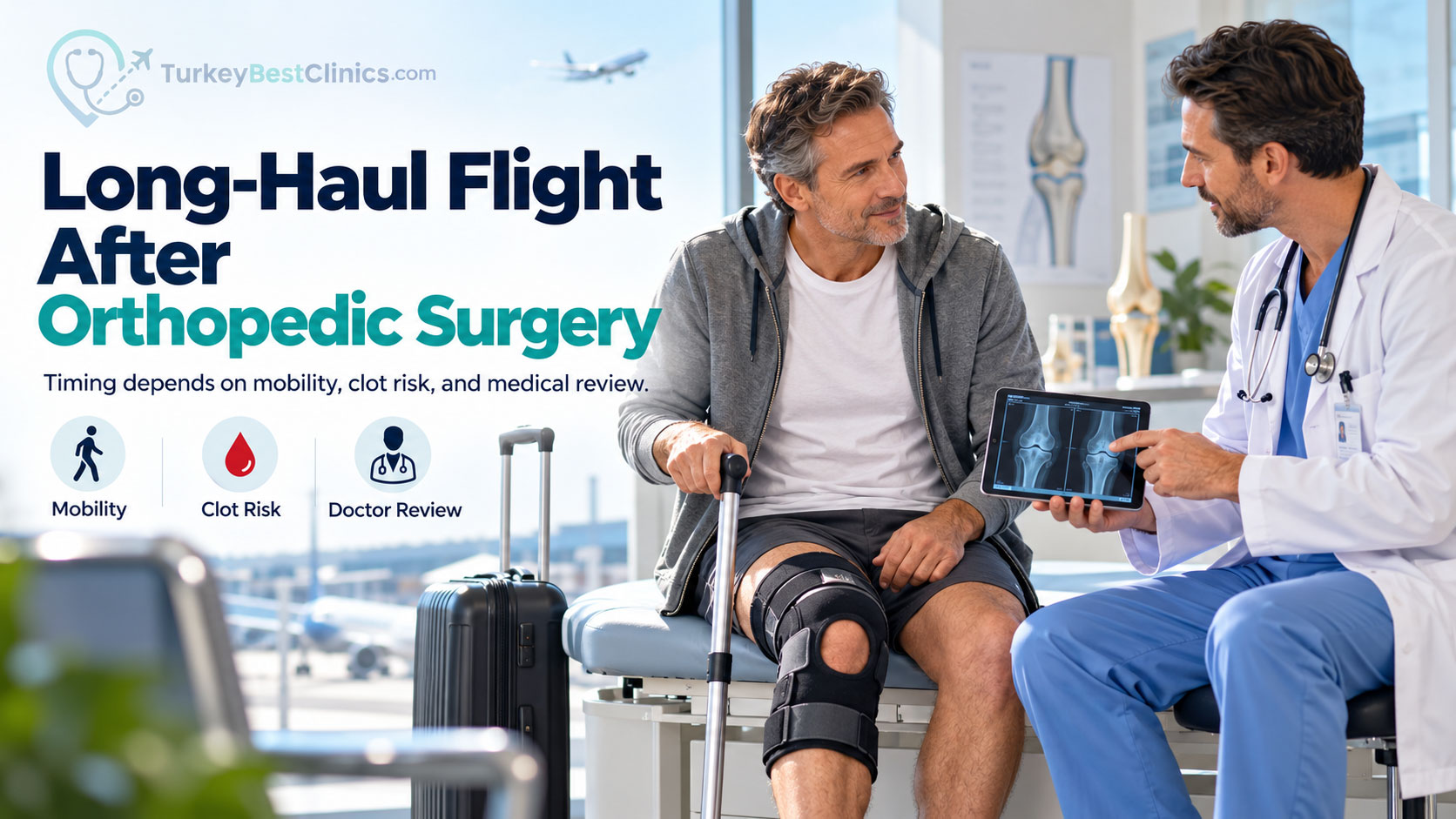
How Is the Flight Date Determined After Orthopedic Surgery?
If you are planning a flight from Turkey to your home country that will involve prolonged immobility, the postoperative schedule is not determined solely by how the wound looks. The risk of deep vein thrombosis (DVT), or blood clot formation in the deep veins of the leg, is assessed together with the extent of the surgery, how comfortably you can move your leg, your walking distance, and your individual risk factors.
There is no universal rule stating exactly when you can fly after a specific operation. After uncomplicated arthroscopic procedures, an assessment may be possible within approximately 7–14 days. However, after major joint surgery such as hip or knee replacement, many surgeons prefer waiting approximately 4–6 weeks before long-distance travel. Following fracture fixation, extensive ligament reconstruction, ongoing swelling, or limited mobility, the waiting period may extend to 6–12 weeks.
Flight clearance is based on your surgeon’s examination and follow-up findings. Before leaving Turkey, you should also check whether the airline requires its own medical form or a fit-to-fly certificate.
DVT Safety Assessment After Hip, Knee, and Fracture Surgery
At facilities holding a Ministry of Health–approved Health Tourism Authorization Certificate, postoperative assessment may be planned through a review by the surgical team, nursing observation, and, when necessary, consultation with a vascular disease or anesthesia specialist. In a fully equipped hospital environment, sterilization procedures, operating-room safety, clinical assessment of clot risk, and emergency response infrastructure are all parts of the same care pathway.
Turkish orthopedic teams structure mobility monitoring according to the type of surgery after knee and hip replacement, arthroscopic ligament surgery, trauma surgery, and fracture fixation. For example, stair climbing after knee replacement, walking with an assistive device, the progression of leg swelling, and wound checks are assessed differently from follow-up after arthroscopic meniscus surgery.
Key Findings Reviewed Before a Flight Decision
- The condition of the surgical incisions, including drainage, redness, or signs of wound opening.
- Increasing one-sided leg swelling, calf tenderness, changes in color, or a difference in temperature.
- Your ability to walk safely with or without an assistive device.
- Symptoms that may require urgent assessment, such as fever, shortness of breath, chest pain, or a feeling of faintness.
- The flight duration, number of connections, and the length of any necessary ground travel after reaching your destination.
- Additional risks such as a previous blood clot, a known tendency to clot, advanced age, obesity, active cancer, smoking, or limited mobility.
If you develop new shortness of breath, chest pain, or sudden one-sided leg swelling, your flight plans should be put on hold and you should seek urgent medical assessment. It is not safe to decide whether to fly based on these symptoms yourself.
Orthopedic Flight Preparation Package and Companion Planning
Depending on the planned services, VIP airport transfer, transportation to the hospital or hotel, interpreter support, coordination of initial care, and essential logistical arrangements may be supported as part of a single process. Before a long-distance flight, the final surgical check, wound assessment, evaluation of walking capacity, and preparation of a fit-to-fly letter are generally scheduled. The length of stay is determined according to the type of surgery and follow-up findings.
Planning may include allowing your companion to stay with you at the hospital, choosing a hotel close to the hospital, and selecting a quiet environment suited to your mobility restrictions. While you rest, your companion may use wellness areas that do not require extensive walking, hotel relaxation areas, or quiet parks near the hospital to help reduce the stress of the process; however, they should remain available during discharge and follow-up appointments.
Process Followed Before Leaving Turkey
- The type of surgery, surgery date, and flight route are recorded.
- The wound, swelling, pain control, and mobility are assessed.
- Blood tests or vascular imaging are arranged if considered necessary.
- You are instructed on how to position your leg during the flight, how often to move in the cabin, and how to use any assistive device.
- The documents required for a medical report or special assistance request to the airline are prepared.
- After you return home, online follow-up appointments and warning signs are provided in writing.
Online follow-up helps the surgical team assess postoperative swelling, wound appearance, walking progress, and any new symptoms that develop after the flight. It does not replace an in-person medical examination in your country; referral to a local healthcare provider is arranged when necessary.
Approximate Waiting Times and Costs for Long-Distance Flights
The periods below are general planning ranges only; flight clearance cannot be finalized without an individual examination. Especially for flights longer than 4 hours, time spent immobile in the cabin, connections, and waiting at the airport should be calculated together.
| Orthopedic procedure or condition | General assessment range | Key condition for the flight decision |
|---|---|---|
| Simple arthroscopic procedure | Approximately 7–14 days or longer | Good wound appearance, safe walking, and low risk of complications |
| Ligament reconstruction or extensive knee surgery | Approximately 2–6 weeks | Controlled swelling, adequate knee movement, and surgeon approval |
| Knee or hip replacement | Usually 4–6 weeks; longer in some cases | Safe mobilization, wound assessment, and individual DVT risk evaluation |
| Fracture fixation or trauma surgery | Approximately 6–12 weeks or longer depending on the individual | Cast, brace, weight-bearing restrictions, and clot risk are assessed together |
The average cost of a flight fitness assessment in Turkey may be approximately €50–€150, depending on the facility’s scope of services and the tests required. This figure may not include the surgery fee, vascular imaging, hospital admission, or special airline services.
| Country | Approximate range for a flight fitness examination | Notes |
|---|---|---|
| Turkey | €50–€150 | Examination and basic report assessment |
| United Kingdom | GBP 100–250 | Private clinic and additional document fees may vary |
| Germany | €100–€250 | May increase depending on specialist assessment and imaging needs |
| United States | USD 150–400 | Insurance coverage and the clinic’s fee policy are determining factors |
Factors Affecting Flight Clearance and DVT Risk
Physician expertise and surgical experience: Flight timing is not the same after knee replacement, hip replacement, arthroscopy, or fracture surgery. The surgeon’s knowledge of intraoperative findings, weight-bearing restrictions, and the course of recovery helps support a more accurate flight decision.
Technique used and materials involved: Techniques such as arthroscopic or open surgery, fracture fixation with plates and screws, intramedullary nailing, knee replacement, or hip replacement may result in different levels of mobility restriction and hospital stay. The type of implant alone does not determine flight clearance; permission to bear weight, wound condition, and overall circulation findings are more important factors.
Clinic location and flight route: A short direct flight from Istanbul does not create the same physical burden as a long, connecting route that also involves ground travel. Transfer time to the airport, the need for a wheelchair, access to the aisle in the cabin, and access to healthcare at the destination should also be included in the planning.
| Surgical approach compared | Key potential advantage | General recovery and hospital-stay considerations |
|---|---|---|
| Arthroscopic or minimally invasive approach | Smaller incisions and, for some procedures, the possibility of earlier movement | Same-day discharge or a short stay depending on the procedure; the decision about long-distance travel still depends on the surgeon’s assessment |
| Open joint or trauma surgery | Direct surgical access for extensive repair and complex fractures | Longer monitoring, more noticeable swelling, or greater weight-bearing restrictions; the flight date is often postponed further |
During the flight, measures such as choosing an aisle seat, performing regular and safe leg movements, drinking enough fluids, and avoiding unnecessarily prolonged immobility may be considered according to your individual plan. Only the physician examining you should decide whether compression products or anticoagulant treatment are needed; do not start any product or treatment on your own.
Next Steps Before the Flight and Frequently Asked Questions
- Is waiting 4–6 weeks after knee or hip replacement always sufficient? No. Wound healing, walking ability, leg swelling, additional risk factors, and the total flight duration are assessed together; a longer waiting period may be required in some cases.
- Can I take a long-distance flight 7 days after arthroscopic surgery? Early assessment may be possible after some low-risk, uncomplicated procedures. However, the date may be postponed if you have weight-bearing restrictions, need a knee brace, have ongoing swelling, or are taking a connecting route.
- Which documents and checks are needed for flight clearance? The surgical summary, latest follow-up findings, information about any assistive device, and the surgeon’s fit-to-fly letter are generally reviewed. You should confirm in advance whether the airline requires a MEDIF or similar special form.
The safest plan is not to finalize your plane ticket before the postoperative follow-up appointment and to arrange your return route according to your surgeon’s written assessment. If a new or rapidly worsening symptom develops on the day of travel, seek urgent medical assistance before continuing your journey.