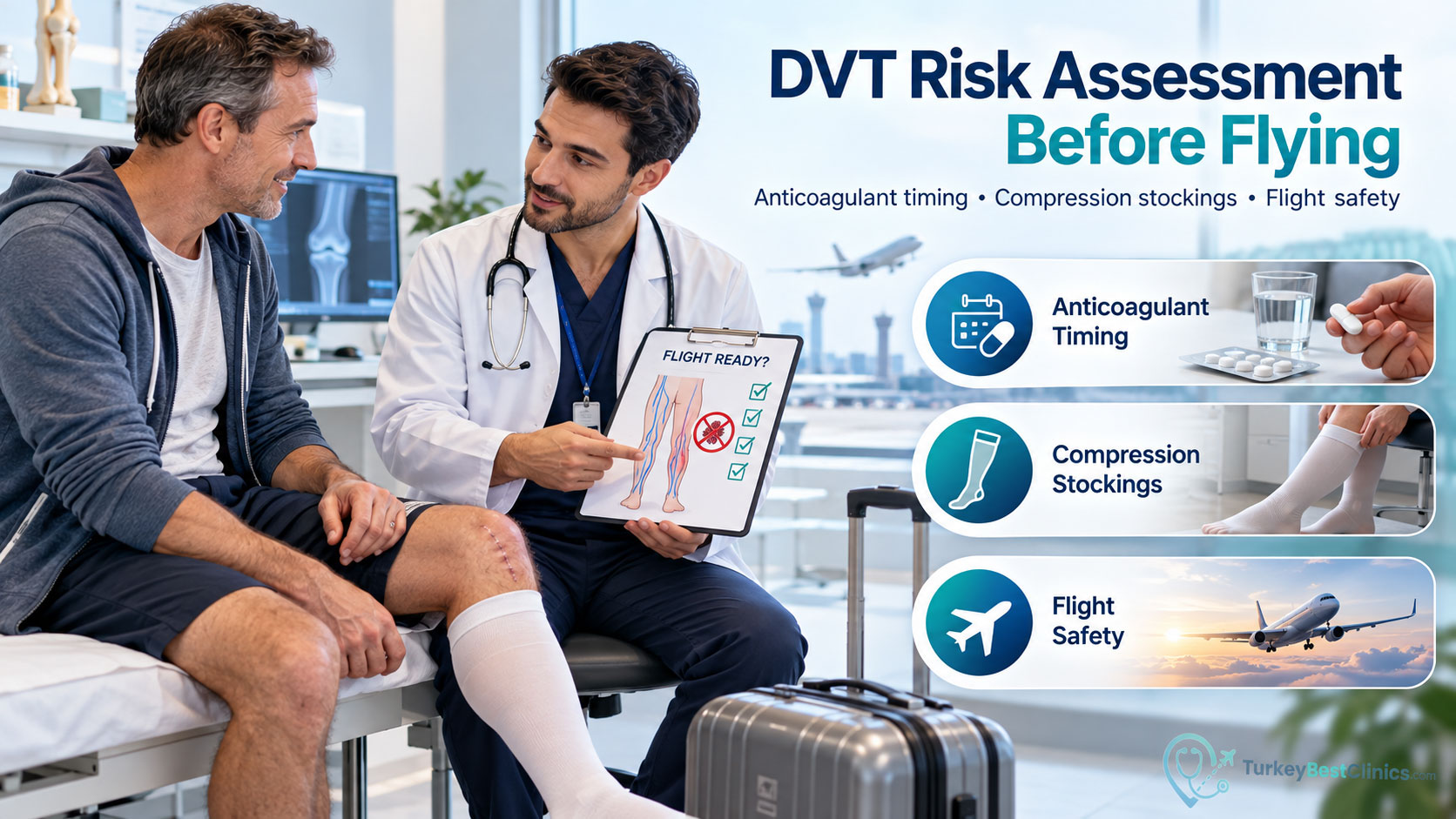
Flight and DVT Risk After Orthopedic Surgery
Remaining immobile for extended periods after orthopedic surgery may increase the risk of developing a clot in the leg veins, known as deep vein thrombosis (DVT). Returning to your home country from Turkey by air requires additional assessment, particularly after hip or knee replacement, knee ligament reconstruction, major bone surgery, and lengthy procedures.
The protocol to be followed before your flight is not a single standard prescription. The scope of surgery, bleeding risk, history of blood clots, level of mobility, flight duration, and current health status are assessed together. Starting, continuing, or changing anticoagulant treatment should only be done according to a written plan from the surgical team.
The Link Between DVT and Pulmonary Embolism
If a clot that forms in a leg vein breaks away and travels to the lungs, it can cause a pulmonary embolism, a serious circulatory condition. New one-sided leg swelling, significant calf pain, increased warmth in the leg, or changes in skin color, as well as sudden shortness of breath, chest pain, a feeling of faintness, or coughing up blood, require urgent medical evaluation.
Orthopedic DVT Safety and Hospital Standards in Turkey
It is important to plan your surgery at a facility that holds a Health Tourism Authorization Certificate regulated by the Ministry of Health of the Republic of Türkiye and provides the necessary hospital infrastructure. A fully equipped operating room, traceable sterilization procedures, a postoperative observation unit, and emergency response facilities are fundamental parts of a pre-flight safety plan.
Orthopedic teams in Turkey coordinate early mobilization and clot-prevention plans after hip and knee replacements, ligament surgery, trauma surgery, and arthroscopic procedures. A specific assessment considers the operative report, implant or surgical technique used, bleeding control, walking distance, and discharge examination; it should not rely solely on a clinic’s general claims of experience.
Checklist for Fitness to Fly
- Condition of the surgical wound and any signs of active bleeding or hematoma
- Ability to move safely, with or without a cane, walker, or other support
- Presence or absence of new swelling, pain, or circulation changes in the calf or thigh
- Blood count, kidney function, and any other laboratory results considered necessary
- Flight duration, number of connections, walking distances at the airport, and need for a wheelchair
- Discharge documents, medication plan, and a contact number to use in an emergency
Your Anticoagulant and Compression Stocking Plan
As part of a package, airport-hospital transfers, accommodation, interpreter support, and initial care or necessary consumables may be arranged. Depending on the type of orthopedic surgery, your stay in Turkey is planned until wound checks, suture or dressing assessment, walking tests, and a fitness-to-fly examination have been completed.
It is particularly important during the first few days that your companion can stay with you at the hospital, your accommodation is close to the hospital, and transportation after discharge is convenient. While you rest, your companion may plan a quiet walk in a park near the hotel, time in the hotel wellness area, or a short, non-strenuous activity. However, crowded places and lengthy city tours should be postponed according to your postoperative mobility restrictions.
Timing of Anticoagulant Treatment
After orthopedic surgery, anticoagulants or similar clot-preventing medications may be used. The choice of medication, dosing interval, timing of the first dose after surgery, and whether treatment should continue during the flight are determined according to bleeding control, kidney function, weight, age, coexisting conditions, and the nature of the surgery.
It is not safe to start an anticoagulant early, increase the dose, stop it before a flight, or change to another medication on your own. Your surgeon and the anesthesiologist or relevant medical specialist should assess bleeding and clotting risks together and prepare a written administration schedule.
Using Graduated Compression Stockings
Graduated compression stockings, commonly known as compression or varicose-vein stockings, can provide higher pressure around the ankle that gradually decreases up the leg. The correct size should be determined according to ankle and calf measurements and leg length. The stocking should be selected based on postoperative swelling and the circulation examination.
- The stocking should not have wrinkles or folds, and the toes should not be excessively compressed.
- If numbness, discoloration, coldness, increasing pain, or pressure marks on the skin develop after putting it on, inform your healthcare team.
- People with weak arterial circulation, significant skin problems, or loss of sensation require an examination before use.
- Your discharge plan should clearly state when to put on the stocking, whether to remove it at night, and how long to wear it during the flight.
Step-by-Step Pre-Flight Process
- The scope of surgery, history of blood clots, and flight plan are documented before surgery.
- At discharge, the wound, circulation, pain control, and ability to walk safely are assessed.
- If considered necessary, tests such as a blood count and kidney function are reviewed; ultrasound is requested only when there is clinical suspicion or specific risk-related findings.
- The anticoagulant and stocking plan is provided in writing, including the start time, duration of use, warning signs, and emergency contact details.
- Airport assistance, a wheelchair, or priority boarding is arranged for the day of the flight if needed.
- After you return to your country, online follow-up is used to assess the wound, mobility, and possible signs of a blood clot.
Comparison of Two Surgical Approaches in Terms of Mobility
| Methods Compared for You | Most Important Potential Advantage for You | Your Recovery and Hospital Stay |
|---|---|---|
| Arthroscopic or minimally incisional approach | Smaller skin incisions and, in suitable cases, the possibility of earlier controlled movement | Usually a shorter hospital observation period, depending on the procedure; the flight decision still depends on the surgeon’s examination |
| Open joint or major bone surgery | Direct surgical access and the opportunity for comprehensive repair in extensive structural problems | May require longer observation, walking training, and rehabilitation; additional assessment may be necessary before a long flight |
Cost Comparison for the DVT Protocol in Turkey
The figures below do not represent the cost of surgery. They are approximate ranges for services such as postoperative DVT risk assessment, fitness-to-fly examination, review of essential tests when required, compression stocking measurement, and a written follow-up plan. Anticoagulant medications, advanced imaging, emergency consultations, and long-term rehabilitation may be charged separately.
| Country | Approximate Service Range | Services That May Be Included |
|---|---|---|
| Turkey | €150–€450 | Examination, discharge assessment, flight plan, and stocking measurement |
| United Kingdom | £300–£900 | Orthopedic follow-up and fitness-to-fly assessment |
| Germany | €350–€1,000 | Follow-up examination, laboratory review, and preparation of medical documents |
| United States | $500–$1,500 | Postoperative risk assessment and specialist consultation |
The exact cost should be stated in a written quotation according to the type of surgery, number of tests required, need for an interpreter or transfer, follow-up duration, and the city where the clinic is located. If DVT is suspected, urgent medical evaluation takes priority over price comparison.
Factors That Change DVT Risk and Flight Planning
- Physician’s expertise and experience: For procedures such as hip or knee replacement, arthroscopy, or trauma surgery, it is important to have regular case management in the relevant surgical field and a postoperative mobilization protocol.
- Surgical technique and materials used: Arthroscopic ligament repair, joint replacement, intramedullary nails, plate-and-screw systems, and major bone reconstruction may involve different mobility and clotting risks. The technique used affects weight-bearing restrictions and the time required for pre-flight assessment.
- Clinic location: Distance from the airport, travel time to the hospital, city traffic, and the need for connecting flights should be considered in the discharge plan. Hospitals in major cities may offer different logistical options in terms of international flight connections and advanced imaging facilities.
- Flight characteristics: Flights longer than four hours, connections, limited seat space, and prolonged standing at the airport may increase the duration of immobility.
- Personal risk profile: Previous DVT or embolism, a known tendency to clot, active cancer, advanced age, obesity, hormone use, smoking, heart or lung disease, and temporary mobility restrictions are included in the assessment.
When possible, choosing an aisle seat, standing up at regular intervals as permitted by your healthcare team, performing ankle movements, and avoiding crossing your legs during the flight may be helpful. Maintain adequate fluid intake and limit alcohol and prolonged uninterrupted sitting. These measures do not replace the written anticoagulant plan.
Next Steps: 3 Questions About Orthopedic Flight Safety
- What examination and walking criteria must I meet before taking a long flight from Turkey after a hip or knee replacement?
- How should my anticoagulant dose be scheduled on the day of the flight, and who will provide the written dosing schedule based on the flight time?
- How can I distinguish postoperative leg swelling from normal edema, and which signs require emergency help in Turkey or after I return to my country?
Sharing your flight date before surgery, arranging a flexible return ticket according to the surgeon’s follow-up plan, and carrying your discharge documents with you can make the process safer. The written protocol should include the surgical summary, medication schedule, compression stocking size, fitness-to-fly note, emergency warnings, and online follow-up contact details.