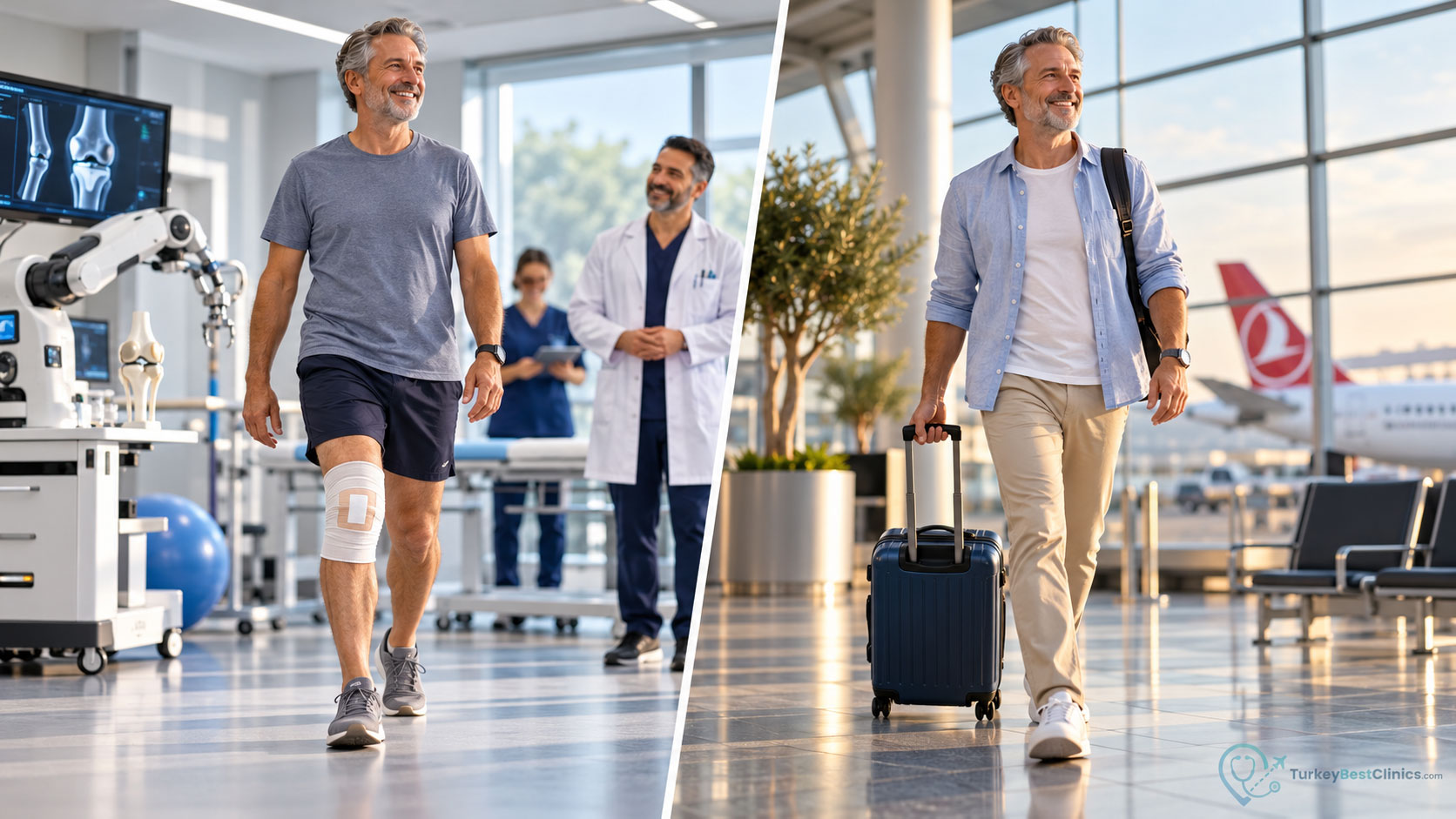
Walking Without Support and Preparing to Fly After Robotic Knee Replacement
Robotic knee replacement aims to replace damaged surfaces in the knee joint with the support of personalized measurements and surgical planning. The robotic system does not replace the surgeon; it helps the surgeon perform bone cuts in the planned alignment with greater control.
Walking without support may be possible before returning to your country, but this goal is not determined by the surgery date alone. The strength of the muscles around the knee, swelling, wound condition, pain control, ability to use stairs, and flight duration must be assessed together. Walking without a cane for short distances is not the same as moving safely through an airport for an extended period.
The decision to fly should be made by the orthopedic team that performed the surgery before travel arrangements are finalized. Particularly for long-haul flights, an individual assessment is needed regarding reduced leg movement, swelling, and the risk of venous blood clots.
Safety and Hospital Standards for Robotic Knee Surgery in Turkey
It is important for the surgery to be planned at a fully equipped hospital and a healthcare institution holding a Health Tourism Authorization Certificate issued by the Ministry of Health of the Republic of Türkiye. If the institution also has international accreditation, this information should be verified together with the accreditation’s scope and validity date; accreditation alone does not guarantee the outcome of surgery.
Safety in robotic knee replacement depends on the coordinated implementation of preoperative imaging, implant selection, sterilization procedures, anesthesia assessment, early postoperative mobilization, and physiotherapy. You should clearly ask about the type of robotic platform used for the knee, the computerized planning method, and the surgeon’s experience with primary or revision knee replacement procedures performed using that system.
Key Areas Reviewed During the Assessment
- Assessment of bone structure using standard knee X-rays and, when necessary, computed tomography.
- Blood count, biochemistry, coagulation tests, and cardiopulmonary evaluations for anesthesia.
- Review of diabetes, circulation problems, excess weight, or previous knee surgeries that could affect wound healing.
- Verification that the implant system, bone quality, and ligament balance are compatible with robotic planning.
International sterilization protocols, operating-room infection control, emergency care infrastructure, and access to physical therapy are just as important as the robotic device used. The surgeon should provide you with clear information about the planned procedure, potential risks, alternatives, and the conditions for returning to your country.
Robotic Knee Replacement Packages and Planning Your Stay in Turkey
The organizational plan may include VIP airport-hospital-hotel transfers, hotel accommodation meeting the selected standards, an interpreter providing language support, and the necessary guidance for the initial care period. The written quotation should separately specify the scope of services, number of companions, length of accommodation, implant, and rehabilitation services.
Before robotic knee replacement, blood tests, lung and heart assessments, knee imaging, and an anesthesia examination are usually planned. For an uncomplicated procedure, the hospital stay may be approximately 2 to 4 days; the total stay in Turkey is often planned for 10 to 21 days to allow for wound checks, suture or dressing assessments, mobility training, and flight clearance. The exact duration is determined by surgical findings and the speed of rehabilitation.
Whether your companion can stay with you in the hospital should be clarified according to the room type and hospital policy. Choosing a hotel close to the hospital reduces transportation stress during the recovery period; while you continue your exercise and rest program, your companion may enjoy quiet park walks, wellness facilities, or low-intensity leisure activities nearby.
Postoperative Care Protocol
- In the first few days, getting out of bed with a physiotherapist, working on knee range of motion, and learning to walk safely begin.
- The use of a walker or crutches is gradually reduced according to balance, muscle strength, and pain.
- Before discharge, everyday activities such as using stairs, using the toilet, and getting in and out of a vehicle are assessed.
- After returning to your country, an Online Follow-up plan may be arranged, including video consultations, wound-photo checks, range-of-motion monitoring, and coordination with a local physiotherapist.
Robotic Knee Replacement Costs in Turkey and Country Comparison
The approximate total cost of robotic knee replacement in Turkey varies according to the implant system, robotic platform, hospital standards, surgeon’s experience, whether one or both knees are treated, and the length of accommodation. For 2026, international healthcare tourism quotations may show an approximate range of €9,000–€15,000 for a single robotic knee replacement; this is an example of a market range and does not replace an individual quotation.
| Country | Approximate cost of single robotic knee replacement | Pricing note |
|---|---|---|
| Turkey | €9,000–€15,000 | Varies according to the hospital, implant, robotic planning, and logistics included |
| United Kingdom | £18,000–£30,000 | Private hospital and surgeon fees have an impact |
| Germany | €18,000–€28,000 | Hospital, implant, and rehabilitation coverage may vary |
| United States | USD 30,000–50,000 | Insurance coverage, hospital, and regional fees are determining factors |
When comparing quotations, do not look only at the total price. Check in writing whether the robotic system, implant, anesthesia, hospital stay, physiotherapy, follow-up examinations, possible additional hotel nights, and online follow-up after returning to your country are included.
Factors Determining Walking and Flight Timing
- Surgeon’s expertise and experience: The knee replacement surgeon’s experience with primary procedures and, when necessary, complex anatomy, practical experience using robotic planning systems, and postoperative rehabilitation protocol are important.
- Robotic method and implant type: Computer navigation, robotic platforms that create three-dimensional plans for bone surfaces, cemented or cementless implant options, and the polyethylene component used may affect the surgical plan and cost. The reason for selecting a particular system should be explained.
- Clinic location: The hospital’s distance from the airport, hotel, physical therapy center, and emergency medical services in Istanbul, Ankara, Antalya, or another city can change the logistics plan.
- Postoperative physical condition: Swelling, knee flexion, quadriceps strength, wound healing, pain control, and the need for a walking aid are decisive factors in the flight decision.
In general, being able to take a few steps without support is not considered sufficient for flying. A safe-travel assessment considers controlled walking, sitting down and standing up, using the toilet, tolerating the time spent waiting at the airport, and using wheelchair assistance correctly when necessary.
Next Steps Before Returning to Your Country
A safer approach is not to finalize your flight ticket until you have had the surgeon’s follow-up examination and received written travel clearance. If a long-haul flight is planned, you may request assistance services, an aisle seat, and transportation support within the airport from the airline in advance; these arrangements do not replace your doctor’s recommendations.
- When can I walk without a cane after robotic knee replacement? This varies according to knee strength, pain, and balance. Your preoperative muscle condition and participation in physiotherapy affect the transition from a walker to a cane and then to walking without support.
- What level of knee movement and wound healing is needed for flying? The wound should be checked, with no significant drainage or signs of infection, you should be able to perform basic daily movements safely, and the risks associated with sitting for a prolonged period should be assessed.
- How will my robotic knee replacement be monitored after I return to my country? Online Follow-up can be used to monitor range of motion, wound appearance, swelling, and adherence to exercises; when necessary, communication can be established with the orthopedic and physiotherapy team in your country.
Do not plan the date of walking without support or your flight based on a single average timeframe. After your preoperative imaging and medical history have been assessed, establish the length of your stay in Turkey and the conditions for returning home in writing together with the surgeon, anesthesia team, and physiotherapist.