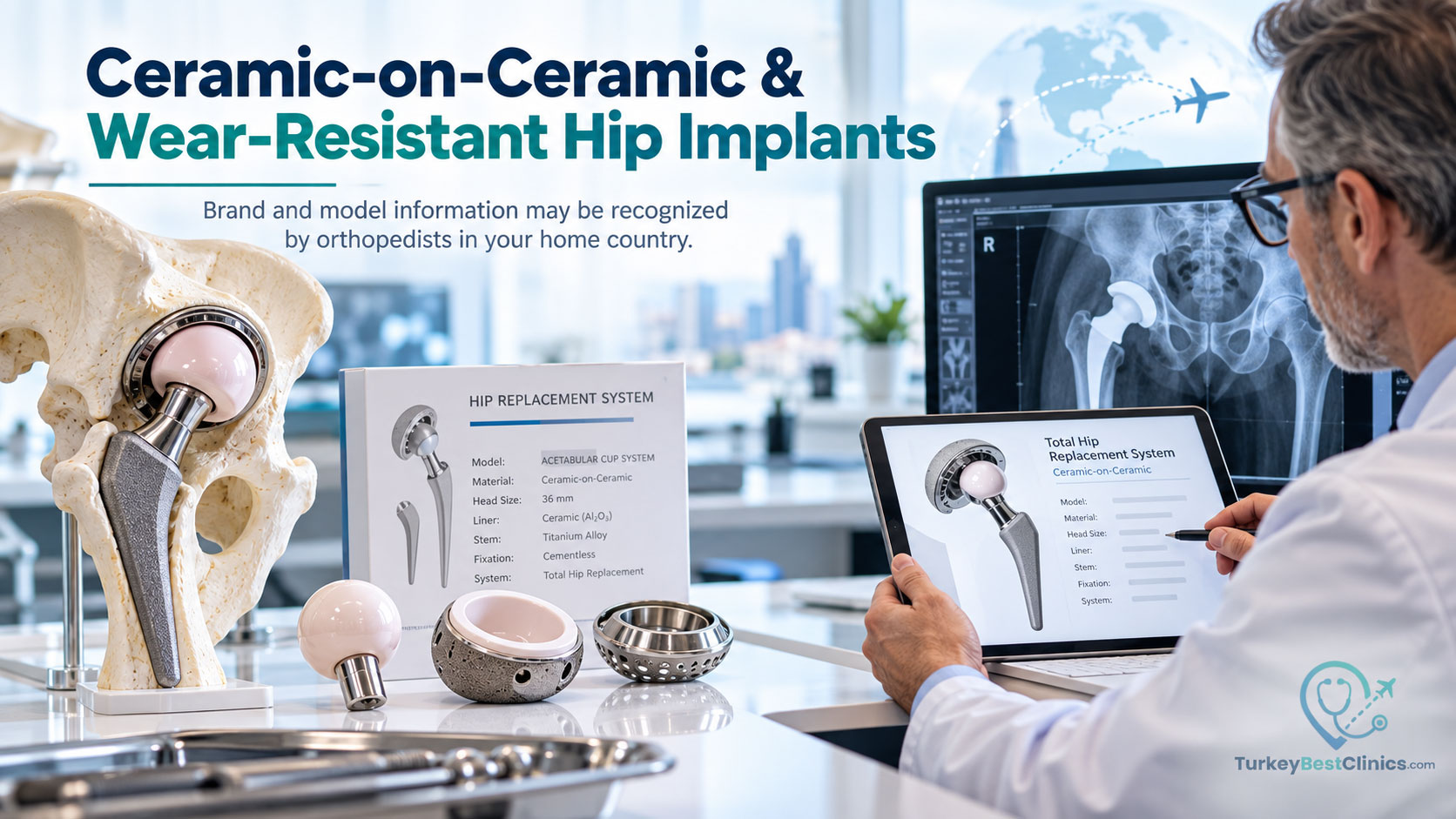
How is a ceramic hip replacement evaluated in your country?
When planning total hip replacement in Turkey, ceramic-on-ceramic bearings and wear-resistant systems such as ceramic and highly cross-linked polyethylene may be used. Whether these products are recognized by orthopedic surgeons in your country depends not only on the ceramic material, but also on the manufacturer, implant model, regulatory approval, distribution chain and completeness of the medical records.
If you are considering surgery in Turkey, it is an essential safety criterion that your orthopedic surgeon can identify and monitor the implant after you return home. Therefore, before making a decision, request the product’s exact model code, size, serial or lot number and implant card in writing—not just the brand name.
The important distinction is this: An implant being legally usable in Turkey does not mean that it will automatically be reimbursed in your country or available at every clinic. Acceptance by your local health authority, insurance coverage and availability for revision surgery must be investigated separately.
Turkey’s healthcare and traceability standards for ceramic implants
It is important to plan your surgery at an institution that holds a Health Tourism Authorization Certificate issued under the regulations of the Turkish Ministry of Health and provides fully equipped hospital infrastructure. This certificate provides institutional authorization for health tourism processes; by itself, it does not show that a specific ceramic hip replacement will be recognized in your country or be suitable for every surgeon.
For a safe evaluation, operating-room sterilization cycles, the implant’s lot-based records, the operative note, anesthesia documents, radiographs and discharge report should all be maintained together. When assessing Turkish orthopedic teams’ experience in hip arthroplasty, ask about their annual number of primary total hip replacements, experience with ceramic-on-ceramic or ceramic-on-polyethylene procedures, and how infection and revision rates are monitored instead of relying on general advertising statements.
Documents demonstrating that the product can be recognized in your country
- The product manufacturer, exact model name, catalog or reference number and available sizes.
- CE conformity and valid technical file information for the European market; where required for the United Kingdom, UKCA or MHRA registration status.
- If the product will be used in the United States, its FDA 510(k), PMA or relevant regulatory status.
- The implant card, UDI or equivalent unique product identifier, and serial or lot number.
- The product’s official distributor in your country and the replacement parts that can be supplied if revision is required.
- The operative report, implant label, radiographs and discharge summary in English or the language used in your country.
Using these documents, your orthopedic surgeon in your country can more reliably assess whether the implant can be added to your follow-up file and monitored. If a manufacturer or model change is planned, you must clearly report it before surgery; even different product families from the same brand may not be compatible with one another.
Your ceramic hip replacement package and surgical process
Depending on the plan, VIP transfers, transportation to the hospital, accommodation, interpreter support and initial care or prescription arrangements may be included in the coordination. The exact scope should be stated in the written quotation. For hip replacement, preoperative blood tests, electrocardiography, pulmonary assessment, and, when necessary, evaluation for dental or infectious foci and hip X-rays are generally planned.
The conditions under which your companion can stay with you at the hospital should be clarified in advance. The hotel’s proximity to the hospital is important for early mobilization and follow-up visits. While you rest, your companion may choose a quiet park, wellness area or in-hotel relaxation option that does not require long walks after hip surgery.
Step-by-step surgical and follow-up protocol
- Remote preliminary assessment: Existing X-rays, previous surgeries, bone density, medications and movement restrictions are reviewed. The final implant selection is not made solely on the basis of online images.
- In-person preparation in Turkey: The examination, hip and pelvic imaging, blood tests, anesthesia consultation and assessment of surgical risks are completed.
- Surgery and hospital stay: For total hip replacement, the hospital stay is usually 2–4 nights; the duration varies according to age, comorbidities, walking ability and surgical findings.
- Recovery monitoring in Turkey: Wound checks, walking training, and assessment of pain and thrombosis risk are carried out. The flight date should depend on approval from the surgeon and anesthesia team.
- Online follow-up: After you return home, reports, wound images, mobility level and opinions from local orthopedic surgeons may be shared during online follow-up. This service does not replace an urgent in-person examination; if you experience fever, wound discharge, significant calf swelling or shortness of breath, seek local emergency medical care.
Hip replacement costs in Turkey, Europe and the United States
The figures below show approximate total package ranges for primary total hip replacement that may be seen in international private healthcare in 2026. The price varies according to the implant system, hospital category, surgeon, unilateral or bilateral surgery, rehabilitation and accommodation included, and should not be considered a binding quotation.
| Country | Approximate total cost | Pricing details |
|---|---|---|
| Turkey | €7,000–12,000 | Varies according to the private hospital, surgery, standard implant and accommodation included in the selected package |
| United Kingdom | £12,000–20,000 | May vary according to the private hospital and implant selection |
| Germany | €10,000–18,000 | The hospital, surgeon and rehabilitation coverage affect the price |
| United States | $25,000–45,000 | Insurance coverage, hospital and surgical fees may be calculated separately |
When requesting a quotation from Turkey, it is useful to ask for the brand and model of the implant, postoperative checkups, X-rays, hospital stay, medications, physical therapy, companion services and any possible additional-night charges as separate line items. The lowest price does not necessarily mean the product will be easiest to monitor long term or most accessible in your country.
Comparing ceramic-on-ceramic and ceramic-on-polyethylene options
| Options being compared for you | Most important potential advantage | Your recovery and hospital stay |
|---|---|---|
| Ceramic-on-ceramic bearing | Low wear potential and a metal-free bearing surface; however, the rare risks of ceramic squeaking or fracture should also be assessed | Recovery is more closely related to bone quality and general health than to the surgical approach; hospital stay is usually 2–4 nights |
| Ceramic head and highly cross-linked polyethylene | Low wear performance, a wider range of products and a possibility that revision components may be available in more markets | Early weight-bearing and discharge protocols may be similar; usually 2–4 nights followed by gradually progressive physical therapy |
Do not choose between these two options based solely on your age or a wear rate mentioned in advertising. Bone quality, hip anatomy, activity level, previous surgeries, head and neck diameter, surgical approach and long-term follow-up options in your country should all be assessed together.
Criteria affecting implant selection, price and traceability
- The surgeon’s expertise and experience: In addition to the number of primary total hip replacements performed, correct placement of ceramic components, leg-length balancing, soft-tissue management and revision surgery experience are important. You should ask in writing about the surgeon’s training history and how outcomes are measured.
- Technology, technique and materials: Actual product characteristics—such as ceramic-on-ceramic, a ceramic head with highly cross-linked polyethylene, cementless or cemented stems, and standard or short femoral stems—change the price and follow-up options. If robotic or computer-assisted planning is used, its contribution to implant selection should be explained.
- Clinic location: Hospital, accommodation, transfer and revision-component supply costs may differ between Istanbul, Ankara, Antalya and other centers. In addition to proximity to the airport, it is important to be able to reach the hospital quickly for early postoperative checks and to have access to emergency orthopedic support if necessary.
When comparing quotations, compare the same implant class, the same length of stay and the same follow-up scope. To support recognition of the product in your country, you can require from the outset that the surgical file include the implant label, lot information, radiographs and an English medical summary.
Three specific questions to ask before making a decision
- What is the exact manufacturer and model code of the selected ceramic-on-ceramic or ceramic-on-polyethylene implant, and how can its CE, FDA, UKCA or relevant local registration status be verified in my country?
- If revision surgery is needed after I return home, are the acetabular cup, liner, femoral stem and head components from the same implant family available through a local distributor?
- In which language and when will the postoperative X-rays, implant card, lot number, operative report and online follow-up plan be provided?
Do not finalize your flight and surgery plans until you have received written answers to these questions. Obtaining a preliminary opinion from your orthopedic surgeon at home can help you independently assess whether the product selected in Turkey is compatible with long-term monitoring and any potential revision process.