How Is Your Bone Healing Monitored After Returning from Türkiye?
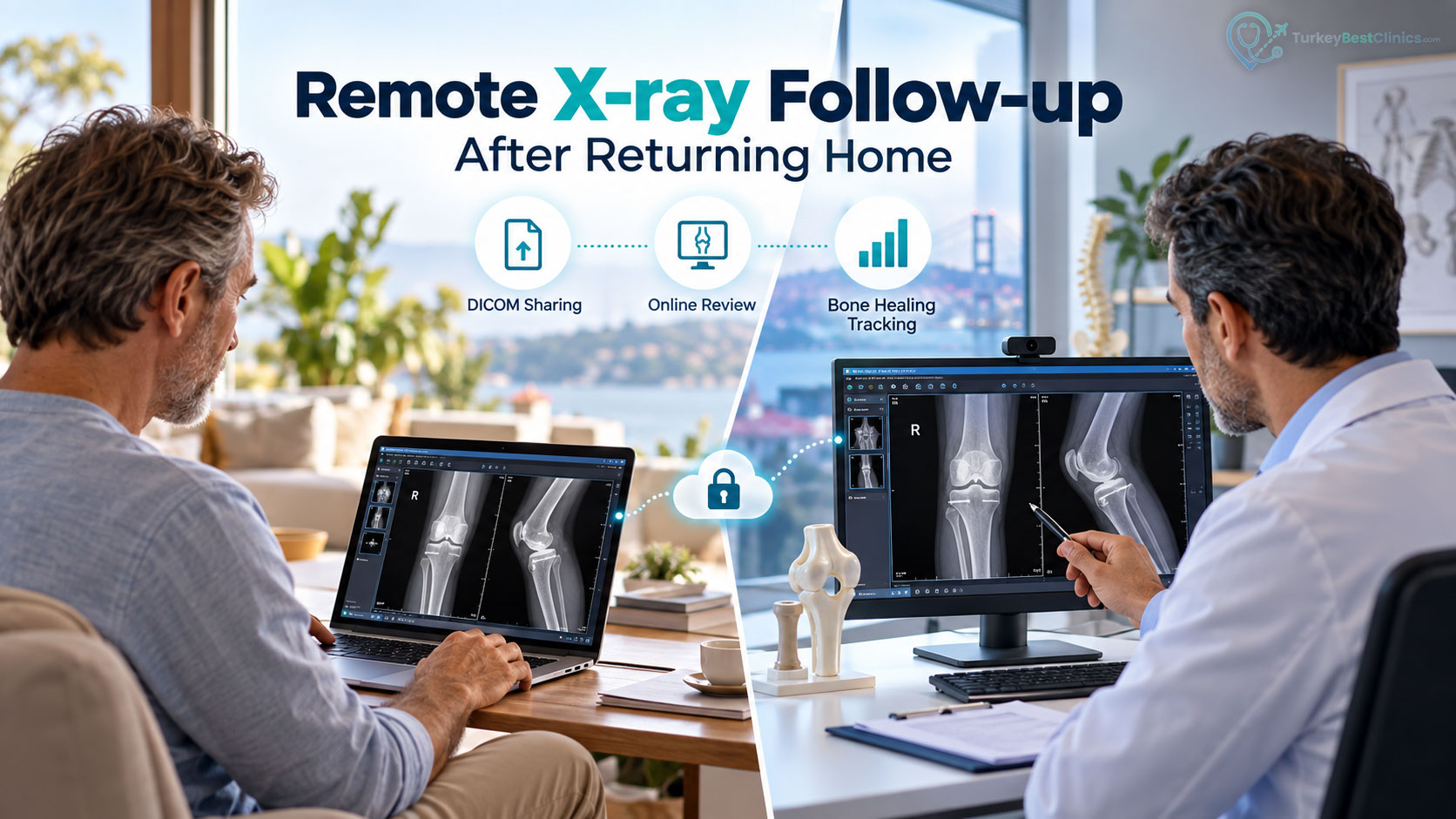
Returning home after orthopedic surgery does not mean communication with your surgical team has to end. Follow-up X-rays, the operative report, implant details, physical therapy notes and examination findings from your local doctor can be sent to your surgeon in Türkiye through secure digital channels.
This follow-up helps assess whether new bone is forming and progressing at the fracture site, whether the plate-and-screw system or intramedullary nail remains properly positioned, and whether the weight-bearing plan needs to be changed. Digital review does not completely replace an in-person examination; if symptoms such as pain, swelling, restricted movement, fever or changes in the wound occur, you need prompt clinical assessment in the country where you are staying.
Key Documents to Include in Your Follow-Up File
- Operative report and discharge summary
- DICOM images and written reports of follow-up X-rays
- Comparison of preoperative and postoperative images
- Brand, model or technical specifications of the implant used
- Current information on range of motion, pain level and weight-bearing status measured during a local orthopedic examination
- Current details about your physical therapy program and exercise tolerance
DICOM Imaging and Your Surgeon’s Clinical Assessment in Türkiye
Sending follow-up X-rays only as photographs taken with a phone may result in loss of measurement accuracy and detail. The most reliable method is to obtain the images from the hospital or radiology center in DICOM format and upload them to a secure, encrypted patient portal.
Your surgeon in Türkiye can compare the images with previous X-rays using the same views and measurement approach. Changes such as blurring of the fracture line, bridging callus formation, implant integrity, changes around the screws and maintenance of alignment are assessed together; a definitive interpretation depends on evaluating the X-ray findings alongside the clinical examination.
Your Online Follow-Up Protocol
- Initial planning: Before discharge, you will be informed of the date and views required for your first follow-up X-ray.
- Local imaging: The requested images are taken at a hospital or radiology center in your country.
- Secure transfer: The DICOM files, radiology report and your current symptoms are uploaded to the authorized digital system.
- Surgical review: Your orthopedic surgeon in Türkiye compares the images with your operative notes and previous follow-up results.
- Online consultation: Weight-bearing, use of your arm or leg, physical therapy and the date of your next check-up are discussed.
- Written follow-up plan: Recommendations, warning signs and the need for local assessment when necessary are added to your digital record.
The interval between X-rays may vary depending on the fracture location, surgical technique, bone quality, age, other medical conditions and clinical findings. Therefore, your surgical team’s written plan should be followed instead of relying on a single standard schedule.
Safety and Authorization in Postoperative Orthopedic Follow-Up in Türkiye
Managing postoperative digital coordination through healthcare providers holding a Ministry of Health-approved Health Tourism Authorization Certificate provides a more structured framework for record management, translation support, patient communication and referrals to the relevant departments. The hospital where the surgeon works should also have suitable operating room, radiology, sterilization and emergency assessment facilities, as these are important for the reliability of the postoperative plan.
Orthopedic teams in Türkiye have clinical experience in different anatomical regions involving fracture fixation, plate-and-screw systems, intramedullary nailing and monitoring bone healing with serial X-rays. However, do not consider the phrase high experience sufficient on its own; ask directly which fracture locations and surgical techniques are covered and during which postoperative weeks follow-up is provided.
Limitations and Safety Considerations of Digital Follow-Up
- Images should be shared through an encrypted system with restricted access permissions.
- It should be recorded who reviewed the X-ray files and on what date the written opinion was prepared.
- Sharing X-ray files by email or open messaging applications may provide a lower level of security for personal health data.
- An X-ray does not show every condition on its own, including infection, vascular or nerve problems, or implant failure.
- If you experience worsening pain, new numbness, discoloration of the fingers or toes, wound drainage, fever or sudden swelling, seek local emergency medical care without waiting for an online response.
Follow-Up Package, Companion Planning and Returning Home
Depending on the planned service, digital file coordination, review of follow-up X-rays by the surgeon in Türkiye, online consultations, interpreter support, guidance for initial care when necessary and travel coordination may be provided. If VIP transfers and hotel arrangements are used, their scope and pricing should be clarified in writing.
You can plan in advance whether your companion may stay with you in the hospital, how long it takes to travel from your hotel to the hospital, and where you can rest quietly, such as in a park or wellness area, on follow-up X-ray days. After lower-extremity surgery, your companion’s daily support becomes especially important because restrictions on prolonged walking, stairs and car travel need to be taken into account.
Before returning home, it is advisable to receive digital and printed copies of your discharge file, your implant card, the recommended follow-up dates and the communication procedure to use in an emergency. Fitness to fly, seating position, movement breaks and weight-bearing limits should be determined according to the type of surgery and your surgeon’s assessment.
Comparison of Two Common Surgical Approaches for Follow-Up
| Methods Compared for You | Most Important Potential Benefit for You | Your Recovery and Hospital Stay |
|---|---|---|
| Open reduction and internal fixation with plates and screws | Direct alignment of the fracture and detailed monitoring of implant position on X-rays | Usually several days of hospital monitoring, depending on the fracture location; weight-bearing is planned gradually |
| Intramedullary nailing | May help preserve the bone axis and allow early controlled movement in long-bone fractures | Short hospital monitoring in most cases; weight-bearing and physical therapy are advanced according to X-rays and clinical findings |
This comparison provides a general framework; whether the fracture is comminuted, open or closed, extends into the joint surface and the quality of the bone can affect treatment outcomes. The aim of digital follow-up is not simply to say whether healing is present or absent, but to assess whether you can safely move on to the next stage of treatment.
Estimated Costs for Digital X-Ray Follow-Up in Türkiye
Remote orthopedic follow-up and digital assessment of follow-up X-rays may be priced separately from the surgical fee. The figures below are approximate international ranges for one online surgical consultation, image review and basic reporting; imaging, translation, local examination and additional consultation fees may be calculated separately.
| Country | Approximate digital orthopedic follow-up fee | Whether follow-up X-rays are included |
|---|---|---|
| Türkiye | €150–€400 | Varies by center; imaging may be priced separately in many packages |
| United Kingdom | GBP 250–700 | Generally separate from the local radiology fee |
| Germany | €250–€650 | X-rays and reporting are usually assessed separately |
| United States | USD 400–1,000 | Varies according to imaging, specialist opinion and insurance coverage |
Factors That Affect the Price and Follow-Up Process
- Physician’s specialty and experience: Subspecialties such as trauma surgery, periarticular fractures, spine surgery or hand surgery may affect the scope of the review and consultation fee.
- Technique and implant used: Procedures such as plate-and-screw fixation, locking plates, intramedullary nailing, bone grafting or joint replacement can change the level of detail required in the follow-up file and the follow-up images needed.
- Clinic location: Translation, coordination and imaging infrastructure may be priced differently in international healthcare centers such as Istanbul, Ankara, İzmir and Antalya.
- Image format and archive status: Access to the DICOM archive, availability of previous images and the need to compare records from different centers may increase the time required.
- Scope of follow-up: A single X-ray interpretation and several months of online monitoring, local orthopedic coordination and preparation of a written report may not have the same price.
Next Steps: Three Specific Questions to Ask About Digital Follow-Up
- In which views and during which weeks should I have my follow-up X-rays taken in my country and send them to you?
- Which encrypted platform should I use to share the DICOM images, operative report and implant details?
- Even if the X-ray appears to show sufficient bone healing, how will decisions about weight-bearing or physical therapy be coordinated with a local orthopedic examination?
Having the answers to these questions added to your surgical and discharge plan in writing can make communication more organized after you return home. Digital follow-up helps coordinate your surgical team in Türkiye with healthcare services in the country where you are staying; local medical assessment always takes priority in the event of emergency symptoms.