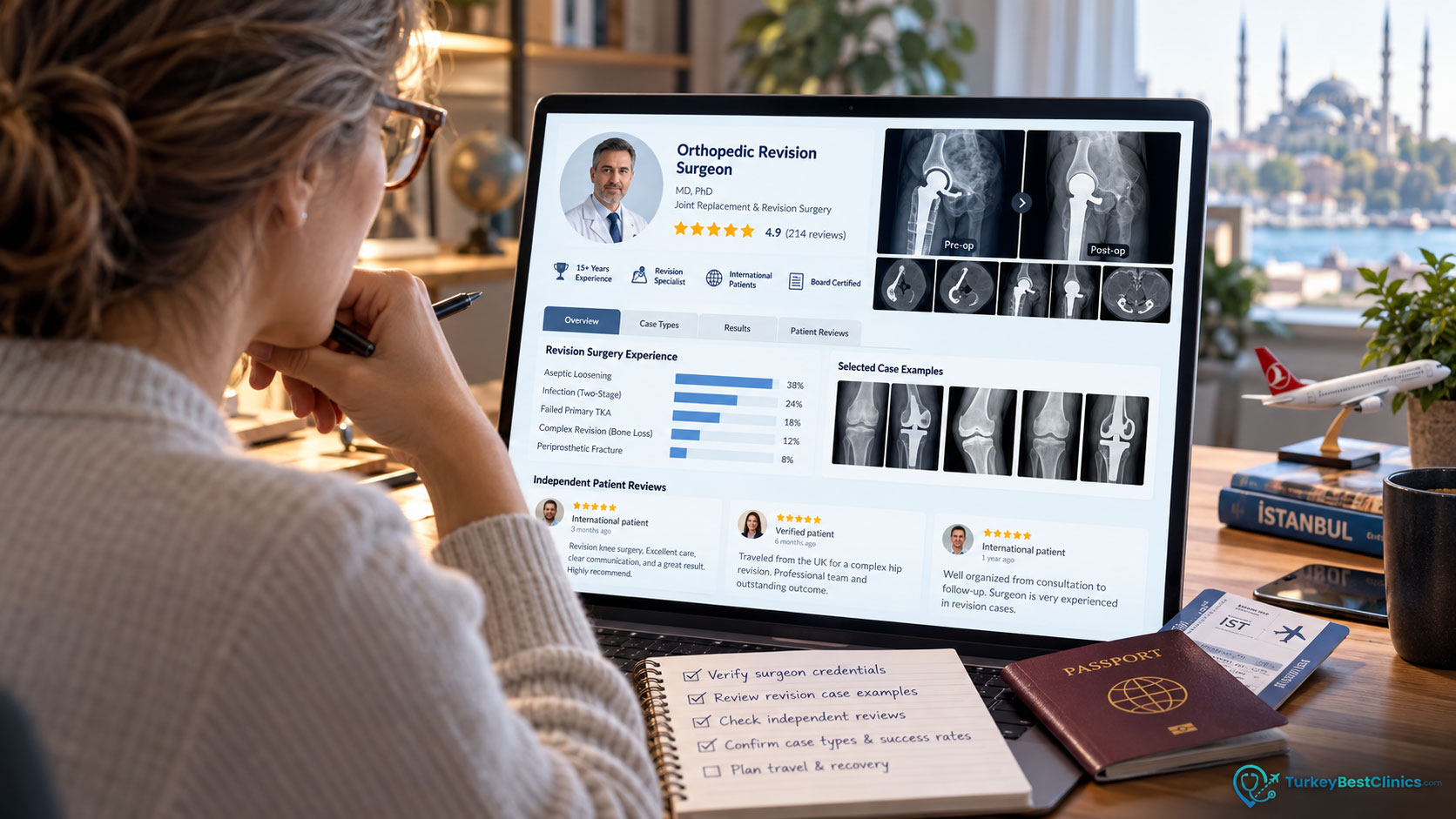
Where Can Reliable Outcome Data for Revision Orthopedics Be Found?
Revision surgery is a complex process that requires the reassessment of a previously performed joint replacement, implant procedure, ligament repair, or bone surgery. Unlike the initial operation, factors such as scar tissue, bone loss, implant loosening, infection, and restricted movement may affect the surgical plan.
When reviewing an orthopedist’s previous revision outcomes, do not look only at the term success rate. Be sure to ask which joint the rate applies to, how many operations it covers, how long the follow-up period was, and how success was defined.
Sources that can be reviewed to verify success rates
- Surgical records and anonymized outcome reports from the hospital where the surgeon practices
- Articles published in peer-reviewed medical journals and presentations at scientific conferences
- National or international joint replacement registries and, where applicable, clinical audit reports
- The hospital’s Ministry of Health authorization details and, where applicable, independent accreditation records such as JCI
- Detailed international patient reviews on independent platforms such as Google
- Professional association memberships and specialist credentials related to revision surgery
Case reports on a clinic’s own website may be a starting point; however, they should not be considered independent evidence on their own. A sound assessment checks clinical data, the surgeon’s credentials, and the real-life care experience separately.
How should success rates be interpreted?
For example, a 95% success rate may be misleading if it combines two-stage knee replacement revisions for infection, hip revisions for aseptic loosening, and simple implant replacements in the same table. More meaningful data specifies a particular type of operation, a defined follow-up period, and clear measures such as reoperation, infection, dislocation, or functional improvement.
It is useful to request the following information from the doctor in writing: the number of relevant revision cases performed during the past three to five years, the 90-day complication rate, reoperation rate, infection rate, average length of hospital stay, and outcomes at a minimum of one year of follow-up. Due to the confidentiality of personal medical records, named files may not be shared; instead, you can request anonymized statistics and a sample follow-up report.
Safety and Orthopedic Standards for Revision Surgery in Turkey
Check whether the hospital where the surgery will be performed operates under a current Health Tourism Authorization Certificate issued by the Ministry of Health of the Republic of Türkiye. This certificate indicates that administrative and operational requirements for providing international healthcare services have been met; however, it does not by itself prove the success rate of a specific orthopedist.
Safety assessment in revision surgery should cover a fully equipped operating room, implant sterilization and traceability systems, infection-control protocols, intensive-care access, a blood bank, postoperative physiotherapy, and infectious disease support when needed. Particularly when a prosthetic joint infection is suspected, learn in advance how microbiological sampling, imaging, and a staged surgical plan are managed.
When assessing a Turkish orthopedist’s experience, distinguish general orthopedic practice from experience in revision joint surgery. Hip and knee replacement revision, post-traumatic implant correction, shoulder replacement revision, and repeat surgery due to infection involve different areas of expertise. The surgeon’s recent case mix, the revision systems used, and the complication-management protocol are therefore important.
Using international reviews as evidence
Google Maps, independent medical tourism platforms, and some country-specific review websites may provide insight into transportation, interpretation, discharge, and communication quality. However, reviews have limited value in measuring surgical success; satisfaction does not mean the same thing as a medical outcome.
- Does the review clearly state the type of surgery, the time period, and the follow-up process?
- Is there verifiable information about the process showing that the reviewer actually received treatment at the same hospital?
- Does the review describe only the day of surgery, or does it also include the three-, six-, or twelve-month outcome?
- Is the clinic’s response to negative reviews measured, respectful of medical confidentiality, and solution-oriented?
- Are there signs of artificial reviews, such as the same sentences being repeated across different profiles?
What Processes Are Included in an Orthopedic Revision Package?
An organizational package may typically include airport-to-hospital transfers, accommodation, interpreter support, and logistical assistance during the initial care period. It is important to plan in advance whether your companion can stay with you in the hospital, how far the hotel is from the hospital, and whether nearby quiet park walks or wellness facilities will be available while you rest, particularly given the mobility restrictions associated with revision surgery.
Before revision surgery, previous operative reports, the implant card, X-rays and CT images, blood tests, joint-fluid analysis when necessary, and infection markers are evaluated. Depending on the scope of the planned procedure, you may need to stay in Turkey for approximately 7 to 14 days; in two-stage infection treatment, the duration and schedule for a second visit are determined separately.
Step-by-step surgical and follow-up protocol
- Preliminary assessment: Current symptoms, previous surgeries, implant information, and imaging are reviewed.
- In-person examination: Range of motion, gait pattern, pain, wound condition, and neurological findings are assessed.
- Surgical planning: The scope of the revision, the implant system to be used, the possible need for bone grafting, and potential complication scenarios are explained.
- Hospital process: Blood tests, anesthesia assessment, surgery, early mobilization, and physiotherapy are carried out.
- Discharge and online follow-up: After you return to your country, the wound, mobility, pain, imaging, and rehabilitation process are monitored through online consultations.
The date when you are cleared to fly should be determined together with considerations such as leg swelling, the risk of blood clots, wound checks, and walking support. Before a long flight, your individual risks should be assessed separately with the anesthesia and orthopedic teams.
Comparing revision approaches
The comparison below provides a general framework, particularly for hip or knee replacement revisions. The final choice depends on the condition of the implant, bone loss, and signs of infection.
| Methods Compared for You | Most Important Potential Advantage for You | Your Recovery and Hospital Stay |
|---|---|---|
| Single-stage revision | In appropriately selected cases where infection control and implant conditions are favorable, treatment may be planned within a single surgical episode. | Approximately 3–6 days in hospital; the walking and rehabilitation plan varies according to implant stability. |
| Two-stage revision | In cases of prosthetic joint infection or suspected significant contamination, it allows infection control to be managed as a separate stage. | A longer course of treatment and a second operation may be required after the first surgery; the total process may take weeks or months. |
Revision Surgery Costs in Turkey and Country Comparison
The cost of revision orthopedics is determined by the joint involved, the difficulty of implant removal, bone loss, infection, the need for grafting, hospital stay, and the scope of physiotherapy. The figures below are not binding quotes for a specific operation; they are broad, approximate market ranges for complex procedures such as hip or knee replacement revision.
| Country | Approximate Surgical Range | What to Consider When Interpreting the Price |
|---|---|---|
| Turkey | €8,000–€20,000 | Check whether the implant, accommodation, interpretation, tests, and rehabilitation are included in the package. |
| United Kingdom | £18,000–£35,000 | In private hospitals, surgeon, anesthesia, implant, and inpatient charges may be calculated separately. |
| Germany | €15,000–€30,000 | Additional procedures such as infection treatment or bone reconstruction may increase the total cost. |
| United States | $30,000–$70,000 | Insurance coverage, hospital charges, and rehabilitation expenses can significantly change the total cost. |
When requesting a written quote, ask for surgery, implant, anesthesia, pathology, microbiology, possible intensive care, medications, physiotherapy, complication management, and additional-night charges to be listed separately. Rather than choosing the lowest figure, a quote that genuinely covers the scope of the revision and explains possible additional procedures is more meaningful.
Factors Determining the Orthopedist’s Experience and Revision Surgery Cost
The main factors affecting the price and surgical plan include the following:
- The doctor’s specialization and experience: In addition to general orthopedic experience, assess the annual number of hip, knee, shoulder, or trauma revision cases; experience managing problems such as infection, dislocation, and bone loss; and scientific publications and teaching activities.
- Technique and materials: Cementless or cemented revision stems, modular augments, porous metal supports, bone grafts, specialized revision cages, and two-stage antibiotic spacers can change the cost and recovery plan.
- Clinic location: Hospital infrastructure, international patient services, intensive-care access, accommodation costs, and physiotherapy facilities may differ in Istanbul, Ankara, Izmir, and other centers.
When assessing these criteria, instead of trying to estimate the surgeon’s personal success rate, ask which outcome measures are monitored in cases similar to your diagnosis. If the brand and model of the previous implant are known, the availability of compatible revision components should also be included in the planning.
Next Steps and Verification Questions for Revision Surgery
Before your first online consultation, prepare previous operative reports, the implant card, the imaging CD or digital link, and your current medication list. Share your personal data through a secure channel; do not use public social media messages or unverified file links.
- How many revisions has this orthopedist performed on my joint for a reason similar to mine during the past three years, and according to what follow-up period were the reoperation and infection rates calculated?
- Is a single-stage or two-stage revision planned in my case, and how is this choice related to bone loss, implant loosening, or signs of infection?
- Can the surgical outcomes described in international reviews be independently verified, and how will online follow-up and physiotherapy continue after I leave Turkey?
Clear, measurable, and written answers to these questions strengthen the safety assessment. A diagnosis or surgical decision cannot be made based solely on online research; imaging, physical examination, medical history, and assessment by the surgeon and anesthesiologist should be considered together.