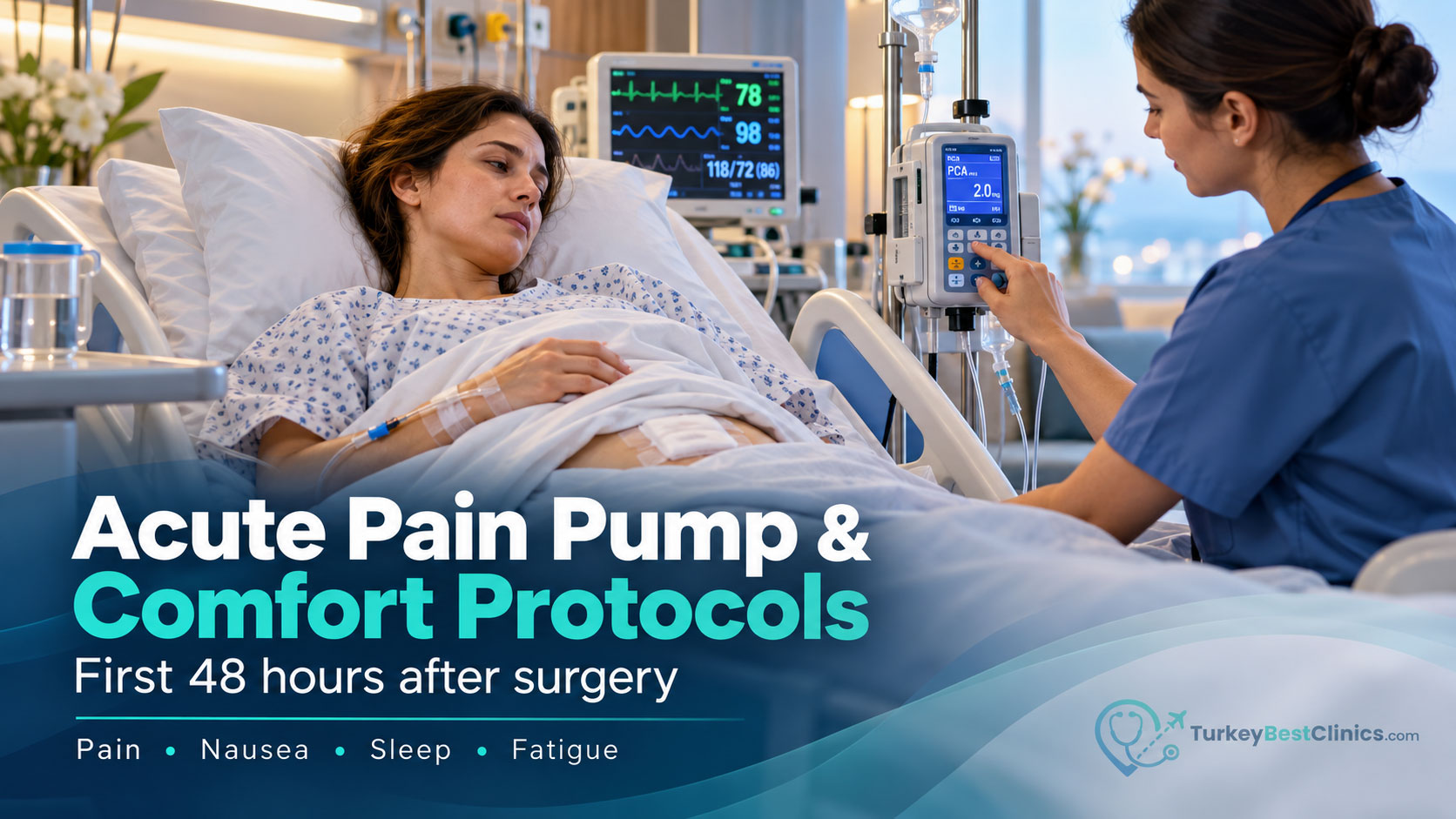
How Is Surgical Pain Management Planned During the First 48 Hours?
The first 48 hours after surgery are the period when pain around the incision, movement-related tenderness, nausea, disrupted sleep, and fatigue may be more noticeable. The aim is not to promise complete elimination of pain, but to control it at a level that supports breathing, safe movement, rest, and basic daily needs.
The plan in Turkey is prepared by assessing the type of surgery, incision size, expected pain intensity, previous pain experiences, existing health conditions, and the anesthesia method used. Pain levels are monitored at regular intervals using numerical scales, facial expressions, or functional questions; decisions are not based on a single measurement alone.
Important limitation: The type of pain pump, treatment approach, and monitoring frequency are determined by the surgical team and anesthesiologist. The information here provides a general overview of the process and does not replace individualized treatment or a prescription.
Hospital Safety and Oversight for Pain Pumps in Turkey
When planning surgery as part of medical tourism, confirm that the procedure will be performed in a fully equipped hospital and at a facility holding a Health Tourism Authorization Certificate issued by the Ministry of Health. This certificate is an important administrative indicator that the facility is authorized to provide international health tourism services; however, each surgical procedure, pain protocol, and intensive care capability should be assessed separately.
When a pain pump is used, the device should be identified, its settings checked by a second healthcare professional, lockout dose limits defined, and pump records kept in the patient file. Medication safety, hand hygiene, management of single-use sets, documentation of intravenous access or catheter care, and accessibility of emergency equipment are essential parts of a safe process.
The Role of Turkish Physicians in Pain Management
In Turkey, anesthesiology and reanimation teams may assess intravenous patient-controlled analgesia, regional anesthesia, and catheter-based pain management for various surgical groups, including abdominal, orthopedic, thoracic, obstetric and gynecologic, urologic, and plastic surgery. To understand the team’s practical experience, ask directly about its annual surgical volume, the regional anesthesia techniques it uses, how pain is assessed during night shifts, and its complication management protocol.
A pain pump should be assessed together with indicators such as respiratory rate, level of consciousness, blood pressure, pulse, oxygenation, and nausea. If you experience increasing drowsiness, difficulty breathing, a sudden change in consciousness, uncontrolled pain, or a pump alarm, contact the team without delay using the nurse call system.
Postoperative Pain Pump and Companion Support Package
A coordination package may include airport-to-hospital transfers, accommodation near the hospital, medical interpreter support, and guidance for the initial care period; confirm the scope in a written quotation. For the first 48 hours, preoperative blood tests, any necessary imaging, an anesthesia assessment, and documentation of pain risk are planned. The length of hospital stay varies according to the extent of surgery and safe discharge criteria.
Ask in advance whether your companion can stay in the same room or in nearby accommodation permitted by the hospital. A quiet park walk near the hospital, a hotel relaxation area, or low-intensity wellness services may be selected according to your surgical restrictions and the need for your companion to reach the hospital quickly.
Step-by-Step Progression of the First 48 Hours
- Before surgery: Your pain history, allergy information, previous anesthesia experiences, and current health conditions are assessed. Your pain scale and communication preferences may be recorded in your file.
- Postoperative recovery: Consciousness, breathing, circulation, nausea, and pain are monitored together. If considered appropriate, a pain pump or regional pain management method is initiated.
- First 12 hours: Pump settings, connections, the catheter site, and the response to pain are checked regularly. Deep breathing, coughing, changing position, and safe movement in bed are supported.
- 12–24 hours: Pain is expected to be assessed separately at rest and during movement. If permitted by the surgeon, getting out of bed and brief mobilization may be planned with nursing or physiotherapy support.
- 24–48 hours: The team assesses whether pain control can transition to a plan without a pump or with lower-intensity treatment. Nutrition, urination, wound appearance, mobility, and companion education contribute to the discharge decision.
- After returning home: A discharge summary, wound-care instructions, follow-up schedule, and communication channel are provided. During online follow-up consultations, pain progression, mobility, secure transfer of wound photographs if required, and warning signs are assessed.
Comparison of Two Main Pain Management Approaches
| Methods Compared for You | Most Important Potential Advantage for You | Your Recovery and Hospital Stay |
|---|---|---|
| Intravenous patient-controlled analgesia pump | Allows you to request additional doses within predefined limits based on changes in pain, with records maintained through a central pump | Depends on the type of surgery; when used together with movement and respiratory assessments, it may support early mobilization |
| Regional anesthesia or catheter-based pain management | May reduce pain signals from the surgical area regionally and, in some surgeries, may limit the burden of systemic side effects | The catheter site, movement restrictions, and sensory changes are monitored; the length of stay is determined by the surgery and overall condition |
These two approaches are not alternatives in every surgery; in some cases, they may be considered together or sequentially. The choice takes into account bleeding risk, infection risk, coagulation status, neurological findings, the surgical site, and mobilization goals.
Cost Comparison of First-48-Hour Pain Management in Turkey
A pain pump is often not priced as a separate product from surgery, anesthesia, the room, nursing monitoring, and the hospital stay. The figures below are broad approximate ranges for medical tourism planning, not a definitive quotation for a specific surgery; the city, hospital level, surgical scope, and need for additional monitoring may change the price.
| Country | Approximate range for first-48-hour pain management and hospital monitoring | Currency |
|---|---|---|
| Turkey | Approximately €300–€1,500 as an additional component or as part of the surgical package | EUR |
| United Kingdom | Approximately £1,000–£4,000; may vary according to the private hospital and type of surgery | GBP |
| Germany | Approximately €1,200–€4,500; may vary according to the scope of the hospital stay | EUR |
| United States | Approximately $3,000–$12,000 or more; insurance and hospital pricing are determining factors | USD |
When requesting a quotation, ask for the pain pump, pump set, nursing monitoring, anesthesia assessments, regional catheter monitoring, additional overnight stays, emergency imaging, and post-discharge online consultations to be listed separately and specify whether each is included. This allows you to compare not only the total amount but also exactly which services you are purchasing for the first 48 hours.
Factors That Change Pain Pump Selection and the Comfort Protocol
- Physician expertise and experience: The anesthesiologist’s practical experience with patient-controlled pumps, regional blocks, or catheter management for your type of surgery affects the ability to recognize complications and update the protocol.
- Technology and technique: Important pump features include lockout dose limits, a total dose limit, an alarm system, and event recording. For regional techniques, the choice between ultrasound-guided nerve blocks, continuous catheters, or a single administration is significant.
- Clinic location: International coordination and interpreting may be more accessible in medical tourism centers such as Istanbul, Ankara, Izmir, and Antalya. However, the key criteria are intensive care support, 24-hour access to anesthesiology, and postoperative monitoring infrastructure.
- Nature of the surgery: With a large incision, multiple procedures, or thoracic or abdominal surgery, respiratory and movement goals may require more detailed planning. For minimally invasive procedures, a different pain management plan instead of a pump may be considered sufficient.
- Safe discharge criteria: The team evaluates together whether pain can be managed during movement, consciousness and breathing remain stable, basic mobilization can be performed safely, wound care is understood, and the plan for returning home is appropriate.
These criteria affect not only comfort but also safe recovery. Do not change the pump settings yourself; contact the nursing team directly if there is a device alarm, connection problem, or unexpected symptom.
Three Specific Questions to Ask Before Leaving Turkey
- For my surgery, is an intravenous patient-controlled pump or an ultrasound-guided regional pain management method considered more appropriate, and how will this choice affect my movement and breathing goals?
- During the first 48 hours, who will check the pump settings, at what intervals, and according to which pain and respiratory criteria?
- When will the online follow-up consultation take place after I return home, and what is the 24-hour communication channel for increasing pain, wound changes, or an unexpected symptom after using the pump?
Before traveling from abroad, obtain written information about the name of the surgery, expected hospital stay, pain management approach, companion policies, total price inclusions, and emergency communication plan. This helps ensure that your expectations for the first 48 hours align with the hospital team’s actual protocol.