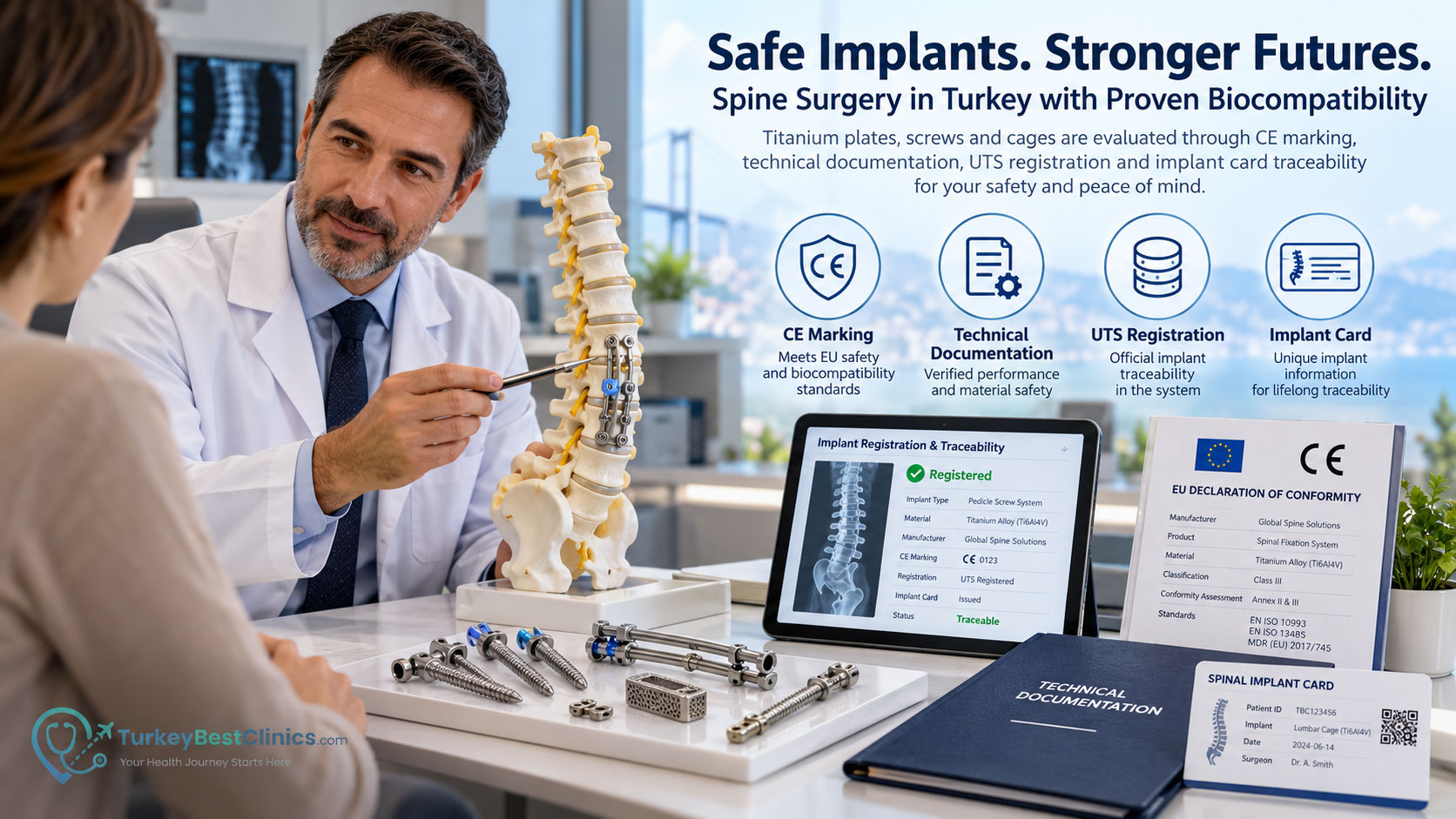
What a Titanium Spinal Implant Means for Your Care
Titanium screws, rods, plates, and interbody cages used in spinal surgery are selected to stabilize a specific section of the spine, support bone fusion, or reduce pressure on the spinal cord and nerve roots. Titanium and titanium alloys are commonly used implant materials because of their low density, mechanical strength, and relative compatibility with body tissues.
The term “international validity” should be considered under two separate headings: recognition of a product’s safety and conformity documents in another country is not the same as the ability to apply the manufacturer’s warranty conditions in that country. Do not assume that every implant used in Türkiye is safe or covered by a worldwide warranty simply because it is “titanium”; the brand, model, manufacturer, lot number, and scope of the documentation should each be verified separately.
What Does Biocompatibility Show?
Biocompatibility refers to the assessment of the risk that a material may cause a toxic, excessively allergic, irritating, or otherwise undesirable biological response in relation to its intended duration of use and body location. The ISO 10993 series of biological evaluation standards may be used as a reference in this process; however, the existence of an ISO 10993 test does not mean that your individual surgical outcome is guaranteed.
Türkiye’s Safety Chain for Titanium Screws and Plates
In Türkiye, the suitability of a surgical implant should be assessed by reviewing the manufacturer’s quality system, the product’s technical file, conformity assessment, product registrations in Türkiye, and the medical-device traceability procedures of the hospital where the surgery is performed. If you are seeking treatment as part of medical tourism, confirming that your chosen institution holds a Turkish Ministry of Health-approved Health Tourism Authorization Certificate is an important checkpoint for healthcare organization and international patient procedures; this certificate alone does not prove the quality of a particular implant brand.
When assessing the experience of Turkish surgeons in spinal surgery, do not rely only on the phrase “highly experienced.” Ask about the surgeon’s case distribution in directly relevant procedures, such as pedicle screw placement, cervical or lumbar fusion, revision surgery, deformity correction, or minimally invasive screw systems, as well as the navigation method used and the complication-management protocol.
What CE, MDR, and ÜTS Registrations Mean
- CE marking: Indicates that the product meets the relevant conformity requirements under European Union medical-device legislation; it is not, by itself, a guarantee of clinical success or lifelong durability.
- EU MDR 2017/745: Provides a more comprehensive framework for the medical device’s risk classification, clinical evaluation, post-market surveillance, and traceability.
- Notified body: For devices where it is required, the name of the organization conducting the conformity assessment and the document number should be checked.
- ÜTS registration: Supports the product’s traceability within Türkiye’s medical-device tracking system; recording the brand, model, and lot information is important.
- Implant card: Contains information such as the product name, serial or lot number, manufacturer, and implantation date. Keep this card after returning to your country.
In the United States, FDA 510(k) or PMA processes may be relevant, while in the United Kingdom, UKCA requirements or transitional provisions may apply. The presence of CE documentation and relevant national registrations in Türkiye does not mean that the product is FDA-approved or automatically eligible for reimbursement in the United Kingdom.
Spinal Surgery Package and Implant Documentation Checklist
Your planning may include VIP transfers, a hotel near the hospital, interpreter support, and arrangements for initial care and medication. Before spinal surgery, MRI or CT scans, standing X-rays, blood tests, an anesthesia assessment, and, when considered necessary, a bone-density measurement are reviewed; depending on the scope of surgery, you may need to stay in Türkiye for approximately 5–10 days.
The conditions under which your companion can stay with you in the hospital should be clarified in advance through the hospital’s visitor and companion policy. Choosing a hotel near the hospital can make transportation easier during the early mobilization period. After spinal surgery, your companion may plan a quiet walk in a nearby park, wellness activities, or short rest periods in accordance with your movement restrictions.
Your Preoperative Documentation File
- The implant’s commercial name, catalogue number, size, and manufacturer
- CE certificate or declaration of conformity, and the notified body number if applicable
- Technical specifications of the implant: titanium grade, alloy standard, and surface coating
- ÜTS registration details and the implant card to be provided after surgery
- The manufacturer’s warranty, complaint-reporting, and recall procedures
- Operative report, list of implants used, and discharge summary
Difference Between Minimally Invasive and Open Surgical Approaches
| Methods Compared for You | Most Important Potential Benefit for You | Your Recovery and Hospital Stay |
|---|---|---|
| Minimally invasive screw placement | Smaller incision and, in some suitable cases, more limited disruption of muscle tissue | Approximately 2–4 days in hospital; early mobility depends on suitability and the scope of surgery |
| Open fusion and instrumentation | A wider surgical field for deformity, multilevel compression, or complex revision procedures | Approximately 3–7 days in hospital; physical recovery may be planned over a longer period |
This table provides a general framework; your imaging findings, bone density, surgical levels, and comorbidities determine the approach. Navigation or robotic assistance may help improve the accuracy of screw placement; this technology should also be considered together with clinical assessment and the surgeon’s plan.
Spinal Implant Costs in Türkiye and Documentation Coverage
The price of spinal surgery in Türkiye does not consist solely of the cost of titanium screws or plates. The surgeon, hospital, anesthesia, imaging, number of implants, fusion cage, need for intensive care, accommodation, and postoperative follow-up can all change the total package. The ranges below are only approximate market comparisons; a definitive quotation should be prepared after reviewing your images and medical records.
| Country | Typical Spinal Instrumentation Range | Currency | Important Note About the Price |
|---|---|---|---|
| Türkiye | 12,000–30,000 | € | Implants, hospital services, and basic international-patient services may vary depending on the package |
| United Kingdom | 25,000–55,000 | £ | Private hospital, number of implants, and surgical levels are determining factors |
| Germany | 22,000–45,000 | € | Hospital stay and rehabilitation coverage vary according to the quotation |
| United States | 45,000–100,000 | $ | Insurance, hospital, and surgeon fees can significantly change the total cost |
These figures are not a price guarantee or an endorsement of a particular implant brand. Ask for the quotation to state in writing the implant brand and model, the number of screws or rods to be used, whether the interbody cage is included, any additional costs that may arise from revision risks, and the follow-up plan after returning to your country.
Factors That Change Implant Selection and the Overall Process
- Surgeon’s expertise and experience: Direct experience in cervical, lumbar, deformity, or revision surgery may affect the surgical plan and potential additional procedures. Ask about specific case experience, such as navigation-assisted pedicle screw placement.
- Technology, technique, and material: The titanium alloy standard, polyaxial pedicle screw, rod diameter, whether the interbody cage is made of PEEK or titanium, surface coating, and minimally invasive or open technique may affect the price. Your surgeon should explain whether each material is suitable for your bone structure.
- Clinic and hospital location: Hospital infrastructure, operating-room capacity, intensive-care access, and accommodation costs in centers such as Istanbul, Ankara, or Izmir may change the total package. When choosing a city, consider not only the price but also the plan for possible early follow-up and emergency access.
Under the heading “warranty certificate,” obtain the following distinction in writing: Which manufacturing defects or material faults does the manufacturer cover, what is the notification period, are transportation and revision-surgery costs excluded, and is there an authorized service provider or distributor in your country? Clinical situations such as implant breakage, loosening, infection, nonunion, or adjacent segment disease are often not automatically covered by the manufacturer’s warranty.
Document Verification and Next Steps
Before leaving your country, ask the clinic for the implant brand-and-model list, manufacturer information, conformity documents, and surgical plan. At discharge, obtain your implant card, operative report, and imaging records in both digital and printed formats; request an English summary that you can provide to a spine surgeon in your country.
Online follow-up may include remote review of wound healing, pain and movement, suture or dressing plans, imaging schedules, and physical-activity restrictions. This system does not completely replace an in-person examination; if you develop a fever, progressive weakness, changes in bladder or bowel control, wound discharge, or sudden severe pain, you need urgent medical assessment in the country where you are located.
Three Specific Questions to Ask Before Making a Decision
- Will the manufacturer, model number, CE/MDR documentation, and ÜTS registration of the titanium screws, rods, or cage to be used be shared before surgery?
- Will the implant card include the lot or serial number, and how will the manufacturer’s warranty conditions be applied in my country through the distributor?
- What are the planned fusion levels, the choice between a minimally invasive or open approach, the expected hospital stay, and the online follow-up schedule after returning home?
If you do not receive written, document-based answers to these questions, postponing your decision may be safer. International validity is not defined by a single certificate; it gains meaning through a traceable product, an appropriate hospital, a qualified surgical plan, clear warranty terms, and a sustainable follow-up pathway in your country.