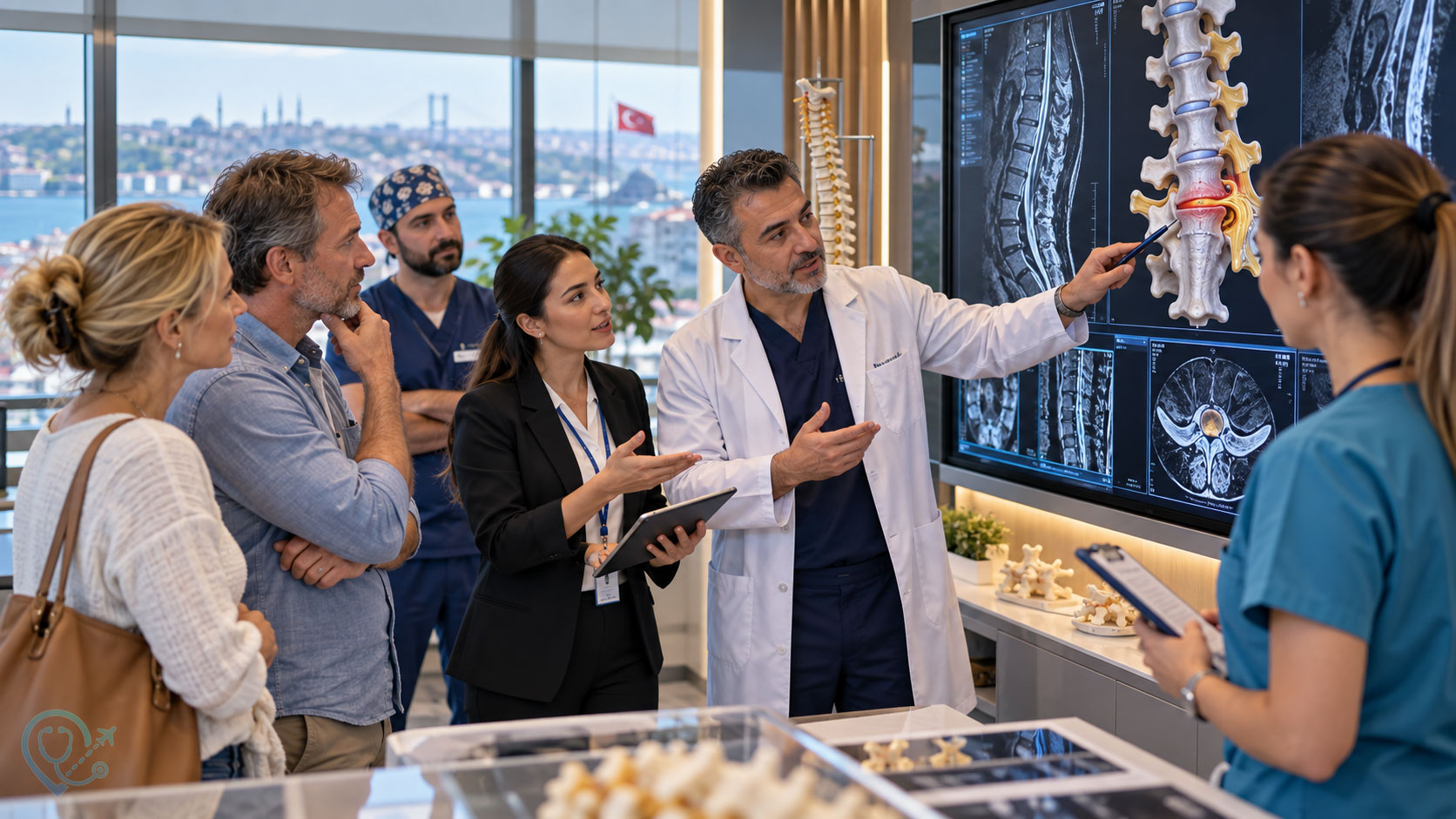
The Role of Neuromonitoring in Complex Spine Surgery
Complex spine surgery may require multiple surgical stages involving the spinal cord, nerve roots, and spinal stability to be assessed as part of the same treatment plan. Neuromonitoring is a monitoring method that helps track the nervous system’s electrical responses during surgery; it is not, by itself, a guarantee of success or protection that completely eliminates complications.
When choosing a team in Turkey, look beyond whether the equipment is available. Ask how recordings are obtained, who responds to changes in alerts, and how findings are communicated to the surgical team. In particular, the intended use of methods such as motor evoked potentials, somatosensory evoked potentials, and electromyography should be explained in advance.
Neurophysiological Areas Reviewed During Assessment
- SSEP: Helps monitor signals from sensory nerve pathways throughout surgery.
- MEP: May be used to assess the functional responses of motor nerve pathways.
- EMG: May contribute to assessing electrical activity associated with nerve-root irritation or pedicle screw placement.
- Triggered EMG: May provide additional information about bone boundaries and the proximity of nerve roots, particularly during screw placement.
- Free-running EMG: May help monitor spontaneous electrical activity associated with surgical manipulation.
The method used may vary depending on clinical factors such as scoliosis, spinal deformity, tumors, revision surgery, spinal cord compression, or multilevel screw placement. Therefore, rather than simply being told that “neuromonitoring will be performed,” it is advisable to request written information about the planned recording types and their role in clinical decision-making.
Safety and Authorization Documents for Spine Surgery in Turkey
The first point to check is whether the facility where the procedure will be performed provides services under a Health Tourism Authorization Certificate issued by the Ministry of Health of the Republic of Türkiye. Verify the certificate’s validity, the facility’s official details, and the authorized structure of its international patient unit directly with the institution and in writing.
A health tourism authorization certificate alone does not demonstrate that a particular surgeon has advanced experience in neuromonitoring. The hospital’s operating-room infrastructure, intensive care capacity, emergency imaging facilities, sterilization procedures, and plan for accessing relevant specialties in the event of complications should also be reviewed. If the hospital has accreditation, check on the document which organization issued it and what scope it covers.
Reviewing the Team’s Actual Experience Through Documentation
- Check the surgeon’s specialty and training in relevant subspecialties, such as spinal deformity, revision surgery, or tumor surgery.
- Ask whether neuromonitoring has been used in recent operations of similar complexity; do not focus only on the total number of surgeries—ask about the group of cases most similar to yours.
- Request a written description of the responsibilities of the neurophysiologist, neuromonitoring technician, and surgical team.
- Ask about the protocol that the anesthesia, surgical, and neurophysiology teams will follow if an alert change occurs.
- Confirm whether baseline values, critical changes, measures taken, and end-of-surgery records are included in the operative report.
De-identified sample reports may help you understand whether the institution actually follows this process. However, medical documents belonging to other individuals must not be shared, and personal data must be protected.
Companionship and Preparation in a Complex Spine Surgery Package
An international patient package may include airport-to-hospital transfers, accommodation, interpreter support, and coordination of the initial care process. Check in the written quotation whether these services are included in the surgical fee, how many nights of accommodation are provided, and what the charges are for additional nights.
Ask in advance whether your companion is permitted to stay with you in the hospital; this may vary depending on the type of ward and the hospital’s policies. Staying at a hotel close to the hospital can be practical, allowing your companion to take a quiet walk in a park, use wellness services, or relax at the hotel without making long journeys while you are recovering.
Preoperative Preparation and Follow-Up Schedule
- Review of current MRI or CT images in DICOM format by the surgical team.
- When necessary, assessment of standing spinal X-rays, scoliosis measurements, or three-dimensional reconstructions.
- Planning of blood tests, an anesthesia evaluation, cardiopulmonary assessment, and additional tests based on your current health status.
- Comparison of previous neurological findings, muscle-strength assessments, and preoperative baseline recordings for neuromonitoring purposes.
- Explanation that hospital stays for complex surgery may often last several days, although the actual duration depends on the scope of surgery and recovery.
Before returning to your country, obtain a written protocol specifying which doctor will conduct online follow-up appointments, how imaging results should be sent, and which local healthcare facility you should contact if an urgent symptom develops.
Comparing the Cost of Complex Spine Surgery in Turkey
The approximate total cost of complex spine surgery in Turkey may generally be quoted in the range of €12,000–€30,000, depending on the scope of the procedure. This figure is intended only as a general market indication; deformity correction, revision surgery, tumor surgery, the number of implants, intensive care requirements, and the scope of neuromonitoring can significantly change the price.
| Country | Approximate range | Scope to check |
|---|---|---|
| Turkey | €12,000–€30,000 | Whether surgery, hospital stay, implants, neuromonitoring, and transfers are included |
| United Kingdom | GBP 35,000–70,000 | Whether private hospital, surgeon, implant, and rehabilitation costs are itemized separately |
| Germany | €25,000–€55,000 | The scope of operating-room, intensive care, implant, and follow-up fees |
| United States | USD 60,000–150,000 | Hospital, physician, anesthesia, imaging, and potential additional inpatient charges |
Ask separately whether neuromonitoring in the quotation covers only equipment use or also includes the neurophysiology team working throughout surgery and written reporting. Clarify before signing the contract how revision surgery, the need for additional screws or grafts, a longer-than-expected hospital stay, and follow-up expenses in your country will be handled.
Criteria for Assessing Neuromonitoring Experience and Communication Skills
Criteria Affecting Cost and the Treatment Process
- The surgeon’s expertise and experience: Current experience with similar procedures involving spinal deformity, multilevel fusion, revision surgery, or spinal cord compression is important. Examine the quality of cases similar to the planned surgery rather than focusing only on the total number of cases.
- Technology and methods: The need for SSEP, MEP, free-running EMG, and triggered EMG, as well as the recording system used, the availability of a real-time neurophysiologist, and imaging technologies supporting pedicle screw placement may affect the scope and cost.
- Hospital location: Hospitals in major centers such as Istanbul, Ankara, or Izmir may differ in their access to international flights and advanced intensive care facilities. Location can also affect transfer time, companion accommodation, and the postoperative follow-up plan.
- Communication language: Check whether a medical interpreter in English or your preferred language will be available not only during telephone calls but also for consent, preoperative information, discharge, and online follow-up.
- Written communication: The explanation of current findings, the rationale for the recommended approach, the limitations of alternatives, risks, estimated hospital stay, and follow-up plan should be provided in a language you understand, rather than presented as a definitive diagnosis claim.
To assess the institution’s international patient communication skills, ask how a sample imaging report would be explained, whom you should contact in the event of an urgent neurological change, and in which language discharge instructions would be provided. The interpreter’s training in medical terminology, confidentiality obligations, and ability to communicate directly with the surgeon are also important.
Practical Comparison of Surgical Approaches
| Methods Compared for You | Potentially Important Benefit for You | Your Recovery and Hospital Stay |
|---|---|---|
| Open posterior surgery | Provides surgical access through a wide field of view for multilevel deformity correction or complex stabilization | Muscle tissue involvement may be greater; the hospital stay and recovery period may be longer depending on the scope of surgery |
| Minimally invasive or robot-assisted approach | In appropriately selected cases, smaller incisions, guided implant placement, and less tissue trauma for some patients | May support earlier mobility; however, it may not be suitable for very advanced deformities or extensive revision surgery |
This table provides a general framework; the choice between an open, minimally invasive, or robot-assisted approach is based on imaging findings, previous surgeries, bone quality, and the intended correction. The use of a robotic system does not replace the surgical team’s neuromonitoring protocol.
Your Checklist: Questions to Ask After Choosing a Team in Turkey
Before comparing the quotation and medical plan, request clear written answers in a language you understand to the following three questions:
- Which of the SSEP, MEP, and EMG methods will be used in this complex spine surgery, and what steps will the responsible neurophysiologist and surgical team follow if an alert change occurs?
- Which imaging or navigation method will be used for the planned screw placement and deformity correction, and how will postoperative control imaging and online follow-up after I return to my country be managed?
- At which stages will an interpreter in English or my preferred language, informed consent, discharge instructions, and emergency communication support be available?
Assess these answers together with the surgeon’s curriculum vitae, the hospital’s authorization documents, the detailed cost breakdown, and the follow-up protocol. Be cautious about definitive surgery, timing, or outcome promises made before your imaging files have been reviewed.