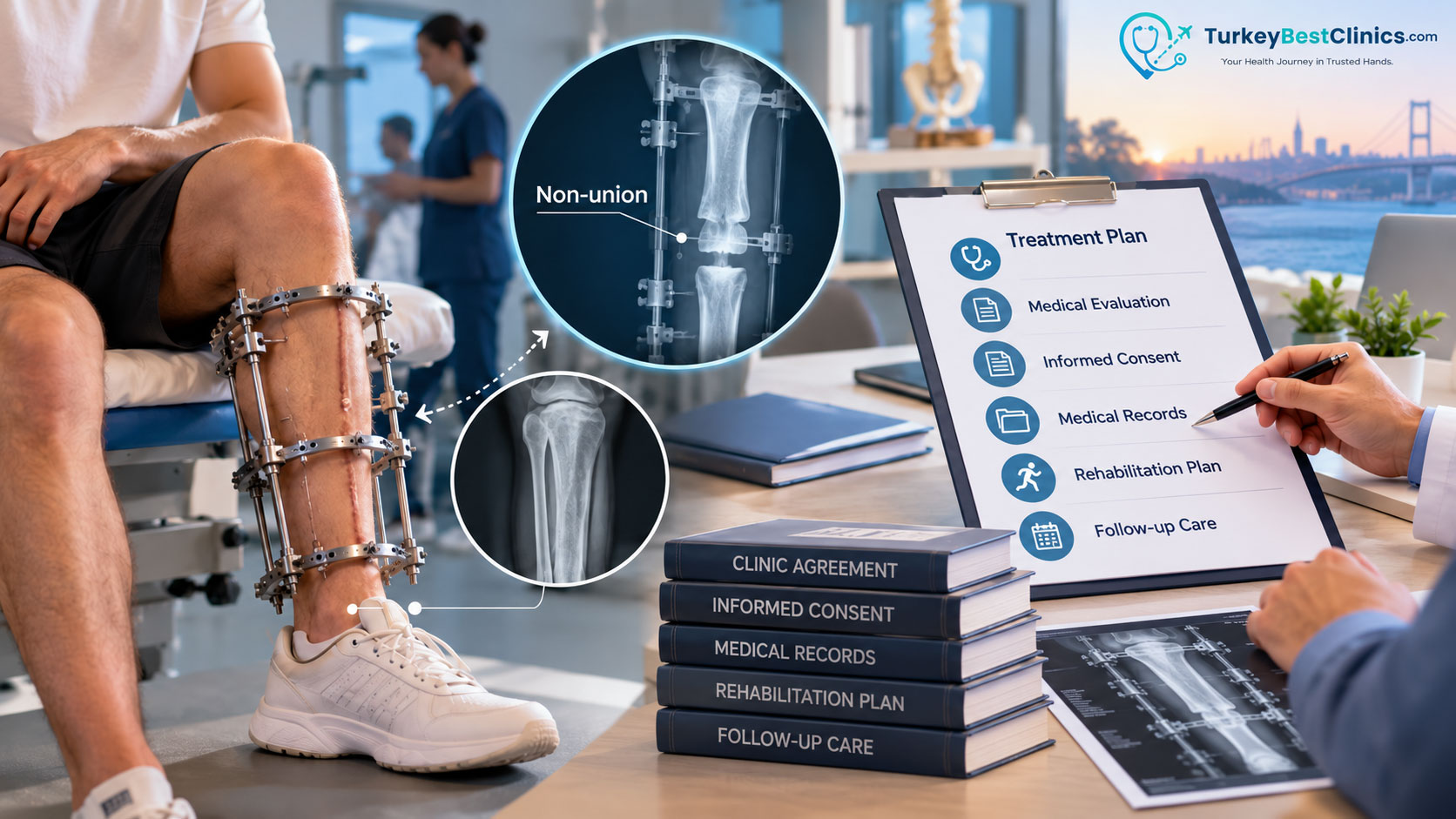
What does non-union mean after limb-lengthening surgery?
During limb-lengthening surgery, the bone is cut in a controlled manner and the distance between the two bone ends is gradually increased. New bone is expected to form in this gap; however, the healing period can be affected by factors such as bone quality, the amount of lengthening, infection, mechanical loading, and smoking.
Non-union refers to a situation in which the bone ends do not show sufficient biological or mechanical healing within the expected period and the likelihood of spontaneous union is considered low. A single X-ray result does not prove legal liability; serial imaging, clinical examination, blood tests, and surgical records must be evaluated together.
If non-union is suspected, it is important to request a written medical assessment and follow-up plan before returning to your country. If you experience worsening pain, redness, discharge, fever, implant movement, or a new deformity in the limb, contact the surgical team and an orthopaedic specialist in your country without delay.
The difference between delayed union and non-union
Delayed union may mean that the bone is healing more slowly than expected, and the possibility of improvement with additional time may remain. Non-union is generally diagnosed through a combined assessment of clinical and radiological findings by the treating orthopaedic team or an independent specialist. Therefore, also check whether the contract contains provisions stating that liability will automatically be accepted after a specific number of days.
The framework for revision safety and surgical liability in Turkey
Having surgery at a healthcare organisation holding a Health Tourism Authorisation Certificate issued by the Ministry of Health of the Republic of Türkiye indicates that the organisation is authorised to provide international healthcare services. This certificate alone does not mean that non-union will not occur or that every revision will be performed free of charge. The facility’s hospital licence, whether the surgery will be performed in a fully equipped hospital, and the availability of intensive care and infection-management facilities should also be reviewed.
Claims of experience in limb lengthening should not be limited to a general promotional statement. Request written, verifiable information about the number of femur or tibia lengthening procedures performed, the protocol used for motorised intramedullary nails or external fixators, experience with revisions requiring bone grafting, and the arrangements for remote follow-up. You should be provided with sterilisation records, the implant lot and serial numbers, the operative report, and the discharge summary.
Medical and legal headings that should be included in the contract
- The scope of the initial surgery, the target lengthening amount, and the brand, model, serial number, or lot number of the implant to be used.
- An informed consent form clearly stating the risks of non-union, infection, implant breakage, nerve damage, joint stiffness, and the possibility of further surgery.
- The conditions under which a revision assessment will be performed, with separate explanations of the costs of free consultations, imaging, the surgeon’s fee, hospital care, the implant, anaesthesia, accommodation, and transfers.
- Who will make the revision decision and whether a second opinion or independent panel assessment will be permitted.
- The email address and telephone number for submitting complaints, the response time, the emergency procedure, and the online follow-up method after you return to your country.
- The governing law of the contract, the competent court or arbitration venue, the prevailing language, and the validity of the translated copy.
A doctor’s duty of care is not a guarantee that the risk of complications will be reduced to zero. However, failure to perform an appropriate indication assessment, neglect of necessary follow-up, defects in the implant or surgical procedure, or failure to manage a complication in a timely manner may lead to a different legal assessment.
Limb-lengthening revision packages and the follow-up process
An international health tourism package may include airport-to-hospital VIP transfers, hotel arrangements, interpreter support, and logistical assistance with initial care or prescriptions; the scope of these services and any additional charges should be clearly stated in the contract. Non-union assessments generally involve reviewing current X-rays, computed tomography when necessary, blood tests if infection is suspected, and detailed records from the previous surgery. Depending on the nature of the revision, the required stay in Turkey may range from several days to several weeks.
Clarify in advance whether your companion can stay with you in the hospital and whether the hotel is within walking distance of the hospital or accessible by a short transfer. If there are prolonged weight-bearing and walking restrictions, arrangements may be made for your companion, such as a quiet walk in a park near the hospital, controlled wellness services, or opportunities to rest at the hotel; however, infection risks and the surgeon’s movement restrictions take priority.
Step-by-step revision protocol
- During the initial consultation, the date of the first surgery, the bone lengthened, the amount of lengthening, the implant used, and previous imaging are reviewed.
- After the examination, X-rays, computed tomography when necessary, and laboratory tests for infection are planned.
- If non-union is confirmed, the possibilities of a mechanical problem, biological insufficiency, or infection are analysed separately.
- The revision may involve one or more methods, such as implant exchange, compression, bone grafting, plate support, external fixation, or infection control.
- Before discharge, written instructions are provided regarding weight-bearing limits, dressing changes, physiotherapy, the imaging schedule, and signs requiring emergency medical attention.
- After you return to your country, a plan is made for sharing images through a secure digital channel and completing online follow-up at set intervals.
Comparison of two main lengthening approaches from a revision perspective
| Methods Compared for You | Most Important Potential Advantage for You | Your Recovery and Hospital Stay |
|---|---|---|
| Internally lengthening motorised intramedullary nail | Controlled lengthening without carrying an external frame and more limited daily care requirements | The initial hospital stay may usually be short; if healing is inadequate, nail exchange, compression, or bone grafting may be required. The duration is determined according to the X-ray findings. |
| Lengthening with an external fixator | Direct adjustment of length and alignment, allowing flexible planning for some complex bone problems | Frame care may be more intensive; close follow-up is required for pin-site infection and restricted joint movement. The hospital stay and overall treatment duration depend on individual findings. |
Comparison of revision costs in Turkey, Europe, and the United States
The cost of non-union revision can vary significantly depending on the technique used for the initial surgery, whether infection is present, whether bone grafting is required, and whether the implant needs to be replaced. The figures below are approximate ranges intended for planning purposes only; check the scope and excluded items before obtaining a written quotation.
| Country | Approximate revision cost | Items that may commonly be included in the price |
|---|---|---|
| Turkey | €12,000–€30,000 | Revision surgery, hospital care, anaesthesia, and basic check-ups; the implant and extended accommodation may be priced separately. |
| United Kingdom | £18,000–£45,000 | Private hospital, surgical team, implant, and short-term follow-up. |
| Germany | €20,000–€45,000 | Hospital care, surgery, imaging, and some follow-up services; complex graft procedures may be calculated separately. |
| United States | USD 35,000–80,000 | Hospital care, surgery, and implant; insurance coverage, rehabilitation, and complication-related costs may vary. |
Especially for revisions requiring travel back to Turkey from abroad, the contract should state in writing who will cover flights, the companion’s expenses, hotel accommodation, physiotherapy, medication, and orthopaedic check-ups in your country. Distinguish whether the term “guarantee” covers a medical outcome or only waives a specified surgical fee.
Factors affecting the revision decision and your legal protection
The surgeon’s expertise and documented surgical experience
When assessing a revision, the orthopaedic and traumatology specialist’s actual experience in deformity correction, lengthening surgery, and non-union management is important. The surgeon’s qualifications, the hospital where the surgery will be performed, the implant to be used, and the option of an independent second opinion should be included in the proposal documents.
Technical and biological causes
An internally lengthening nail, external fixator, plate support, autologous bone graft, or other applications intended to support bone healing do not result in the same legal or financial consequences. The method selected should be justified based on X-rays, computed tomography, signs of infection, the amount of lengthening, bone alignment, and the weight-bearing protocol.
The clinic’s location and contract structure
Whether you are in Istanbul, Ankara, or another city is important in terms of access to the surgical hospital, the frequency of check-ups, and ease of emergency access. If the clinic, hospital, surgeon, intermediary healthcare organisation, and company receiving payment have different legal identities, each party’s role should be clearly stated in the contract.
In the event of a dispute, preserve your medical file, contract, invoices, payment receipts, consent forms, correspondence, and imaging records. Since administrative application channels, consumer dispute procedures, litigation, or arbitration options in Turkey may vary depending on the specific contract and the nature of the incident, consult a lawyer practising healthcare law in Turkey and, where necessary, a legal adviser in your country. This content does not constitute a legal opinion.
Next steps after non-union
- Will the revision be free of charge? Does the contract separately specify the scope of free surgery for non-union, as well as implant and hospital costs and travel and accommodation expenses?
- How can you obtain an independent second opinion? Can your X-rays, computed tomography scans, operative report, and implant information be securely shared with an independent orthopaedic specialist in Turkey or in your country?
- How will follow-up continue after you return home? Who is responsible for the online follow-up schedule, imaging intervals, the emergency contact number, and communication with your doctor in your country?
Do not finalise payment or a revision plan until you have received written answers to these three points. Separating medical necessity, legal responsibility, and financial scope can help you make a safer and more transparent decision.