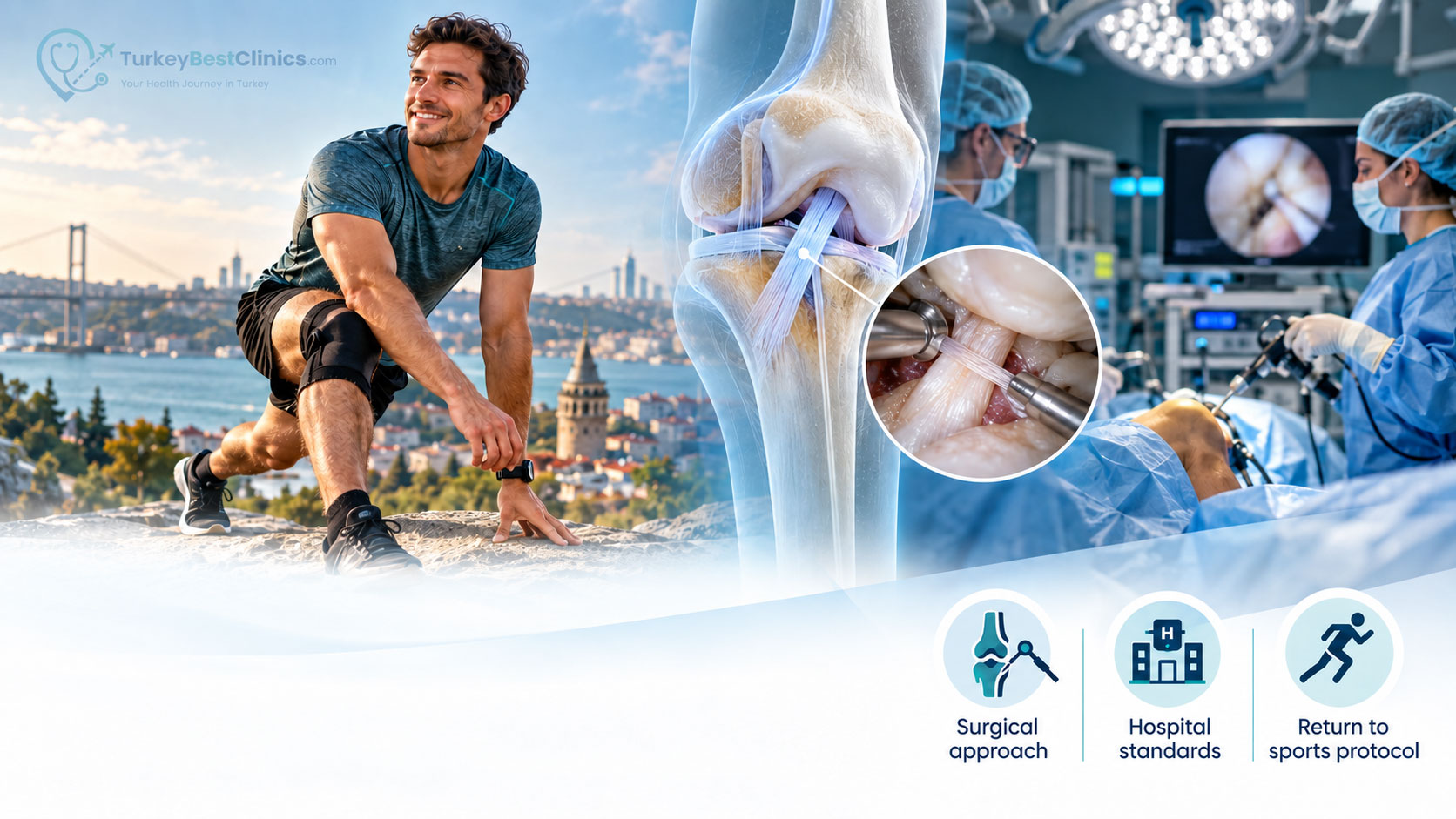
What Does Returning to the Field After ACL Repair Mean?
The anterior cruciate ligament is one of the main structures that controls forward movement of the knee and instability during rotational movements. In sports involving changes of direction, such as football, basketball, skiing, handball and tennis, a reduction in pain alone after an ACL injury is not considered sufficient for returning to professional competition.
In Turkey, the term “ACL repair” may refer to two different approaches: preserving and repairing the ligament’s own anatomical tissue in suitable tears, or recreating the damaged ligament using a tendon graft. The surgical decision is based on the tear’s location on the ligament, tissue quality, accompanying meniscus or cartilage damage, age, sport and previous knee surgeries.
A return-to-professional-sport rate cannot be guaranteed as a single percentage. In the general athletic literature, return-to-sport rates at any level are commonly reported at around 80–90%, while returning to preoperative performance and the same level of competition is more variable; many studies report this rate at approximately 55–65%. Although results for selected tears treated with ACL repair are promising, long-term retear data are not as extensive as those for reconstruction.
Turkey’s Hospital and Safety Standards for ACL Surgery
Authorization, operating-room infrastructure and sports-surgery assessment
When planning surgery in Turkey as part of medical tourism, it is important to verify that the procedure will be performed at a fully equipped hospital by an organization holding a Ministry of Health-approved Health Tourism Authorization Certificate. This certificate is a basic administrative criterion for ensuring that health tourism services are provided in accordance with regulations; by itself, it does not guarantee the success of a particular surgery.
At the hospital where the surgery will be performed, assess the orthopedic surgery infrastructure requiring laminar airflow, sterilization traceability, operating-room infection-control protocols, anesthesia safety, access to intensive care and coordination of postoperative physical therapy. Some institutions may hold international accreditations such as JCI; however, you should directly verify the accreditation, its current scope and the institution’s actual service areas related to ACL surgery with the clinic.
Turkish orthopedic teams work with techniques and applications such as hamstring tendon grafts, bone–tendon–bone grafts, allografts, anatomical tunnel placement, meniscus repair and mobile camera systems in arthroscopic knee surgery. For ACL repair, selected avulsion-type tears in which the ligament has separated from the femoral side may be evaluated for suture anchors or suture-augmented repair techniques. Asking about the surgeon’s number of ACL repairs and reconstructions performed in the last 12–24 months, reoperation rates and examples involving athletes in sports similar to yours can support a rational choice.
Measurable safety indicators for professional athletes
- Preoperative magnetic resonance imaging to assess the tear level and the condition of the meniscus and cartilage.
- Assessment of muscle strength, range of motion, balance and landing mechanics in both legs.
- A written protocol addressing the risks of postoperative infection, blood clots, joint stiffness and reinjury.
- Regular communication between the physical therapist, orthopedic surgeon and, when necessary, sports physician.
- A plan for online consultations, image sharing and rehabilitation reporting after returning to your country.
What an ACL Repair Package Includes and Your Stay in Turkey
The planned medical tourism package may include VIP airport-to-hospital transfers, accommodation at the selected hotel standard, medical interpreter support and essential guidance required during the initial care period. The scope should be clarified in writing according to the hospital and accommodation options.
Before ACL surgery, a knee examination, review of current MRI images, blood tests, an anesthesia assessment and, when necessary, a chest X-ray or electrocardiogram are planned. After uncomplicated arthroscopic surgery, you may be advised to stay in Turkey for approximately 4–7 days and travel after your stitches, wound and initial movement have been checked; however, the exact duration depends on the assessment of the surgeon and anesthesia team.
The possibility of your companion staying with you at the hospital, hotel options close to the hospital and transfer arrangements can be planned in advance. While you focus on rehabilitation and rest, your companion may reduce waiting-related stress with a quiet walk in a nearby park, time in a wellness area or a short cultural visit; long walks and crowded schedules should be avoided during the first few days.
Step-by-step process before and after surgery
- Your documents, MRI images and previous surgical reports are reviewed remotely for an initial assessment.
- During an in-person examination in Turkey, the suitability of the ligament for repair or the need for reconstruction is assessed.
- Anesthesia, bleeding risk, existing medical conditions and products currently being used are evaluated; medication adjustments should only be made by your doctor.
- Arthroscopic surgery is performed, and if meniscus damage is present, repair or another appropriate procedure may be planned during the same session.
- Physical therapy, crutch use, knee range of motion and weight-bearing limits are explained in writing.
- After you return to your country, wound appearance, range of motion, pain, swelling and physiotherapy progress are assessed during online follow-up.
ACL Surgery Costs in Turkey and Country Comparison
The approximate total cost of ACL surgery in Turkey varies according to the surgical technique, graft type, meniscus procedure, hospital category, surgeon’s experience and services included in the package. The figures below are general medical tourism ranges for 2026; a definitive quotation should be prepared after imaging and examination.
| Country | Approximate range for ACL surgery | Price note |
|---|---|---|
| Turkey | €3,500–€7,500 | May vary according to the choice of arthroscopy, hospital, surgeon and basic transfer package. |
| United Kingdom | £10,000–£18,000 | Private hospital and surgeon fees; rehabilitation may be priced separately. |
| Germany | €8,000–€15,000 | The graft, meniscus repair and hospital stay affect the total. |
| United States | $15,000–$35,000 | Anesthesia, surgeon, hospital and imaging bills may be issued separately. |
Check in writing whether the quotation provided in Turkey covers only the surgery fee or also includes MRI, anesthesia, hospital stay, initial physical therapy, transfers, interpreter services and follow-up examinations. Flights, long-term physiotherapy, treatment of complications and follow-up costs in your country are assessed separately in most packages.
ACL Criteria That Determine Return to Professional Sport
Three key factors affecting price and the process
- Physician expertise and experience: A focus on sports surgery, the volume of arthroscopic knee procedures, the distribution of cases involving ACL repair and reconstruction, and revision-surgery experience may affect both the surgical plan and the cost.
- Choice of technique and materials: In suitable cases, primary ACL repair, suture-augmented repair, suture anchors or an internal brace approach may be considered; if the ligament tissue is insufficient, reconstruction using a hamstring, patellar tendon or quadriceps tendon graft may be recommended. The graft type and any additional meniscus procedure can change the price and rehabilitation duration.
- Clinic location: In cities such as Istanbul, Ankara, Izmir and Antalya, the hospital category, operating-room capacity, international patient services and hotel costs may be reflected in the total quotation. When choosing a location, compare not only the price but also access to emergency care and physiotherapy coordination.
Comparison of two surgical approaches for athletes
| Methods Compared for You | Main Advantage for You | Your Recovery and Hospital Stay |
|---|---|---|
| Arthroscopic ACL repair in selected cases | Preservation of your own ligament tissue, more limited use of bone tunnels and, in some cases, the potential for more natural proprioception. | Usually an overnight or day-case stay; full return to sport commonly takes 8–12 months, although the tear type and rehabilitation are decisive. |
| Arthroscopic ACL reconstruction | If the ligament tissue is unsuitable for repair, a tendon graft may provide more predictable mechanical stability. | Usually a 1–2-night stay; returning to pivoting sports commonly takes 9–12 months or longer. |
The decision to return to the team should not be based on the calendar alone. Absence of knee swelling, full range of motion, at least 90–95% strength compared with the opposite leg, adequate symmetry in hop tests, no inward collapse of the knee during changes of direction and completion of sport-specific conditioning should all be assessed together.
Psychological readiness is also important at the professional level. Fear of reinjury may affect decision-making speed and landing technique; therefore, field work, strength training, proprioception, neuromuscular control and sports psychology support may all be included in the same rehabilitation plan. Because the risk of retearing after ACL repair may be reported as higher than after reconstruction in some selected groups, you should specifically ask the surgeon about their own results and the sport-specific risk assessment.
Practical Next Steps After ACL Repair
Before deciding on surgery in Turkey, your records should be reviewed remotely, your knee should be examined in person and your rehabilitation plan should be put in writing; if your goal is to return to professional sport, coordination with your club’s medical team is also necessary. No clinic can guarantee a return to sport by a specific date or at a definite rate.
- Is my ACL tear suitable for repair, or would reconstruction with a hamstring or patellar tendon graft be more rational?
- Which strength, hop and movement-control tests will I need to pass before returning to pivoting sports such as football, basketball or skiing?
- After I return from Turkey, how often will you monitor my MRI, wound checks and physiotherapy progress online?