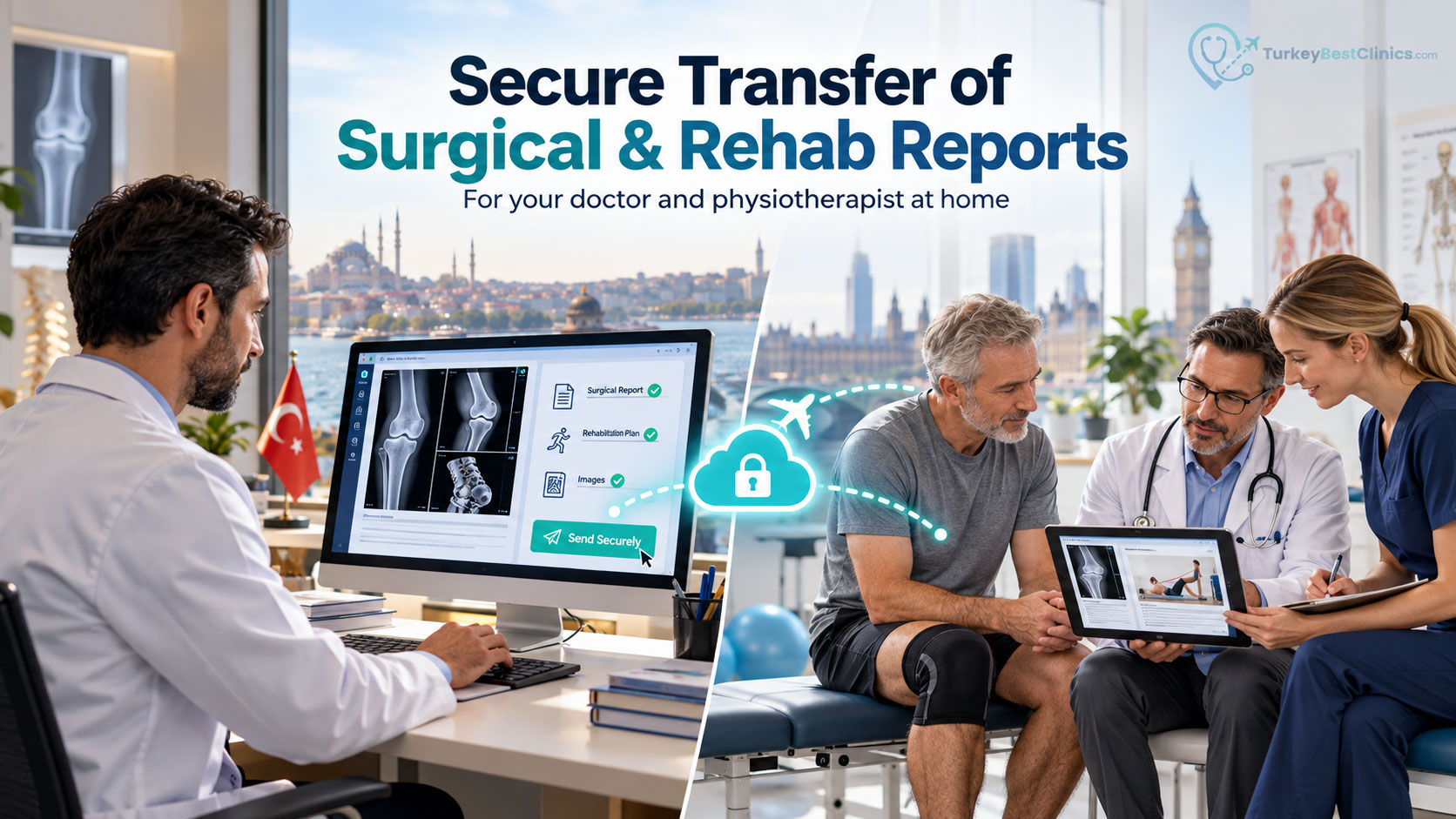
Sending Your Postoperative Report to Your Local Care Team
After your surgery in Turkey, the surgical report, discharge summary, and rehabilitation plan can help your doctor and physiotherapist in your home country continue your treatment safely. These documents should explain not only how the surgery was performed, but also movement restrictions, wound care, follow-up dates, and exercise progression.
The safest approach is for your surgeon to sign the documents, complete them with the necessary medical imaging and laboratory results, and then send them to your local healthcare team through a secure channel with your written consent. Email, an online patient portal, or direct doctor-to-doctor communication may be used; however, sending files openly and without protection should be avoided.
Key information your report file should include
- The date of surgery, the full name of the procedure performed, and the surgeon’s assessment
- Details of the surgical approach used and, where applicable, the technical specifications of any implant or special material
- Findings observed during surgery and any complications, if present
- Discharge status, wound checks, and symptoms requiring urgent medical attention
- Weight-bearing, joint range-of-motion, and daily activity restrictions
- Physiotherapy frequency, recommended exercise stages, and progress criteria
- Follow-up appointments, imaging requirements, and the online follow-up plan
Surgical Reporting in Turkey and Ministry of Health Authorization
It is important that your surgery be performed in a fully equipped hospital using sterilization protocols and operating-room safety procedures. It is equally important that your medical documents be prepared in an organized manner. If the organization providing services within the scope of health tourism holds a Health Tourism Authorization Certificate approved by the Republic of Türkiye Ministry of Health, this can help ensure that international coordination is managed within an institutional framework.
Rather than using only general statements, your Turkish surgeon should specify the surgical site, technique used, expected recovery milestones, and the restrictions that must be observed during physiotherapy. For example, in joint surgery, the permitted range of motion, when weight-bearing may begin, the implant model used, and the timing of follow-up imaging can be stated clearly. In spinal surgery, lifting restrictions, neurological warning signs, and postural recommendations may also be explained separately.
Security and document verification steps
- Having the report dated and signed by the surgeon or an authorized physician
- Checking the organization’s Health Tourism Authorization Certificate details
- Preparing imaging files in DICOM format and reports in PDF format
- Having the translation completed by a professional familiar with medical terminology
- Obtaining your informed consent before sending the documents to your local doctor
- Confirming that the recipient has received the files after they are sent
Contents of Your Surgery and Rehabilitation File
The coordination package may include VIP transfers, hotel arrangements, interpreter support, and logistical assistance required during initial care or after discharge. Additional arrangements may also be made for your companion to stay with you in the hospital, for accommodation close to the hospital, and for low-effort activities such as quiet park walks or wellness areas while you are resting.
For report transfer, at least one original document in Turkish and a professional translation in a language understood by your local healthcare team should be prepared according to the type of surgery. The length of your stay in Turkey varies depending on the scope of the procedure. The preoperative examination, blood tests, anesthesia assessment, required imaging, surgery, initial follow-up, and fitness-to-fly assessment are planned together.
Two secure transfer methods
| Methods Compared for You | Main Advantage for You | Your Recovery and Follow-Up Timeline |
|---|---|---|
| Sending files through an encrypted patient portal | Brings reports, imaging, and translation files together in one access area, with download and delivery information that can be tracked. | Documents are usually uploaded before discharge, allowing the local team to review them on the same day. |
| Direct communication between the surgeon in Turkey and your local doctor | Technical questions can be answered quickly, and the physiotherapy plan can be clarified based on the surgical findings. | The first online consultation is usually held before you return home or during the first few days after your return. |
Translation and file organization
Text prepared in English, German, French, or another language used in your country should undergo a medical terminology review rather than being translated word for word by an automated system. Terms such as “non-weight-bearing,” “partial weight-bearing,” “active movement,” and “passive movement” have direct implications for physiotherapy, so the translation should not leave room for ambiguity.
The file sent to your local team may include the surgical report, anesthesia summary, discharge document, prescription information, imaging reports, an imaging CD or DICOM link, the rehabilitation protocol, and emergency contact information. Medication names or dosage information should appear only in documents prepared by an authorized physician; new treatment recommendations should not be improvised during online communication.
Report Transfer and Coordination Costs
There is no fixed international price for report preparation, medical translation, imaging transfer, and surgeon–physiotherapist coordination. The ranges below are approximate indications for comprehensive document preparation and communication services only; surgery, hospital stays, physiotherapy sessions, and flight costs may not be included.
| Country | Approximate report and coordination cost | Services that may typically be included |
|---|---|---|
| Turkey | €150–€600 | Report preparation, medical translation, file consolidation, and online communication with a physician |
| United Kingdom | £200–£800 | Private clinic correspondence, interpreting, and specialist opinion coordination |
| Germany | €250–€900 | Doctor-to-doctor correspondence, document verification, and transfer of the rehabilitation plan |
| United States | $300–$1,200 | Medical record review, specialist coordination, and translation services |
Before accepting a price quotation, clarify how many pages will be translated, whether imaging files will be transferred, how many online consultations with the surgeon are included, and whether written responses will be provided to your local physiotherapist. Some organizations only send documents, while others provide online follow-up for a specified period after your return home.
Factors That Affect Document Content and Communication
The scope of report transfer is directly related to the surgeon’s specialty and experience with the relevant type of surgery. After complex joint reconstruction, spinal surgery, or microsurgery, your local physiotherapist should receive not only a general discharge summary but also staged movement and loading restrictions.
- Physician’s specialty and experience: A surgeon’s ability to reflect the technical details of the procedure in the report reduces the risk of misinterpretation by the local team.
- Procedure-specific technique or material: An arthroscopic or open approach, robotic assistance, tendon graft, joint prosthesis, spinal implant, or biological material may change rehabilitation restrictions and the imaging required.
- Clinic location: Centers such as Istanbul, Ankara, Izmir, or Antalya may offer broader international coordination and multilingual document support. However, the choice of city should also be assessed in terms of transport to the hospital and the feasibility of attending follow-up appointments.
- Rules of the local healthcare system: Your country’s data-protection regulations, insurance preauthorization, doctor referral procedures, and requirements for accepting translations should be checked in advance.
These criteria may affect both the scope of document preparation and the service fee. When requesting a written quotation from the healthcare organization, also ask where your personal data will be stored, who will have access to the files, and how you can withdraw permission for sharing.
Three Practical Steps After Returning Home
- How should my local physiotherapist adapt the rehabilitation plan from Turkey to my treatment schedule in my home country? This question helps ensure that exercise frequency, movement limits, weight-bearing level, and progress criteria are assessed together.
- How can my local doctor access information about the implant or surgical material used in my operation? The implant card, manufacturer details, serial number, and documents required for follow-up imaging should be stored together in one file.
- During online follow-up, which symptoms should prompt me to contact the surgeon in Turkey or my local emergency medical services? A written action plan should be prepared in advance for symptoms such as fever, wound discharge, increasing pain, new weakness, changes in circulation, or shortness of breath.
Before returning home, store the final versions of your reports, the translation, the imaging link, and contact details on your phone and in a secure cloud account. After confirming that your local doctor and physiotherapist have received the file, schedule the first online follow-up consultation. During this consultation, your recovery status, exercise tolerance, and next follow-up date can be reviewed together.