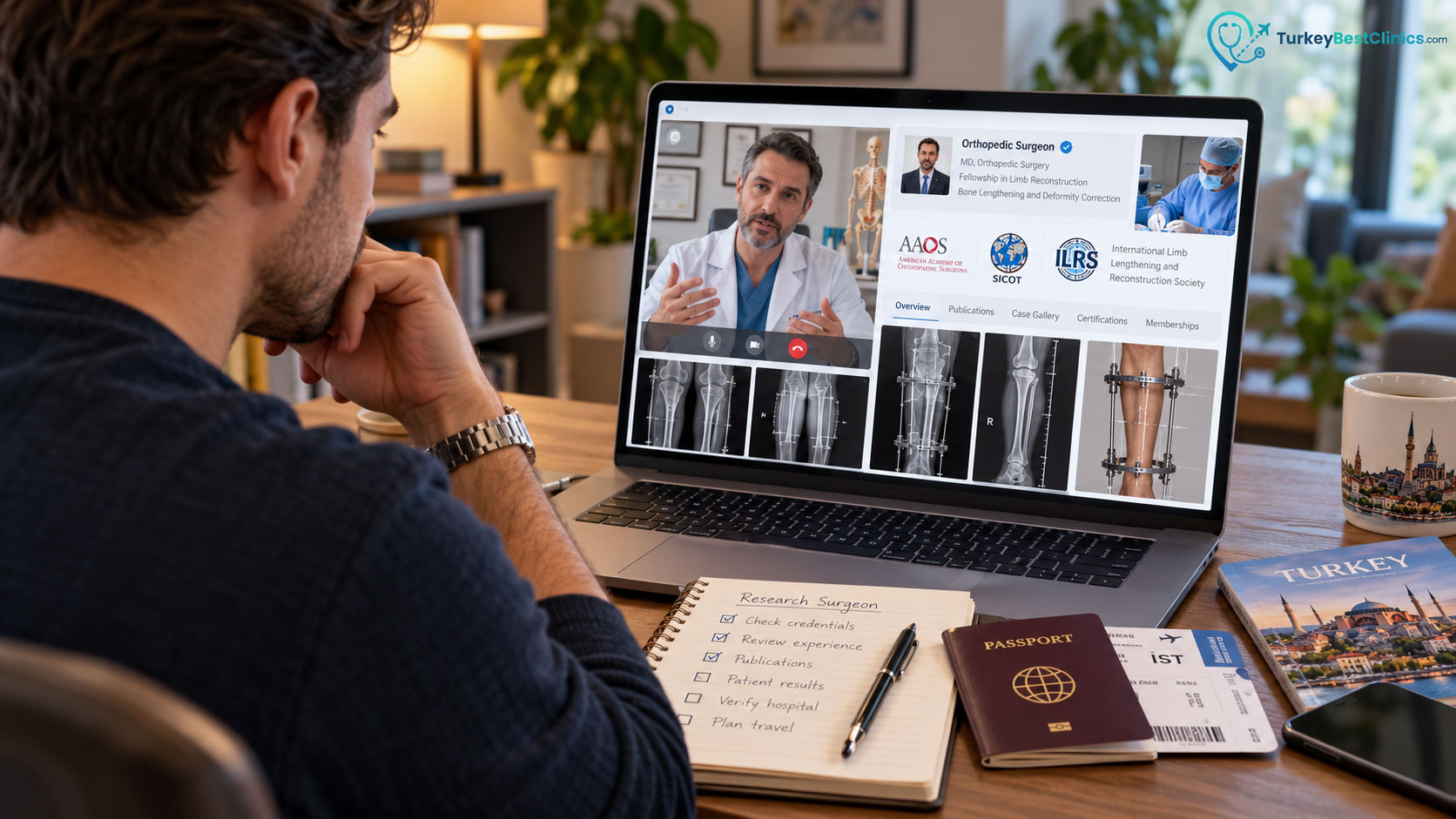
Why Is Verification Important When Choosing a Limb Lengthening Surgeon?
Limb lengthening surgery is based on controlled bone cutting, gradual separation of bone segments, and monitoring the formation of new bone. Cosmetic lengthening and reconstructive procedures, such as correcting a leg-length discrepancy or deformity, may not require the same surgical plan.
For this reason, rather than relying solely on statements such as “international experience” or “academic success” on a website, you should review the surgeon’s official memberships, licensing status, scientific work, and the credentials of the hospital where the surgery will take place. If an intramedullary magnetic nail, motorized nail, or external fixator will be used, you should also ask specifically about the surgeon’s actual experience with that technique.
During the initial consultation, the limb lengthening goal, bone structure, joint range of motion, soft-tissue flexibility, neurovascular status, and rehabilitation capacity should be assessed. A single photograph or online message is not sufficient to determine surgical suitability with certainty.
Checking LLRS Membership and Limb Lengthening Society Records
LLRS is one of the internationally recognized professional organizations in the field of limb lengthening and reconstruction. However, the presence of the abbreviation LLRS on a surgeon’s website alone is not proof of active membership, a specific level of seniority, or a particular surgical outcome.
How can you review official society records?
- Visit the society’s own website: If it has a membership directory or a “find a surgeon” feature, search using the surgeon’s full name, city, and country.
- Distinguish between similar names: Compare the middle name, surname spelling, academic title, and workplace information with the name shown on the surgeon’s passport or professional profile.
- Ask about membership status: Confirm directly with the society what statuses such as active member, associate member, fellow, or similar designations mean.
- Contact the society’s secretariat: You can write to its official email address to ask whether a specific person currently holds membership and which details may be disclosed to the public.
- Distinguish conference participation from membership: Presenting at a conference or attending a course does not automatically mean that someone is a society member or instructor.
In addition to LLRS, national or regional organizations in limb lengthening, deformity surgery, orthopedics, and traumatology may also be reviewed. Consider society membership as one indicator of credibility; it should not be considered sufficient on its own without also evaluating the surgeon’s specialist credentials, surgical volume, complication management, and follow-up plan.
Hospital and Surgeon Authorization for Limb Lengthening in Turkey
When applying for treatment within the scope of health tourism in Turkey, check whether the facility where the procedure will be performed holds an International Health Tourism Authorization Certificate issued by the Ministry of Health of the Republic of Türkiye. Confirm the certificate’s validity and whether the facility is listed as an authorized healthcare institution through official Ministry sources or in writing from the healthcare organization concerned.
An authorization certificate does not automatically demonstrate that the surgeon is an expert in a particular operation. You should separately investigate the surgeon’s valid specialist registration in Türkiye, the hospital’s orthopedics and traumatology department, its operating-room infrastructure, and its postoperative rehabilitation services.
Which records should you look for in a limb lengthening surgeon’s academic profile?
- University or teaching and research hospital profile: The position title, department information, and previous appointments should appear on the institution’s official website.
- Publication databases: Search for the surgeon’s full name on PubMed, Scopus, Web of Science, Google Scholar, or ORCID.
- Author matching: Check whether the publication’s subject is genuinely related to limb lengthening, deformity correction, intramedullary nails, external fixation, or rehabilitation.
- Publication type: Distinguish between peer-reviewed research, systematic reviews, case series, conference abstracts, and commercial promotional content.
- Recency: Older publications demonstrate an academic background, but do not by themselves prove current surgical approaches or device experience.
An ORCID profile can be a useful starting point; however, an ORCID record is not an accreditation confirming the accuracy of every publication or the person’s clinical success. Compare the publication details with the journal’s own website, the DOI record, and, where possible, the PubMed record.
Limb Lengthening Packages and the Preoperative Verification Process
A health tourism plan may include basic logistics concerning airport-to-hospital transfers, accommodation, interpreter support, and the initial care period. Clarify in writing in advance whether your companion can stay with you at the hospital, how far the hotel is from the hospital, and whether quiet walking areas or wellness options are available nearby during rehabilitation.
Before limb lengthening, full-length weight-bearing X-rays, lower-extremity alignment measurements, joint range-of-motion assessments, and general preoperative tests are commonly considered. The type of device used, the intended amount of lengthening, the intensity of postoperative physiotherapy, and the length of stay in Turkey vary according to the individual assessment.
What should be included in writing in the treatment protocol?
- Dates of the initial examination and imaging
- The fully equipped hospital where the surgery will be performed and access to intensive care
- The planned hospital stay and discharge criteria
- When physiotherapy will begin and how often it will take place each week
- The procedure to follow in cases of joint stiffness, infection, nerve tension, or device problems
- An Online Follow-up plan specifying how imaging and examination results will be reviewed after you return to your country
Ask in advance whether you will need orthopedic, physical therapy, or rehabilitation support in your home country for postoperative follow-up. Remote follow-up cannot replace every aspect of an in-person examination; a written plan for seeking local healthcare in the event of emergency symptoms or rapid deterioration should be provided.
General comparison of two main surgical approaches
| Methods Compared for You | Most Important Advantage for You | Your Recovery and Hospital Stay |
|---|---|---|
| Motorized or magnetic intramedullary nail providing internal lengthening | No prominent external fixator frame and potentially less extensive daily care | Usually a hospital stay of several days; bone healing and physiotherapy may take months |
| External fixator or combined internal-external fixation | Flexible planning for complex deformities, certain bone problems, or specific correction requirements | May require frame care and longer rehabilitation; the length of hospitalization depends on the scope of the plan |
The appropriate method is determined by the bone diameter, intended lengthening, status of the growth plates, joint motion, previous surgeries, and the surgeon’s clinical assessment. The phrase “the newest device” does not automatically mean it is the best option for every anatomical structure or every goal.
Comparing Limb Lengthening Surgery Costs and Quotes in Turkey
The figures below are approximate ranges that may be seen in the international private healthcare market; they can vary according to the surgical plan, device, hospital, rehabilitation, and length of stay. Do not compare prices directly between countries without asking about the scope of the written quote and any additional charges.
| Country | Approximate total range | Items to check particularly carefully in the quote |
|---|---|---|
| Turkey | €35,000–€70,000 | Magnetic nail or external fixator, hospital stay, physiotherapy, follow-up appointments, and device cost |
| United Kingdom | £70,000–£120,000 | Surgeon’s fee, private hospital, rehabilitation, and the scope of any potential revision |
| Germany | €60,000–€100,000 | Implant, imaging, hospitalization, physiotherapy, and follow-up period |
| United States | $80,000–$150,000 | Hospital, anesthesia, implant, rehabilitation, and separate complication-related charges |
Factors That Change the Price and Process in a Limb Lengthening Quote
- The surgeon’s qualifications and experience: Ask in writing about their training in deformity surgery, limb lengthening, intramedullary nailing, and external fixation; their approximate annual number of surgeries; and their experience with similar anatomical plans.
- Technology, technique, and materials: A motorized or magnetic intramedullary nail, external fixator, combined technique, nail removal surgery, and the characteristics of the implant used can affect the total cost.
- Clinic and hospital location: Hospital costs in Istanbul, Ankara, Izmir, or another city should be assessed together with accommodation, transportation, access to physiotherapy, and companion expenses.
Ask for the quote to list surgery, anesthesia, implant, X-rays, blood tests, hospital stay, physiotherapy, interpreter services, transfers, follow-up examinations, and any potential device removal procedure separately. Also check in the contract who bears financial responsibility for revision surgery, infection, neurovascular problems, or an unexpectedly prolonged hospital stay.
Three Questions to Ask After Verifying a Limb Lengthening Surgeon
- Can the surgeon’s membership status in LLRS or other limb lengthening societies be confirmed through the society’s official records system or secretariat?
- What is the surgeon’s experience in recent years with similar cases involving the planned magnetic intramedullary nail or external fixator, and what is their approach to complication management and revision?
- After returning to your country, according to what schedule and through which responsible team will X-ray checks, physiotherapy coordination, and Online Follow-up be conducted?
Instead of general verbal answers to these three questions, request names, dates, official links, documents, or a written protocol. When identity and publication matches, Ministry of Health authorization, hospital infrastructure, the surgical technique, and the follow-up plan are verified together, your decision becomes more measurable and transparent.