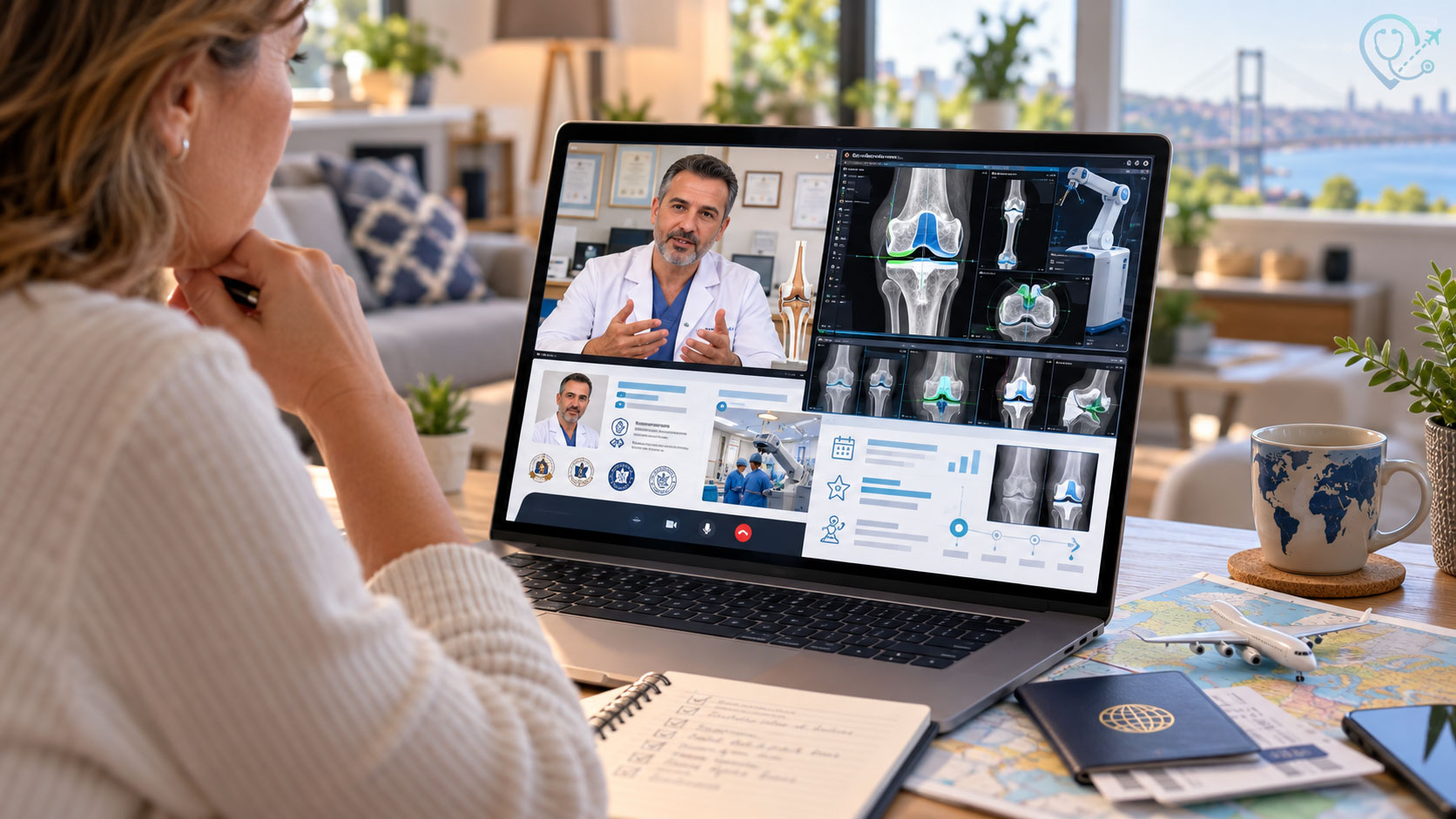
Key Points for Evaluating MAKOplasty Experience Remotely
MAKOplasty is an approach that uses robotic-arm-assisted surgical planning and technology, particularly in knee and hip joint surgery. The system helps plan bone cuts and implant positioning using a three-dimensional anatomical model created from computed tomography data; however, the robotic system does not perform the surgery on its own.
When making your decision, do not rely solely on the term robotic surgery displayed on a clinic’s website. Review the orthopedic surgeon’s training in the relevant joint surgery, annual case volume, length of experience using the MAKO system, and postoperative follow-up plan together.
Remote verification is not completed with a single document. The surgeon’s official specialist registration, the hospital’s authorization from the Ministry of Health, confirmation that the stated robotic platform is genuinely available, the clarity of the personalized treatment plan, and the consistency of the answers to your questions should all be assessed together.
Safety and Authorization for Robotic Knee and Hip Surgery in Turkey
Official and hospital documentation
As a first step, verify whether the facility where the procedure will be performed holds a Health Tourism Authorization Certificate issued by the Ministry of Health of the Republic of Türkiye. Request the certificate’s current date, the organization’s full legal name, and the healthcare services covered by the certificate in writing. Rather than accepting the document only as an image, verify it through official records or the hospital’s verifiable communication channels.
- The hospital’s full name, address, and the campus where the surgery will be performed.
- Whether the Health Tourism Authorization Certificate is current.
- Whether the hospital has an operating room, intensive care unit, and 24-hour emergency support.
- How international sterilization, infection control, and implant traceability procedures are managed.
- Whether the robotic system belongs to the hospital or is used through a temporary service model.
The surgeon’s qualifications and case history
Ask for the surgeon’s specialist qualifications to be verified through the Turkish Medical Association or relevant official professional records. Specialization in orthopedics and traumatology alone does not prove MAKOplasty experience. Ask separately about regular experience with relevant procedures such as knee replacement, partial knee replacement, total knee replacement, or hip replacement.
For international case numbers, a general statement such as “a large number of surgeries” is not sufficient. Ask the surgeon for aggregate statistics from the past 12 or 24 months, with personal data removed and cases categorized by procedure. For example, MAKO-assisted partial knee replacement, MAKO-assisted total knee replacement, and hip surgery should be listed under separate headings.
Evidence that can be requested remotely
- Specialist certificate and professional résumé.
- Records of manufacturer training, cadaver courses, or advanced surgical training related to the robotic system.
- The annual case range for the relevant procedure and the surgeon’s personal role in those cases.
- A sample surgical report with identifying information removed.
- Information about implant brand and model traceability, as well as the implant card provided to the patient.
- Institutional information on how complication, revision surgery, and infection rates are monitored.
These documents should not include personal data such as passport numbers, dates of birth, telephone numbers, file numbers, or facial images. A transparent institution should provide the information needed for verification while also protecting privacy.
MAKOplasty Package, Preparation, and Companion Planning
An international healthcare package may include airport-to-hospital transfers, accommodation, interpreter support, and basic logistical coordination during the initial care period. The package agreement should clearly state the scope of these services, the number of nights included, the conditions under which a companion can benefit from them, and any additional charges.
Before robotic knee or hip surgery, you may need an imaging protocol, blood tests, an anesthesia assessment, and a review of your current medications and chronic conditions. Ask in advance where and according to which protocol the computed tomography scans will be performed, and when the surgeon will incorporate the images into the surgical plan.
Before traveling, clarify in writing whether your companion can stay with you in the hospital, the conditions for a private room, and visiting hours. A hotel close to the hospital may offer practical advantages by allowing your companion to access nearby quiet park walks, wellness areas, or peaceful places to rest while you recover; however, your postoperative movement restrictions and transportation safety should always take priority.
Step-by-step process protocol
- X-rays, MRI scans, or existing CT images are reviewed through a secure digital channel.
- During a video consultation, the surgeon assesses pain, restricted movement, previous surgeries, and expectations.
- If necessary, the technical specifications of the CT scan to be performed in Turkey and preoperative tests are planned.
- The hospital stay, start of physical therapy, and criteria for safe discharge are explained.
- After you return to your country, the dates of online follow-up consultations and the designated contact person are established.
Costs of Robotic Joint Surgery in Turkey, the UK, Germany, and the USA
The cost of robotic knee or hip surgery varies according to the type of implant, whether the procedure is unilateral or bilateral, hospital stay, physical therapy, imaging, and the scope of complication coverage. The ranges below show approximate private healthcare price levels for market research only; they do not constitute a personal quotation or indicate medical necessity.
| Country | Approximate price range | Items that may be included |
|---|---|---|
| Turkey | €10,000–€18,000 | Surgery, standard implant, hospital stay, and basic transfer; coverage varies by institution. |
| United Kingdom | £15,000–£25,000 | Private hospital, surgeon, anesthesia, and implant fees; robotic use may be priced separately. |
| Germany | €18,000–€30,000 | Hospital, surgical team, implant, and rehabilitation costs; package coverage varies. |
| United States | $30,000–$60,000+ | Hospital, surgeon, anesthesia, implant, and additional services not covered by insurance. |
When requesting a quotation, ask for the services covered by the term “robotic surgery” to be itemized in writing. The surgeon’s fee, robotic platform usage fee, CT planning, implant, anesthesia, potential intensive care, additional nights, physical therapy, interpreter services, and pre-return check-up should each be listed separately.
Factors Affecting the Price and Verification Outcome
- Surgeon’s qualifications and experience: Annual case volume in knee or hip joint surgery, the number of MAKO-assisted procedures, separate reporting of partial and total replacement experience, and training history are important.
- Method and technology used: The quotation should clearly specify the actual technical details, such as the MAKO robotic-arm-assisted system, three-dimensional CT-based planning, partial knee replacement, total knee replacement, or robotic hip replacement. You should also ask at which stages robotic assistance will be used instead of conventional surgery.
- Clinic location: Hospital, implant supply, rehabilitation, and international patient coordination costs may differ in Istanbul, Ankara, Izmir, and other cities. When choosing a location, assess not only the price but also access to intensive care, airport transportation, and ease of communication after returning to your country.
Asking how many people came from each country is not, by itself, sufficient to assess the “number of international cases.” The institution should explain the case definition, whether the same surgeon personally performed the surgery, the period covered by the data, and how complications are classified. If the institution cannot share this data, ask why and what verifiable indicators it can provide instead.
Next Steps After Remote Verification
Before your initial video consultation, organize your imaging, previous surgical reports, list of treatments you use, and known health conditions. Make sure the surgeon’s recommendation is based not only on imaging but also on the need for a clinical examination and your postoperative goals.
- Is CT planning mandatory for MAKOplasty? Find out which CT protocol will be used, how the images will be transferred into the surgical plan, and whether scans taken before traveling to Turkey will be accepted.
- How is the surgeon’s actual robotic case experience documented? Request aggregate procedure-specific case data from the past 12–24 months, manufacturer training records, and the institution’s method for monitoring complications.
- How will follow-up continue in your country after surgery? Clarify in writing the follow-up dates in Turkey, the online monitoring program, physical therapy reports, the team to contact in an emergency, and the process for sharing information with your local orthopedist.
These checks can help you make a more informed decision when choosing robotic orthopedic surgery in Turkey. However, reviewing documents remotely does not replace an in-person examination, anesthesia assessment, or independent second opinion. Before making a decision, evaluate the package scope, potential risks, alternative surgical options, and criteria for returning safely to your country in writing.