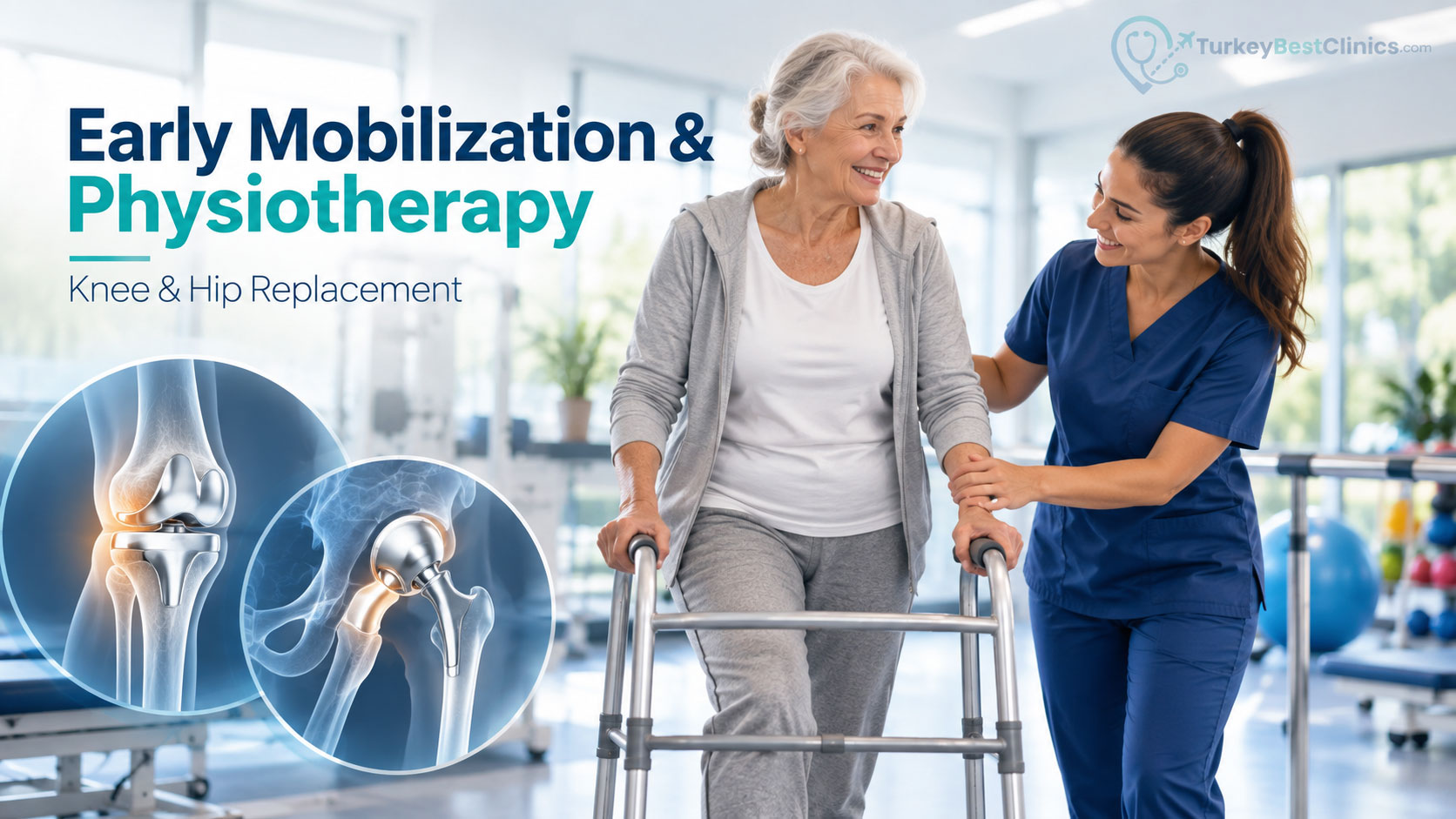
The First Step After Knee or Hip Replacement: Safe Mobilization
The first goal after knee or hip replacement surgery is to support circulation without prolonged bed rest and to return to daily movements in a controlled manner. However, the decision to stand up the day after surgery is determined by the stability of the implant, bone quality, surgical approach, bleeding status, blood pressure, dizziness, and your surgeon’s weight-bearing instructions.
When considered appropriate, the physiotherapist will guide you through sitting on the edge of the bed, standing up, taking a few steps with a walker, and returning safely to bed. After knee replacement, controlled bending and straightening of the knee are central to the process. After hip replacement, it is essential to follow movement restrictions based on the surgical approach used.
The aim is not to push through pain, but to establish a safe and repeatable movement routine within the limits set by the surgical team. Sudden turning, walking without support, or using stairs without the physiotherapist’s approval should be postponed.
Example Schedule for the Day After Surgery
- Morning clinical assessment: Blood pressure, pulse, temperature, the wound area, drain status, blood results, and any dizziness that could prevent standing are assessed.
- First bedside session: Ankle pumps, breathing exercises, gentle activation of the leg muscles, and position changes are performed.
- First time standing: A walker is used with support from the physiotherapist and, when necessary, a nurse. The first distance may be just a few steps.
- Repetition during the day: If your clinical condition allows, short and controlled walks, sitting in a chair, and transferring to the toilet are practiced.
- Evening reassessment: Pain, swelling, fatigue, wound appearance, and walking safety are reviewed to determine the intensity of the hotel program.
Hospital Safety and Surgical Oversight in Turkey for Joint Replacement
It is important to plan this process through an organization holding a Health Tourism Authorization Certificate issued by the Turkish Ministry of Health and through a fully equipped hospital. For knee and hip replacement surgery, a sterile operating room, anesthesia support, imaging facilities, laboratory access, access to blood products, and intensive care support when necessary are all parts of the same plan.
Turkish orthopedic teams work with primary total knee arthroplasty, total hip arthroplasty, revision replacement procedures, and early postoperative rehabilitation protocols. When assessing a team’s experience, it is more meaningful to look beyond a general statement of “expertise” and consider the joint being treated, annual surgical volume, the implant’s registration and follow-up system, and the surgeon’s specific experience in knee or hip reconstruction.
Postoperative Clinical Checkpoints
- Monitoring the wound, dressing, and any drain
- Checking circulation, sensation, and movement in the lower limb
- Managing pain and nausea according to the clinical protocol
- Assessing safe transfers with a walker or crutches
- Providing written explanations of weight-bearing limits
- Sharing an emergency contact number and follow-up date before discharge
If you experience marked calf swelling, new shortness of breath, chest pain, a high fever, heavy wound drainage, uncontrolled pain, or a cold or pale-looking foot, you should contact the surgical team directly rather than continuing with the hotel program.
Hospital-to-Hotel Physiotherapy Plan in a Knee and Hip Replacement Package
As part of the organization, airport-to-hospital-to-hotel transfers, suitable hotel accommodation, interpreter support when needed, and coordination of the initial care process can be combined into a single plan. When selecting a hotel, the availability of an elevator, bathroom grab bars, bed height, travel time to the hospital, and sufficient space for physiotherapy should be checked in advance.
Hotel rehabilitation after knee or hip replacement usually begins after hospital discharge; the exact timing depends on your surgeon’s approval. During the initial assessment, walking distance, wound condition, knee range of motion or hip movement restrictions, pain level, the weight-bearing instructions stated in your documentation, and stair use are reviewed.
Whether your companion can stay with you in the hospital, whether the hotel is close to the surgical center, and whether your companion can enjoy a quiet park walk or low-intensity wellness areas within the hotel while you rest are planned according to the early movement restrictions after knee or hip replacement. Your companion is expected to help with luggage, transfers, the walker, and daily needs; however, they should not pull or lift your operated leg or lead exercises in place of the physiotherapist.
Personalized Physiotherapy at the Hotel
- Transfer training: Safe transfers between the bed, chair, toilet, and vehicle.
- Walking practice: Short distances with a walker or crutches, turning, and controlled stopping and starting.
- Knee replacement exercises: Straightening the knee, controlled bending, activating the thigh muscles, and ankle movements.
- Hip replacement exercises: Activation of the muscles around the hip and safe position changes appropriate to the surgical approach.
- Swelling and fatigue management: Positioning the leg appropriately, scheduling rest periods, and adjusting activity intensity.
- Activities of daily living training: Dressing, shower safety, seating height, and getting in and out of a vehicle.
The number and duration of sessions are not standardized. In the first few days, short and frequent sessions with rest breaks may be more appropriate. The program may be reduced during the same day because of the wound, pain, blood pressure, fatigue, or movement quality.
Rehabilitation Costs After Knee and Hip Replacement in Turkey
In Turkey, the scope of surgery, hospital accommodation, physiotherapy sessions, transfers, and hotel services can vary significantly depending on the package. The figures below are general market ranges only; the implant system, whether the surgery is primary or revision, whether the procedure is unilateral or bilateral, and the length of the hotel stay determine the final price.
| Country | Approximate total range for knee or hip replacement | What the price includes |
|---|---|---|
| Turkey | €8,000–€15,000 | Surgery, hospital care, and the selected rehabilitation/accommodation plan |
| United Kingdom | £15,000–£25,000 | Private hospital surgery and basic rehabilitation |
| Germany | €16,000–€24,000 | Surgery and hospital care in a private healthcare facility |
| United States | $30,000–$60,000 | Surgical, hospital, and rehabilitation expenses not covered by insurance |
When requesting a quotation, ask for written details of the number of hospital nights, the number of hotel nights, the number of included physiotherapy sessions, follow-up examinations, imaging, interpreting services, transfers, and any possible additional-night charges, in addition to the surgery itself.
Clinical Factors That Affect Mobilization and Cost
- The surgeon’s expertise and experience: Surgical experience in areas such as ligament balancing and alignment planning in knee replacement, or leg-length and stability assessment in hip replacement, may affect the surgical plan and intensity of follow-up.
- Technology, technique, and materials: Robotic-arm-assisted planning or computer navigation in knee replacement; an anterior or posterior approach in hip replacement; and the choice of a cemented or cementless implant may change the cost and rehabilitation instructions. These options are not equally suitable for every anatomy.
- Clinic location: In Istanbul, Ankara, Izmir, and other cities, the distances between the hospital, hotel, physiotherapist, and airport affect the transfer plan. Choosing an accessible hotel with an elevator close to the hospital may make daily logistics easier, especially during the first few days.
The general differences between two main surgical approaches can be summarized below; the final choice is made based on imaging, bone structure, previous surgeries, the condition of the muscles and tendons, and your surgeon’s assessment.
| Methods Compared for You | Potential Key Advantage for You | Your Recovery and Hospital Stay |
|---|---|---|
| Robotic or navigation-assisted planning in knee replacement | May help plan bone cuts and implant alignment according to individual anatomy | Early walking still depends on your clinical condition; many plans may involve approximately 2–4 days of hospital monitoring |
| Traditional mechanical alignment in knee replacement | Offers a widely used approach based on the surgeon’s direct technical experience | The mobilization protocol is determined more by general health, pain, and muscle control than by the implant itself |
| Anterior approach in hip replacement | In some people, may allow certain hip movements to be preserved during the early period | Short hospital monitoring may be possible if the wound and muscle condition are suitable; movement restrictions are still determined by the surgeon |
| Posterior approach in hip replacement | A method used by many clinical teams, offering different options in terms of surgical visualization and implant selection | Restrictions such as excessive hip bending, inward rotation, or crossing the legs may be applied for a certain period |
Next Steps and Questions Before Leaving Turkey
The decision to return home is based not only on the calendar, but also on your ability to transfer safely, completion of basic walking goals, suitable wound assessment, and the surgical team’s approval for flying. If your flight plan requires prolonged sitting, leg movements, break arrangements, transfer assistance, and the necessary medical documents should be assessed in advance.
After your return, the Online Follow-up process can be used to share the appearance of the wound, walking distance, adherence to exercises, pain trends, and physiotherapy reports with the surgical team. A video consultation does not replace an in-person examination; if you develop new or rapidly worsening symptoms, you should contact emergency healthcare services in your country.
Three Topics to Clarify During the Initial Consultation
- What level of weight bearing and walking aid is planned for the day after surgery? Clarify whether full weight bearing after knee replacement, partial weight bearing after hip replacement, or additional movement restrictions will be required.
- How will knee range of motion or hip movement restrictions be monitored at the hotel? Ask how many sessions will be provided, who will adjust the exercises, and how the program will change if pain or swelling increases.
- What criteria apply to returning home by air and to the online follow-up protocol? Request written information about wound assessment, stair use, reducing reliance on the walker, flight duration, and the communication plan with your physiotherapist at home.