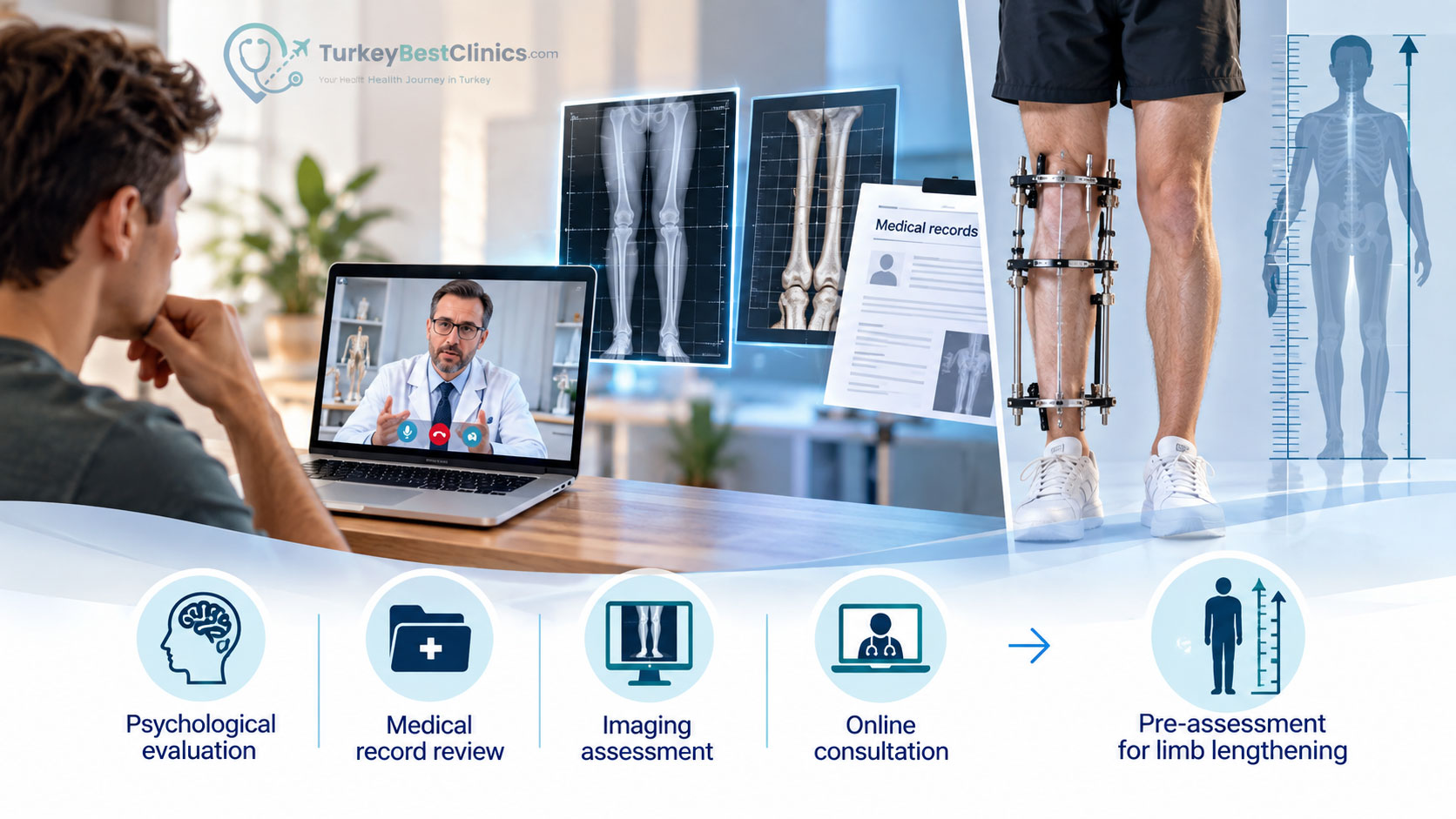
Initial Suitability Assessment Before Deciding on Limb Lengthening
Limb lengthening is major orthopaedic surgery that involves controlled bone lengthening and a rehabilitation period that may last for months. The aim is not simply to gain centimetres; bone healing, joint range of motion, muscle-tendon balance, daily mobility and psychological preparedness are assessed together.
A preliminary assessment carried out before you travel to Turkey does not replace an in-person examination. Even if your records appear suitable, the final decision is made after jointly reviewing the orthopaedic examination in Turkey, up-to-date radiographs, laboratory results, anaesthetic assessment and psychological consultation.
Why is remote pre-assessment important?
- It helps determine whether your limb-lengthening goal is medically and functionally realistic.
- It provides an initial understanding of leg-length differences, alignment problems, previous surgeries and bone quality.
- Your readiness for intensive rehabilitation, pain management and long-term follow-up can be discussed.
- Missing tests can be identified, allowing time and cost planning before travelling to Turkey.
Radiographs, Bone Quality and the Basis of the Lengthening Plan
Orthopaedic pre-assessment for limb lengthening usually begins with a combined review of your detailed medical history, physical condition and imaging records. The date, imaging centre and imaging method should be clearly indicated on the documents you provide; the written report alone is often not sufficient.
Key bone and joint factors assessed
- Height and body proportions: Trunk-to-leg balance, current leg length and the intended amount of lengthening are considered together.
- Length and alignment measurements: Full-length standing leg radiographs can be used to assess femur and tibia lengths, knee and ankle alignment, and the mechanical axis.
- Growth plates: The condition of the growth plates is assessed according to your age. Since growth plates are closed in adults, surgical planning is considered within a different framework.
- Bone density and healing capacity: If considered necessary, bone mineral density, vitamin D, calcium-phosphorus balance, thyroid markers and overall nutritional status may be investigated.
- Joints and soft tissues: Movement in the knees, hips and ankles, as well as muscle shortening, tendon tightness and neurological findings, may affect tolerance to lengthening.
- Previous surgeries: Plates, screws, prostheses, a history of infection or previous fractures may alter the choice of a new surgical approach.
If the images are unclear, computed tomography or another examination may be requested. The same list of tests is not used for every candidate; decisions are personalised according to your medical history and initial imaging findings.
Medical records you can prepare before travelling to Turkey
- Full-length standing leg radiographs taken within the last 6–12 months and DICOM images
- Discharge summaries, operative notes and implant information from previous surgeries
- An up-to-date list of your medications, known medical conditions and allergies
- Measurements of your height, weight, leg lengths and any asymmetry
- A history of previous rehabilitation, fractures, infections or clotting problems
- A short video showing your daily mobility; this video cannot establish a diagnosis on its own and is only used to support the preliminary consultation.
Psychological Preparation and Assessment of Surgical Readiness
The limb-lengthening process requires more than expectations about the result. It also requires the ability to manage a lengthy rehabilitation period, regular exercise, temporary mobility restrictions and an uncertain healing rate. Psychological assessment is not intended to exclude you; it is conducted to understand whether your decision is informed, your expectations are realistic and your support plan is workable.
Topics covered during an online consultation
- How long you have been considering limb lengthening and how your goal developed
- What the expected increase in centimetres means for your daily life, social environment and self-confidence
- Your approach to coping with pain, demanding rehabilitation and periods of temporary dependence
- Anxiety, depressive symptoms, body image, obsessive thoughts or a history of previous psychiatric support
- The support available from your close network, companion and rehabilitation team in your home country
- Your plan for attending follow-up appointments, physiotherapy and the daily programme recommended by the surgeon
It is important that you do not feel pressured during the consultation. If there are significant untreated psychological problems, unrealistic expectations or a possibility that you may be unable to complete the lengthy rehabilitation, surgery may be postponed or an additional mental health consultation may be recommended. This approach is part of making a safe decision and does not constitute a definitive diagnosis.
Hospital and Safety Checks for Limb Lengthening in Turkey
Limb-lengthening surgery should be planned in a fully equipped hospital with operating-room sterilisation protocols, an anaesthesia team, access to intensive care, imaging facilities and a team capable of managing orthopaedic complications. As part of medical tourism, it is important to verify whether the institution you are working with holds a Healthcare Tourism Authorisation Certificate approved by the Ministry of Health of the Republic of Türkiye.
When assessing the experience of Turkish orthopaedic teams in this field, do not rely only on general statements about experience. Ask about the team’s procedure volume and follow-up protocol for applications directly related to limb lengthening, such as lengthening with motorised intramedullary nails, external-fixator use, serial radiographic monitoring of bone union, joint range-of-motion monitoring and neurovascular examinations.
What should be verified before travelling to the clinic?
- That the surgery will be performed in a hospital and that relevant specialties are available in emergencies
- That the difference between the preliminary assessment and the final surgical decision is explained in writing
- The frequency of physiotherapy, imaging intervals and the procedure for seeking help in the event of complications
- The communication plan between the rehabilitation that will continue in your home country after discharge and the team in Turkey
- That blood tests, anaesthetic assessment and psychological evaluation will be repeated if necessary
Limb-Lengthening Package, Preparation and Companion Planning
Depending on the planned service, the package may include VIP airport-to-hospital transfers, accommodation, interpreter support and initial care or prescription arrangements; the scope, dates and exclusions should be confirmed in the written quotation. The length of your stay in Turkey for limb lengthening varies according to the method used, postoperative radiographic monitoring, mobility safety and the rehabilitation plan. Before travelling, a complete blood count, biochemistry, coagulation tests, anaesthetic assessment and any necessary bone imaging may be planned.
The conditions under which your companion can stay with you in hospital, the accommodation’s proximity to the hospital and transport support should be clarified in advance. Long walks and a busy city schedule may not be appropriate during the early period. While you focus on rehabilitation and rest, your companion can plan quiet park walks nearby, use the hotel wellness facilities or take part in low-intensity cultural activities; these options should be adjusted to your postoperative movement restrictions.
Practical comparison of two surgical approaches
| Methods Compared for You | Most Important Potential Advantage for You | Your Recovery and Hospital Stay |
|---|---|---|
| Motorised intramedullary nail | Controlled lengthening without an externally visible frame and more limited daily care requirements | Hospitalisation is generally planned for a short period; frequent radiographs and physiotherapy are required while the lengthening phase continues at home or in your accommodation. |
| External fixator | External stabilisation of the bone segment and more flexible mechanical control in some complex deformities | Frame care, monitoring of pin sites and movement restrictions may be more prominent; the length of hospitalisation and total rehabilitation vary according to the individual plan. |
The choice of method depends on bone diameter, the intended lengthening, joint movement, previous surgeries, bone healing and the surgeon’s assessment. During a remote consultation, only potential options can be discussed; the method to be used is finalised after examination and imaging in Turkey.
Limb-Lengthening Costs and Approximate Comparison by Country
The figures below are approximate ranges based on market research for surgical and follow-up packages whose scope may vary. The implant brand, choice of femur or tibia, treatment of one or two segments, rehabilitation duration, accommodation and management of complications can all affect the price. An exact price cannot be provided without a medical suitability assessment and a written quotation.
| Country | Approximate Total Cost | Currency |
|---|---|---|
| Turkey | 45,000–75,000 | € |
| United Kingdom | 40,000–70,000 | £ |
| Germany | 50,000–85,000 | € |
| United States | 75,000–150,000 | $ |
These ranges are for financial comparison only and do not mean that surgery is suitable for you. Ask for the quotation to list the implant, surgery, hospital, anaesthesia, radiographs, physiotherapy, interpreter, accommodation, companion services, possible need for revision surgery and online follow-up after returning to your country as separate items.
Three key factors that affect cost and the intensity of the process
- The surgeon’s expertise and experience: The surgeon’s procedure volume in limb-lengthening surgery, experience managing motorised intramedullary nails or external fixators, and complication follow-up protocol should be assessed.
- Technology and method: The motorised intramedullary nail, external fixator, bone segment selected and imaging method used may affect both cost and the rehabilitation plan.
- Clinic location: In internationally accessible centres such as Istanbul, hospital, accommodation and transfer prices may vary according to the city, season and distance from the hospital.
Next Steps and Three Critical Questions Before Visiting the Clinic
First, share your medical records and images through a secure channel. Then arrange an online consultation with the orthopaedic team, a psychological preparation consultation and a list of any missing tests. You should not make travel arrangements before reviewing the final examination and written treatment plan.
- Between a motorised intramedullary nail and an external fixator, which option appears safer for my bone formation and joint range of motion?
- For the intended amount of lengthening, how many days will I need to stay in Turkey, how often will I need radiographs and how many physiotherapy sessions per week should I plan in my home country?
- If unrealistic expectations or a risk of difficulty complying with rehabilitation is identified during the psychological assessment, what support plan will be implemented before surgery?
After you return to your country, online follow-up may be conducted through the secure sharing of radiographs, videos showing your range of motion, updates about pain or the wound area, and physiotherapy coordination. This follow-up does not replace local healthcare services in emergencies. If you experience symptoms such as fever, increasing wound discharge, new numbness, worsening pain or changes in circulation, you should contact emergency healthcare services in the country where you are located.