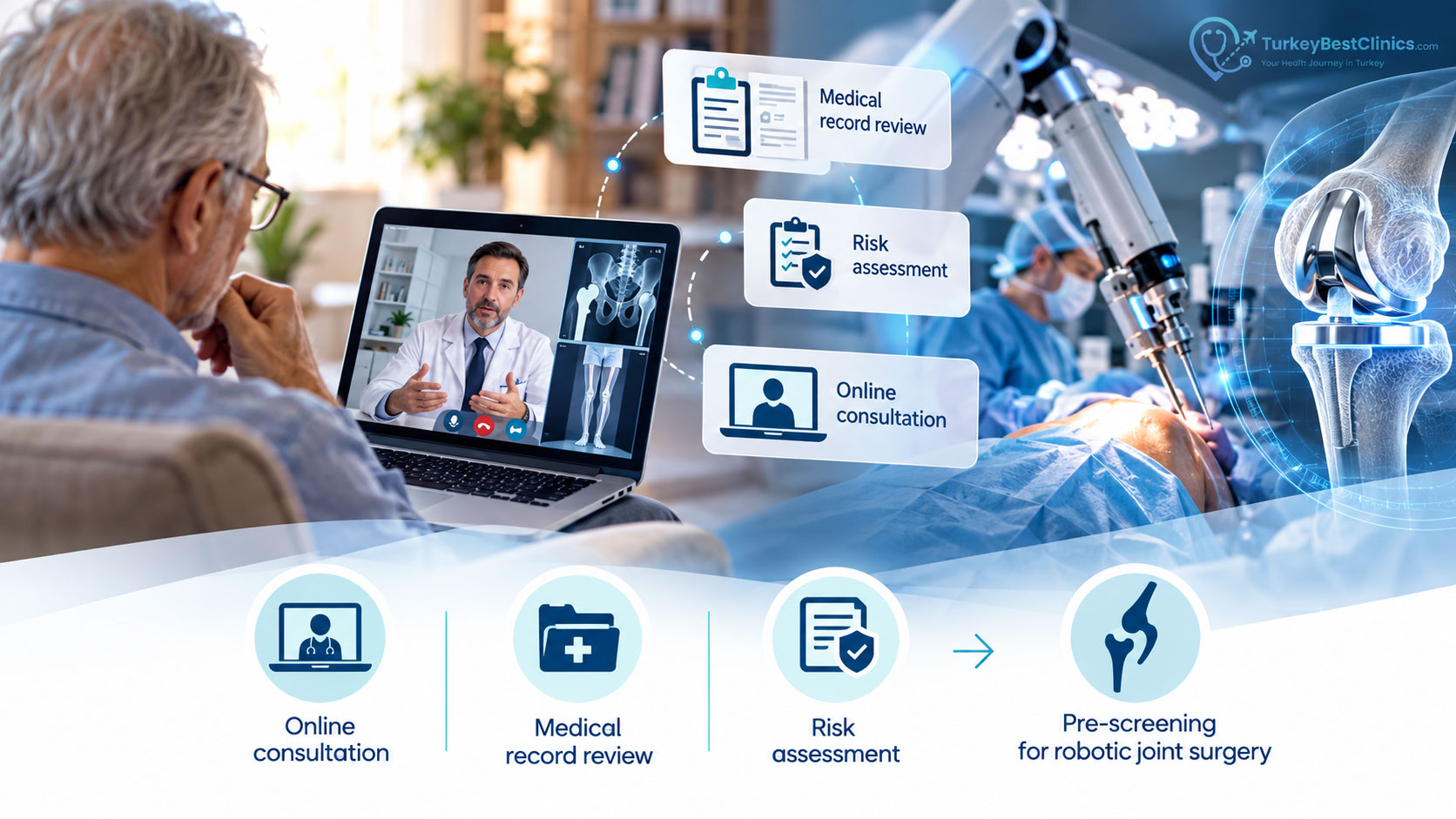
What does a remote preliminary assessment for robotic joint replacement provide?
If you are older or live with heart, lung, diabetes, kidney, or bleeding and clotting problems, a structured preliminary consultation can be conducted before you travel to Turkey to assess your suitability for robotic joint replacement surgery. The purpose of this consultation is not to make a diagnosis, but to help the surgical team review your current symptoms, mobility limitations, treatments, previous surgeries, and travel-related risks in advance.
A robotic system may support the surgeon in performing planned bone cuts and positioning the implant with greater control. Nevertheless, robotic technology alone does not determine whether surgery should be performed; the extent of joint damage, bone structure, overall health, anesthesia risk, and ability to participate in postoperative rehabilitation are considered together.
Online consultation usually leads to one of three possible outcomes: an invitation for a detailed in-person assessment in Turkey, a request for additional medical documents or tests, or prioritization of a different treatment option because of existing risks. A preliminary assessment does not mean that surgery has been definitively approved or that a complication-free outcome is guaranteed.
Documents reviewed during a remote consultation
- Identity details, age, height, weight, and daily mobility level
- Recent X-rays, MRI scans, or CT scans of the knee or hip joint
- Reports relating to the heart, lungs, kidneys, liver, and diabetes
- Previous surgeries, anesthesia experiences, and known allergies
- The active ingredients and doses of current medications, especially treatments affecting bleeding or clotting
- Walking distance, stair use, and the need for a cane or walker
- The suitability of the accompanying person who will provide postoperative support and the rehabilitation plan
Sharing imaging files in DICOM format and, where possible, providing reports in English or with Turkish translations can facilitate surgical planning. If information is missing or outdated, additional examinations may be requested.
Safety considerations for robotic knee or hip replacement in Turkey
Your surgical plan should be carried out with organizations that hold a Health Tourism Authorization Certificate issued by the Republic of Türkiye Ministry of Health and provide the relevant surgical service in a fully equipped hospital setting. The certificate indicates that the health tourism organization complies with applicable regulations; however, the surgeon’s area of expertise, the hospital’s operating-room infrastructure, access to intensive care, and the rehabilitation plan should also be assessed separately.
Assessment for robotic knee or hip replacement may be supported by weight-bearing X-rays, three-dimensional imaging when necessary, implant planning, and preoperative movement analysis. Turkish orthopedic teams may work with different techniques, including total knee replacement, total hip replacement, computer-assisted navigation, and robotic-arm-assisted joint surgery; the method used is determined according to the joint anatomy and surgical objective.
Older age alone is not a reason to exclude someone from surgery. However, cardiovascular capacity, respiratory reserve, kidney function, blood glucose control, nutritional status, fall risk, and cognitive status are assessed together. If you have chronic conditions, preoperative opinions from the relevant specialties may be required, and your current treatments may need to be reviewed in coordination with the surgical team.
Hospital safety and surgical preparation
The hospital where the surgery is performed should have operating-room sterilization procedures, a central sterilization unit, infection-control protocols, access to blood products, intensive-care support, and emergency response facilities. The brand and model of the implant, warranty conditions, implant records, and responsibilities for postoperative follow-up should be explained in writing.
Package and companion planning for robotic joint replacement travel
A health tourism package may include VIP airport-hospital-hotel transfers, accommodation, a medical interpreter, and basic coordination during the initial care period. Since package contents vary between providers, the costs of surgery, the implant, tests, physical therapy, medications, and any possible additional nights should be checked separately and in writing.
The length of stay in Turkey for robotic knee or hip replacement may commonly be planned for approximately 10–21 days, taking preoperative assessment, surgery, early mobilization, and the first follow-up into account; however, this period varies according to the clinical course. Before arrival, the currency of your complete blood count, kidney function tests, blood glucose tests, electrocardiogram, and required imaging should be checked; in Turkey, the anesthesia examination and any additional tests requested by the hospital are completed.
The conditions under which your companion can stay with you in the hospital should be clarified in advance according to the hospital’s companion policy; choosing a hotel close to the hospital can reduce the transportation burden. While you rest, your companion may spend time in a wellness area near the hospital, take a quiet walk in a park, or visit a safe relaxation facility; long walks and crowded activities should be limited according to your early recovery program.
Preoperative and postoperative process protocol
- Your symptoms, medical history, and goals are recorded during the online consultation.
- Images and reports are reviewed by orthopedics, anesthesia, and, if necessary, other relevant specialties.
- If preliminary suitability is established, an examination and testing day is scheduled in Turkey.
- At the hospital, preoperative blood tests, cardiac assessment, an anesthesia consultation, and joint imaging are completed.
- After surgery, early mobilization, wound checks, walking training, and a physical therapy program are provided.
- After you return to your country, online follow-up consultations are used to review the wound, pain, walking capacity, and rehabilitation reports.
The date of return travel is determined not only by the calendar duration, but also by safe walking ability, wound condition, assessment of clotting risk, and the surgeon’s approval. Online follow-up does not replace local orthopedic or physiotherapy care; if emergency symptoms occur, you should seek healthcare services in the country where you are located.
Robotic joint replacement costs in Turkey and international comparison
The average package cost for robotic-assisted total knee or hip replacement in Turkey may range from approximately €8,000 to €15,000, depending on the package contents and implant selection. The figures below are approximate ranges provided for market comparison only; older age, chronic conditions, the need for revision surgery, intensive-care requirements, companion stay, and additional tests may change the total cost.
| Country | Approximate cost | Scope generally considered |
|---|---|---|
| Turkey | €8,000–€15,000 | Surgery, selected implant, hospital stay, and transfers and accommodation depending on the package |
| United Kingdom | £18,000–£30,000 | Surgery, implant, and early follow-up in a private hospital |
| Germany | €15,000–€25,000 | Private surgery, prosthesis, and hospital services |
| United States | $35,000–$60,000 | Hospital, surgeon, anesthesia, and implant fees; coverage may vary according to insurance |
When requesting a quotation, ask in writing whether use of the robotic system, the implant, anesthesia fees, possible intensive care, physical therapy, interpreter services, additional hospital nights, and the protocol to be followed in the event of complications are included in the price. Some providers include the online consultation fee in the package, while others may charge it separately.
Key criteria that affect suitability and the overall process
- The orthopedic surgeon’s expertise and experience: Experience in knee or hip replacement, robotic navigation, primary surgery, and revision management contributes to establishing a safe and realistic plan.
- Robotic technology and implant method: A robotic-arm-assisted system, image-based navigation, preoperative CT planning, patient-specific cutting guides, cemented or cementless implants, and the implant design used may result in different costs and surgical plans. Not every robotic system is suitable for every joint anatomy or surgical objective.
- The clinic and hospital location: The transportation network, access to intensive care, distance from accommodation, and rehabilitation options of a hospital in Istanbul, Ankara, Izmir, or another city affect the overall organization. The distance from the airport and the duration of transfers within the city should also be taken into account because of your limited mobility during the early period.
When these criteria are reviewed together, the level of control of chronic conditions, anesthesia risk, bone quality, history of infection, and access to postoperative physical therapy may also influence the surgical team’s decision. If one of these areas remains unclear during the online consultation, not giving final approval before travel and requesting additional documents or an in-person assessment may be the safer approach.
Next steps before deciding on robotic joint replacement
When preparing for your first online consultation, collect your reports from the last six months, current imaging, a list of the active ingredients in your medications, and documents from previous surgeries in a single file. During the consultation, clearly explain whether your goals are to reduce pain, increase walking distance, make stair use easier, or maintain independence.
- When is CT planning required for robotic knee replacement, and should this imaging be performed before travel or in Turkey?
- If I have heart disease, diabetes, or kidney disease, which specialist opinions and laboratory results are required for anesthesia clearance?
- How will the schedule for returning to my country, physical therapy, and online follow-up be personalized after robotic joint replacement?
The answers to these questions vary according to your individual medical records. An online consultation does not replace an in-person examination and anesthesia assessment in Turkey; suitability for surgery can only be determined by an authorized physician after all data has been reviewed together.