Why Is Hospital Infrastructure Important for Your Orthopedic Surgery?
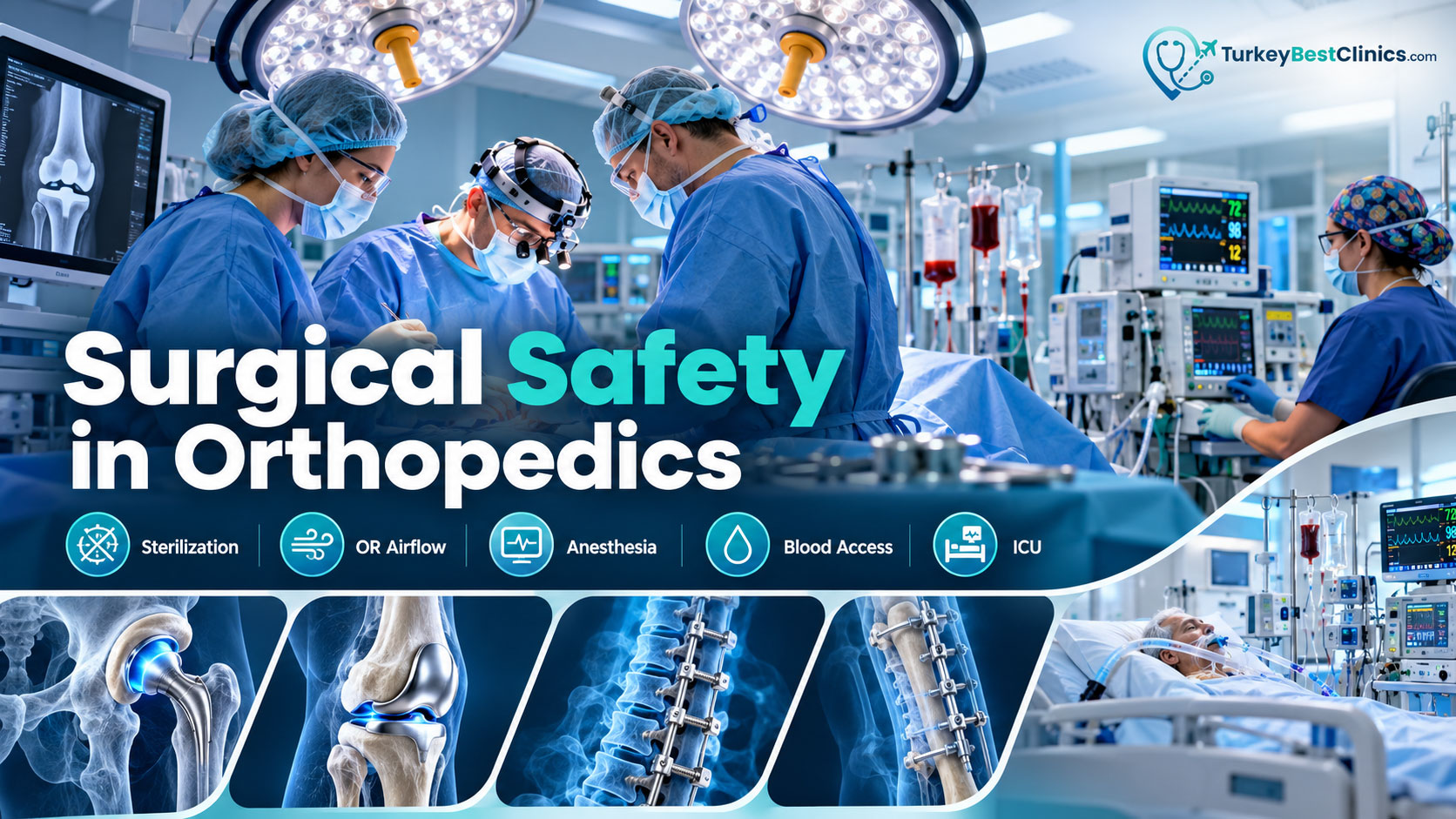
For hip or knee replacement, spine surgery, joint reconstruction, and complex trauma procedures, safety does not depend solely on the surgeon’s experience. The hospital’s sterilization system, operating room air management, anesthesia support, access to blood products, and postoperative intensive care capacity should be assessed together.
JCI accreditation, a laminar airflow operating room, and orthopedic intensive care infrastructure do not mean the same thing. Each reflects a different aspect of the hospital: JCI indicates institutional quality processes, laminar airflow concerns the control of airborne particles during certain procedures, and intensive care infrastructure indicates the capacity for close postoperative monitoring.
Therefore, do not rely only on the phrase “accredited hospital” before making your decision. Verify the building where your surgery will take place, the specific operating room, and, when necessary, the intensive care unit that may be used, using written documentation.
JCI Accreditation and Orthopedic Surgery Quality Control
JCI is an international accreditation organization that evaluates hospitals against established standards covering patient safety, infection control, medication management, operating room processes, emergency response, staff competency, and quality improvement practices. Always check the validity date and scope of the JCI certificate; it may cover the entire hospital or a specific range of services.
Key Points to Check When Verifying Documentation
- The hospital’s full legal name and address
- The validity date of the JCI accreditation
- Which hospital campus is covered by the accreditation
- Whether orthopedic, trauma, spine, or joint surgery services are available at the relevant campus
- The Republic of Türkiye Ministry of Health Health Tourism Authorization Certificate
- Current records of infection control, sterilization, and operating room quality audits
The experience of Turkish orthopedic teams in different types of procedures, such as knee and hip arthroplasty, arthroscopic surgery, spinal implantation, and trauma reconstruction, should be assessed separately. Rather than requesting only the surgeon’s total number of operations, ask in writing for the annual case volume specific to the planned procedure, the complication management protocol, and the postoperative follow-up plan. This will allow for a more meaningful comparison.
Operating Rooms, Laminar Airflow, and Your Companion Plan
A medical tourism package may include VIP transfers, transportation between the hospital and hotel, interpreter support, and initial care arrangements. However, these services do not replace the hospital’s medical infrastructure. Carefully review the package contract to determine which services are included, what additional charges apply, and how emergency transportation is planned.
Before orthopedic prosthesis or implant surgery, blood tests, electrocardiography, pulmonary assessment, imaging, an anesthesia consultation, and infection risk screening may be scheduled. Depending on the complexity of the procedure, you may need to stay in Turkey for approximately 5–10 days; the exact duration will be determined by the surgeon and anesthesia team. After returning to your country, an online follow-up protocol should be established for wound checks, suture or dressing assessment, mobility exercises, and review of imaging results.
Ask in advance whether your companion can stay with you in the same hospital; access to some intensive care areas may be restricted for companions. Choosing a hotel within a short distance of the hospital, ensuring that your companion can access a quiet wellness area or a flat walking park while you rest, and arranging transfers according to your postoperative mobility restrictions can improve comfort.
Technical Questions to Ask About a Laminar Airflow Operating Room
- Is the laminar airflow system used throughout the operating room where the procedure will take place, or only over a specific area around the operating table?
- Does the system operate with downward vertical airflow from the ceiling or with horizontal airflow?
- Are HEPA filtration, air changes per hour, pressure differentials, and maintenance records monitored regularly?
- Are air quality measurements available for orthopedic implant procedures?
- Is the laminar system used as an additional precaution alongside standard infection control protocols?
Orthopedic Surgery Costs and Infrastructure Comparison in Turkey
JCI accreditation or a laminar airflow system is generally not priced separately. Costs vary depending on the type of surgery, the implant brand and materials, the surgeon’s experience, length of hospital stay, intensive care requirements, rehabilitation, and the risk of complications. The ranges below are approximate total package ranges intended only as a guide for major elective orthopedic surgery at selected private hospitals; they should not be used as an official quote for a specific procedure.
| Country | Approximate orthopedic surgery range | Point to consider when assessing infrastructure |
|---|---|---|
| Turkey | €5,000–€15,000 | Are the implant, intensive care, interpreter, transfers, and follow-up included in the package? |
| United Kingdom | £12,000–£30,000 | What does the private hospital and non-NHS pricing cover? |
| Germany | €15,000–€35,000 | Are the implant, rehabilitation, and possible intensive care billed separately? |
| United States | $25,000–$70,000 | Are hospital, surgeon, anesthesia, and rehabilitation bills issued separately? |
When requesting a quote, review the “surgery fee” and “safe surgical infrastructure” as separate line items. The absence of a JCI certificate does not automatically mean that care is inadequate; likewise, having a JCI certificate alone does not prove that a laminar airflow operating room or orthopedic intensive care bed will be available on your surgery date.
Orthopedic-Specific Factors That Affect Cost and the Surgical Process
- Surgeon’s specialization and experience: Experience with primary and revision knee or hip replacement, techniques used in spine surgery, annual procedure volume, and the complication management protocol may affect the total cost.
- Implant and surgical technique: Cemented or uncemented prostheses, ceramic-on-polyethylene or metal-on-polyethylene bearing surfaces, navigation-assisted surgery, robotic-arm-assisted knee surgery, arthroscopic approaches, and open reconstruction require different resources.
- Hospital location: Major centers such as Istanbul, Ankara, Izmir, and Antalya may offer broader international patient coordination, advanced imaging, laboratory, and intensive care services; accommodation and transportation costs may vary, however.
- Intensive care and complication planning: The availability of an orthopedic intensive care bed during the surgical period, 24-hour anesthesiology coverage, a blood bank, imaging, and the capacity for revision surgery should be confirmed in advance.
- Postoperative rehabilitation: Physical therapy assessment, the need for a walker or orthosis, nursing support, wound checks, and online follow-up after returning to your country may change the overall plan.
Practical Comparison of Two Surgical Approaches
| Methods Being Compared for You | Main Advantage for You | Your Recovery and Hospital Stay |
|---|---|---|
| Minimally invasive or arthroscopic approach | Smaller incisions and, for some procedures, the possibility of earlier mobility | Varies by procedure; a shorter hospital stay may be considered in many selected cases |
| Open or reconstructive surgery | Broad surgical access for complex deformities, advanced damage, or revision procedures | Longer monitoring and rehabilitation may be required, and intensive care may be necessary in some cases |
This table provides a general framework; bone quality, a history of infection, previous implants, and coexisting conditions may change the outcome even when the procedure has the same name. The surgical team should determine which approach is appropriate only after imaging, physical examination, and anesthesia assessment.
Three Critical Questions to Ask Before Choosing a Hospital
- How can I verify the JCI certificate, Health Tourism Authorization Certificate, and current infection control records for the exact campus and operating room where my surgery will take place?
- What technical specifications does the laminar airflow system have, and can the HEPA filter, air exchange, and maintenance records be reviewed for my orthopedic implant surgery?
- How will an orthopedic intensive care bed, 24-hour anesthesia support, blood bank, imaging, and online follow-up communication with my doctor in my home country be arranged after surgery?
After receiving these documents and answers in writing, compare the surgeon’s recommendations, the hospital’s technical capacity, and the total cost quote together. Instead of relying on general statements such as “JCI-compliant,” “sterile operating room,” or “intensive care available,” request the certificate number, campus name, operating room specifications, and scope of services.