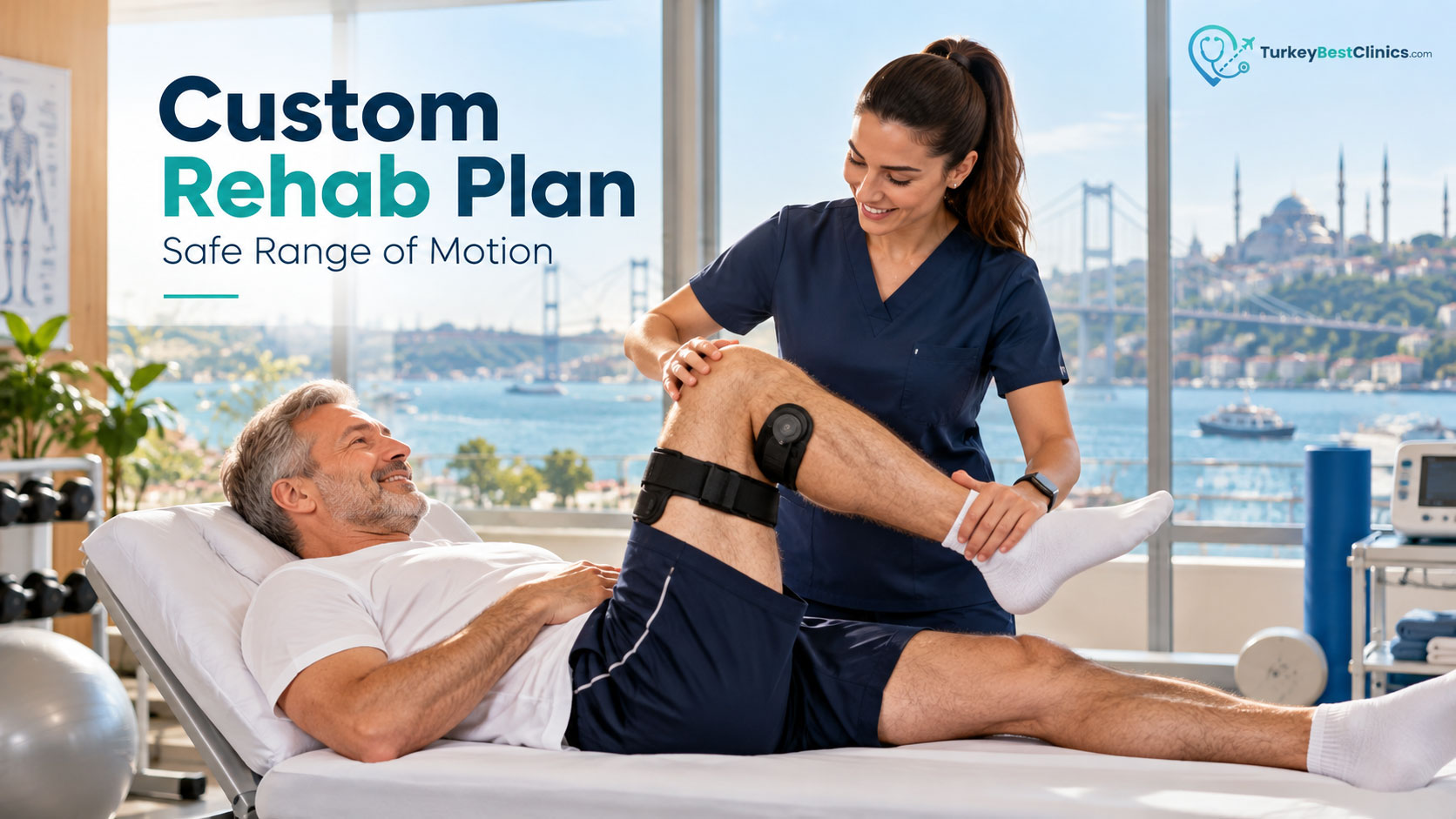
Rehabilitation Planned to Restore Joint Range of Motion
After orthopedic surgery, the goal is not only to reduce pain; you also need to safely regain range of motion in the knee, hip, shoulder, elbow, or ankle, improve daily function, and develop muscle control that protects the joint. The medical rehabilitation plan is shaped according to the type of surgery, the implant or fixation method used, tissue healing, and the movement limits permitted by your surgeon.
Before returning home from Turkey, you will generally undergo an in-person assessment, controlled exercise sessions, walking or joint-use training, and the preparation of a home exercise program. The target range of motion is not a single standard degree; for example, safe progression criteria differ for knee replacement, shoulder arthroscopy, and ligament reconstruction.
Important note: If you develop worsening pain, new or increasing swelling, discharge from the wound, fever, sudden calf tenderness, or shortness of breath, stop exercising and contact the surgical team directly.
Hospital and Safety Standards for Orthopedic Rehabilitation in Turkey
Planning the program at healthcare facilities holding a Health Tourism Authorization Certificate issued by the Ministry of Health of the Republic of Türkiye can make coordination between the clinic, physical therapy unit, emergency response services, and surgical team more transparent. Conducting rehabilitation in a fully equipped hospital setting allows postoperative wound checks, pain assessments, and movement restrictions to be monitored by the same team.
Orthopedic and physical medicine and rehabilitation teams in Turkey work with staged protocols, such as gait training after total knee or hip replacement, controlled knee flexion after anterior cruciate ligament reconstruction, and the transition from passive to active-assisted movement after shoulder surgery. In practice, factors such as sterilization procedures, the suitability of walking aids, fall-risk assessment, and monitoring vital signs during exercise are taken into account.
Key Areas Assessed
- Surgical reports, imaging results, and the surgeon's movement restrictions
- Measurement of joint range of motion with a goniometer
- Pain level, swelling, wound condition, and muscle activation
- Walking, climbing stairs, sitting down and standing up, or using the upper extremity
- Suitability for continuing physical therapy in your home country and transportation conditions
Turkey Rehabilitation Package After Orthopedic Surgery
The package may include airport-hospital-hotel transfers, accommodation close to the hospital, interpreter support for necessary consultations, and basic guidance for the initial care period. The scope should be clarified in writing according to the selected healthcare provider and the duration of rehabilitation.
During the initial assessment, the surgical site is checked, joint range of motion is measured, muscle strength is tested, gait is analyzed, and new imaging is arranged if necessary. Although the length of stay depends on the type of surgery and functional goals, most intensive rehabilitation programs estimate approximately 7–14 days; the exact duration is determined with the approval of the surgeon and physical medicine and rehabilitation specialist.
The conditions under which your companion can stay with you at the hospital, as well as the hotel's proximity to the rehabilitation center and hospital, are planned in advance. Depending on restrictions on weight-bearing or prolonged walking, your companion may use nearby wellness facilities, take quiet walks in parks, or rest in hotel areas while you rest in a controlled manner.
Process Protocol Prepared Before Returning Home
- First day: Your medical records are reviewed, pain and swelling are assessed, and the target range of motion is determined.
- Initial sessions: Joint mobilization, circulation exercises, muscle activation, and safe transfer training are provided.
- Progression period: Active movement, resistance-free strengthening, balance, and gait exercises are added to the extent permitted by the surgeon.
- Discharge preparation: You receive a written plan covering home exercises, the use of assistive devices, and wound and swelling monitoring.
- Online Follow-Up: After you return home, range of motion, pain, and functional progress are monitored through video consultations and shared measurements.
Medical Rehabilitation Costs in Turkey and Country Comparison
The average cost of intensive medical rehabilitation after orthopedic surgery in Turkey varies according to the number of sessions, physiotherapist time, hospital use, and accommodation included. The ranges below are for general planning only; surgical fees, implant costs, advanced imaging, and treatment of complications may be calculated separately.
| Country | Approximate range for an intensive rehabilitation plan | Currency |
|---|---|---|
| Turkey | 1,500–4,500 | € |
| United Kingdom | 2,000–6,000 | £ |
| Germany | 2,500–6,500 | € |
| United States | 3,500–10,000 | $ |
When requesting a quote, check separately how many in-person sessions are included in the total price, the duration of each session, physician check-ups, interpreter and transfer services, accommodation, assistive devices, and online follow-up after you return home.
Factors Determining Rehabilitation Costs and Progress
- Physician expertise and experience: The clinical experience of the relevant team in knee replacement, shoulder surgery, ligament reconstruction, or complex revision surgery may affect the frequency of assessments and the degree to which the program is personalized.
- Methods and technologies used: The use of tools such as goniometric joint measurements, computer-assisted gait analysis, isokinetic muscle testing, neuromuscular electrical stimulation, and cold-compression systems may affect the cost. These devices are not expected to be necessary for every type of surgery; suitability is determined through clinical assessment.
- Clinic location: In cities such as Istanbul, Antalya, Ankara, or Izmir, hospital infrastructure, the scope of the rehabilitation unit, accommodation standards, and transportation distances may result in different total costs.
When comparing prices, looking not only at the number of sessions but also at the regular repetition of measurements, communication between the surgeon and physiotherapist, and the scope of the post-return follow-up plan will provide a more meaningful assessment.
Pre-Travel Check and Next Steps
Before returning home, your joint range of motion, ability to walk safely or use the relevant limb, pain control, and capacity to follow the home program correctly are reassessed. It is not safe to force the target degree or increase exercise intensity without written approval from the surgical team.
Three Specific Questions to Ask When Requesting Information
- After my knee, hip, shoulder, or ankle surgery, what joint range of motion and functional criteria are targeted before I return home?
- How many times will goniometric measurements, gait analysis, and muscle strength testing be performed, and how will the results be shared with the physiotherapist who will continue my care after I return home?
- Based on my type of surgery, how many days of in-person rehabilitation are recommended in Turkey, and for which symptoms should I contact the surgical team again during the Online Follow-Up process?
Receiving the answers together with a written treatment plan, session schedule, and emergency contact details can help ensure that the program in Turkey progresses consistently with the physical therapy to be continued in your home country.