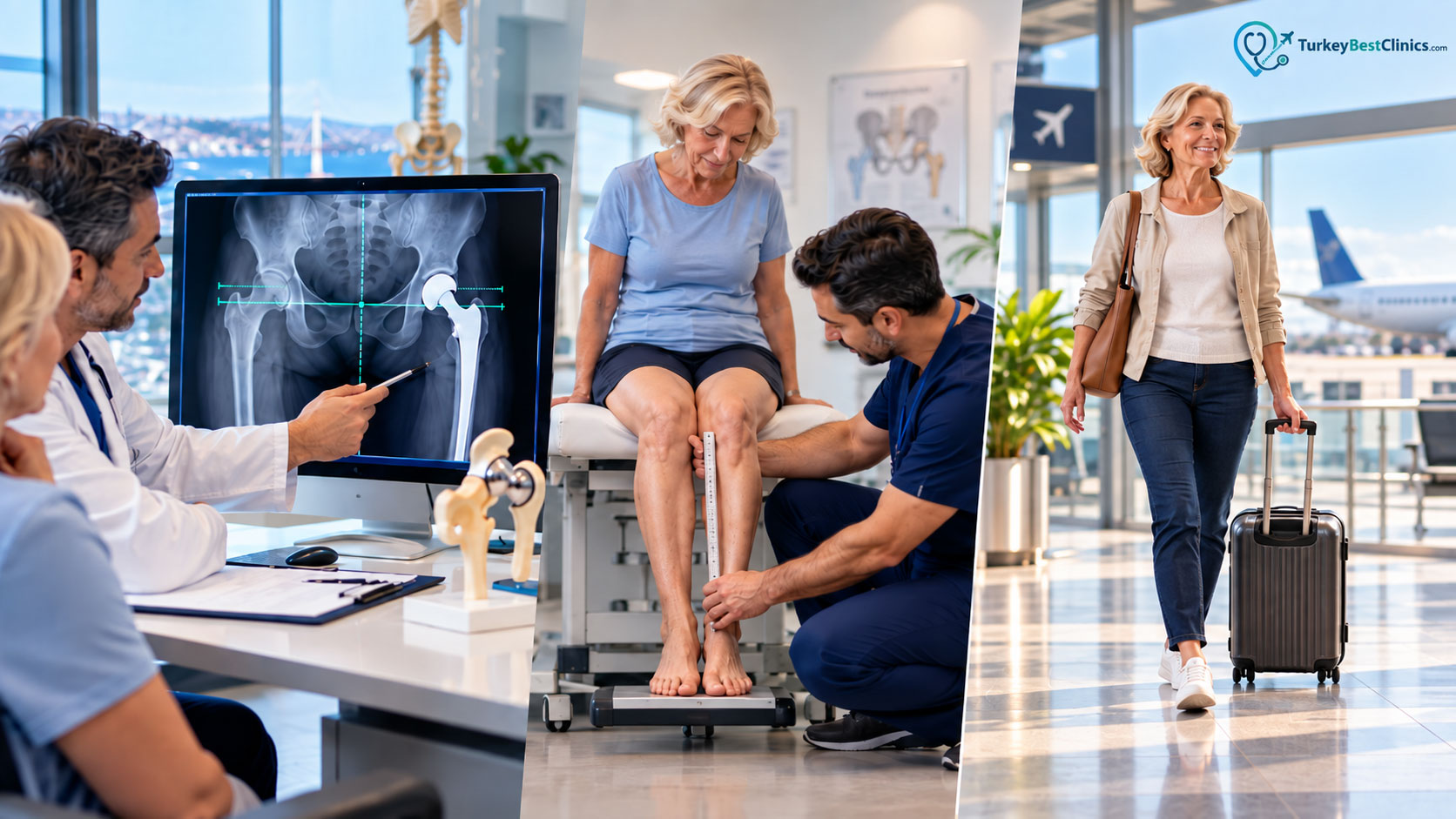
How is leg length discrepancy assessed after hip replacement?
Feeling a difference in leg length after hip replacement surgery does not always mean that there is a permanent inequality in bone length. Pelvic tilt, muscle tension, postoperative swelling, soft-tissue adaptation around the hip, and a protective weight-bearing pattern while walking can create a temporary sensation of difference.
Before returning to your country from Türkiye, the aim is not simply to answer the question, “Are the legs the same length?” The position of the hip replacement, joint stability, wound healing, walking safety, clot risk, and suitability for a long flight are assessed together. Final clearance to fly is given by the orthopedic and traumatology specialist who performed your surgery, based on your current findings.
Key approach used for pre-flight assessment
- Clinical examination: Pelvic posture, hip range of motion, muscle strength, gait pattern, and possible neurological findings are assessed.
- Calibrated X-ray: Usually, an anteroposterior pelvic X-ray is used to assess the position of the prosthetic head, acetabular component, and femoral component.
- Block test: A block of controlled height may be placed under the heel while standing to assess how closely the perceived difference corresponds to the actual bone length.
- Advanced imaging: If the clinical findings and standard X-ray results do not match, a standing long-leg length X-ray or, when necessary, computed tomography may be planned.
Effect of the surgical approach on recovery after hip replacement
Whether the surgery was performed through an anterior or posterior approach does not change the basic measurement method used to confirm leg length before flying. However, the wound, muscle function, and hip movement restrictions may be monitored differently depending on the approach.
| Methods compared for you | Most important potential benefit for you | Your recovery and hospital stay |
|---|---|---|
| Anterior approach hip replacement | Surgical trauma to the muscle tissue may be more limited in some cases; an early walking protocol may be implemented. | Usually, hospital monitoring lasts several days; walking and flight decisions are made after considering the wound, X-ray, and general condition together. |
| Posterior or posterolateral approach hip replacement | May be suitable in terms of the surgeon’s field of view and implant placement preferences; certain movement restrictions are monitored more carefully. | Usually, hospital monitoring lasts several days; hip movements, balance, and stair use are checked before flying. |
Safety and hospital standards for hip replacement assessments in Türkiye
It is important for surgery to be planned at a fully equipped hospital or facility holding a Health Tourism Authorization Certificate issued under the regulations of the Republic of Türkiye Ministry of Health. This certificate indicates that services provided within the scope of health tourism are subject to certain administrative and operational requirements; the hospital’s quality and accreditation status should also be checked separately.
For confirmation after hip replacement, the facility should have a digital X-ray archive, an operative report, implant labels, and imaging infrastructure that allows measurements to be performed. Sterilization processes conducted in accordance with international standards are important not only for operating-room safety but also for pre-flight wound and infection checks.
Orthopedic teams in Türkiye work with a range of clinical scenarios, including primary total hip arthroplasty, cemented or uncemented femoral components, acetabular cup placement, and complex cases requiring revision surgery. During your consultation, you should clearly ask about the implant system used by the surgeon, the annual volume of hip replacement cases, the postoperative radiographic follow-up protocol, and how any possible leg length difference is measured.
Pre-flight safety checklist
- No drainage, wound separation, marked redness, or fever at the surgical site.
- The hip replacement appears to be in an acceptable position on the X-ray, with no suspected acute complication.
- You can stand up safely and walk short distances with support or an appropriate walking aid.
- It has been determined whether the sensation of leg length difference is explained by clinical examination and imaging or requires further investigation.
- Immobility during a long flight, clot risk, and a movement plan during the flight have been assessed by the doctor.
Your hip replacement package and pre-flight companion plan
The arrangements may include VIP airport-to-hospital transfers, accommodation at a hotel near the hospital, medical interpreter support, and coordination required during the initial care period; the inclusion of medications or medical products must be clarified separately according to the doctor’s prescription and applicable regulations. For hip replacement, the length of stay in Türkiye is often planned at approximately 7–14 days to cover surgery, hospital monitoring, the first X-ray, and a safe walking assessment, although the exact duration varies according to your recovery rate.
Planning may include allowing your companion to stay with you in the hospital, choosing a hotel close to the hospital, and providing access to low-impact options such as quiet wellness areas or short walks in a park while you rest. After hip replacement, it is important for your companion not to carry heavy luggage, not to pull you up by the arm, and to arrange wheelchair assistance at the airport in advance.
Preoperative and pre-flight process protocol
- Initial assessment: Existing X-rays, previous surgical information, complaints of leg length difference, walking capacity, and chronic health conditions are reviewed.
- Preoperative tests: A complete blood count, basic biochemistry, coagulation assessment, blood group testing, electrocardiography, and an anesthesia examination are planned according to clinical need.
- Surgery and early recovery: The placement of the prosthetic components, leg length balance, hip stability, and postoperative movement protocol are monitored.
- Follow-up imaging: A pelvic X-ray and, if necessary, a standing long-leg length X-ray are taken before flying. The results are compared with previous images.
- Flight decision: Wound condition, fever, pain control, walking ability, clot risk, and flight duration are assessed together. A single X-ray result alone does not constitute clearance to fly.
- Online follow-up: After you return to your country, the X-ray report, wound photographs, walking status, and new symptoms may be monitored through a secure digital channel. These consultations do not replace an in-person examination; if you have emergency symptoms, you should seek healthcare in the country where you are located.
Hip replacement costs in Türkiye and international comparison
The figures below are approximate values showing general market ranges for 2026. The type of hip replacement, length of hospital stay, surgeon’s plan, implant system, and risk of complications may change the final price; the cost of a pre-flight X-ray and check-up may be calculated separately from the surgery package.
| Country | Approximate range for hip replacement | Items that may typically be included |
|---|---|---|
| Türkiye | €7,000–€12,000 | Surgery, hospital stay, standard implant, basic follow-up checks, and some logistical services |
| United Kingdom | £12,000–£20,000 | Private hospital, surgical team, implant, and rehabilitation plan |
| Germany | €15,000–€25,000 | Hospital care, surgery, implant, and early medical follow-up |
| United States | $30,000–$60,000 | Surgery, hospital care, implant, and additional services varying according to insurance coverage |
When requesting a quotation, it is useful to ask in writing whether the fitness-to-fly assessment is included in the package, whether the X-ray is calibrated, and how many online follow-up consultations are provided after you return to your country.
Factors affecting hip replacement pricing and the leg length confirmation process
- Doctor’s expertise and experience: Experience with primary and revision hip replacement, leg length planning, computer-assisted measurement, and complex anatomies is assessed.
- Implant and measurement technology: The choice of cemented or uncemented components, ceramic–polyethylene or metal–polyethylene bearing surfaces, intraoperative leg length measurement, calibrated AP pelvic X-ray, and, when necessary, EOS or standing long-leg imaging may affect the price.
- Location of the clinic and hospital: Hospital, hotel, transfer, and imaging costs may vary in Istanbul, Ankara, Izmir, and other cities. Distance from the airport may also affect the transfer plan on the day of your flight.
These criteria determine the scope of the surgical quotation and the level of detail in the leg length assessment. Rather than relying on definitive statements such as an “equality guarantee,” it is preferable to request a written plan explaining the measurement method’s margin of error and the findings that would require additional investigation.
Next steps before flying: the three most important questions
- What is the difference between a calibrated pelvic X-ray and a standing long-leg length X-ray, and which one do I need if leg length inequality is suspected?
- Is the leg length difference after hip replacement caused by bone length, or by pelvic tilt and muscle tension?
- How will the wound check, walking test, clot-risk assessment, and online follow-up plan be arranged before a long flight?
It is safer to arrange your flight after reviewing the surgical team’s follow-up date and written fitness-to-fly assessment. If you experience sudden shortness of breath, chest pain, rapidly increasing swelling in one leg, fever, wound drainage, or newly developed severe pain, obtain urgent medical assessment before flying.