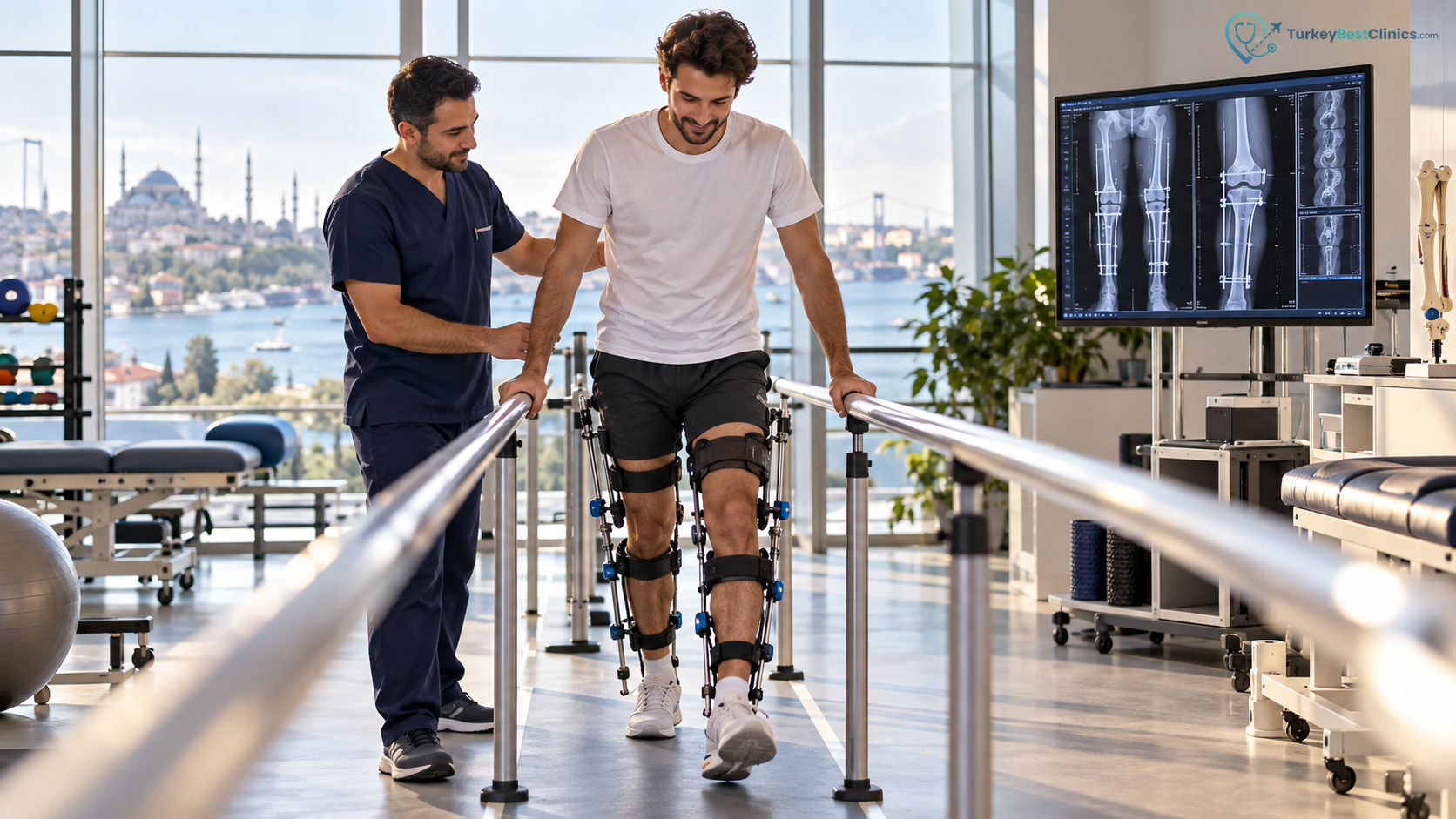
What Does Returning to Daily Life After Limb Lengthening Mean?
During limb lengthening surgery, the bone is carefully divided and new bone tissue is allowed to develop in the gap. The process is not considered complete once the planned number of centimeters has been achieved; bone strength, the range of motion of the knees and ankles, muscle-tendon flexibility and balanced walking are assessed together.
After returning to your country, resuming daily life is generally a gradual process. Short-distance walking, personal care and desk-based work may be possible relatively early, while longer walks, stairs, driving, running, jumping and contact sports may require different waiting periods. The exact timeline is determined according to the technique used, the amount of lengthening, the bone involved, radiological healing and rehabilitation progress.
The key point is that returning safely to sports after limb lengthening does not depend solely on a specific number of months passing. Your surgeon’s examination, regular X-ray checks, your tolerance for weight-bearing and your physiotherapist’s functional assessment must all show favorable results.
Safety Standards in Turkey for Femur and Tibia Lengthening
It is important for the procedure to be planned at a center that holds a Health Tourism Authorization Certificate issued under the regulations of the Ministry of Health of the Republic of Türkiye and operates with a fully equipped hospital infrastructure. Operating-room sterilization protocols, anesthesia assessment, access to intensive care, postoperative imaging and emergency orthopedic support should be explained in advance.
The surgical plan for limb lengthening takes into account whether the femur or tibia will be treated, the target lengthening ratio, joint range of motion and possible muscle-tendon tension. When evaluating a Turkish orthopedic team, relevant practical experience with motorized intramedullary lengthening nails, external fixators, serial X-ray monitoring of bone healing and physiotherapy protocols designed to reduce the risk of contractures is an important criterion.
Preoperative Safety Assessment
- Height, leg length, knee and ankle alignment, and joint range of motion are measured.
- Bone alignment, deformities, growth plates and the planned lengthening area are assessed using X-ray images.
- Blood tests, an anesthesia examination, nutritional status and clotting risks are evaluated.
- Computed tomography or vascular assessment may be arranged if considered necessary.
- The physiotherapist works with you before surgery on muscle flexibility and the use of crutches.
Before your flight, you should receive written information about when the follow-up X-ray will be taken, how to maintain the prescribed level of weight-bearing, how prescribed treatments will be continued in your country and which symptoms require emergency medical attention.
Your Limb Lengthening Package and Return Plan
A medical tourism package may include airport-hospital transfers, accommodation, interpreter support and coordination related to the initial care period. Before signing the contract, check in writing which items are included in the package, whether accommodation for an accompanying person is covered, and whether follow-up X-rays, physiotherapy sessions and any potential implant-removal surgery are included.
The length of stay in Turkey for limb lengthening surgery is not a fixed number; the first postoperative check, pain and mobility management, safe-transfer training and the surgeon’s approval for flying are decisive factors. If you return to your country during the lengthening period, coordination with a local orthopedic and physiotherapy team should be established, and X-rays should be sent online to the surgical team in Turkey.
The conditions under which your companion can stay with you in the hospital, the choice of a hotel close to the hospital and the transportation plan should be clarified in advance. While your weight-bearing is restricted, your companion may relax with low-intensity options such as a quiet walk in a nearby park or time in the hotel’s wellness area; however, crowded or prolonged activities should not interfere with your care program.
Postoperative Care Protocol
- During the first few days, pain, the wound site, circulation, nerve function and leg swelling are monitored.
- The device settings or nail protocol are followed according to the lengthening rate determined by the surgeon; the rate must not be changed independently.
- Physiotherapy focuses on knee and ankle movement, hip strength, muscle flexibility and safe transfers.
- X-rays are taken at regular intervals to assess new bone formation.
- After returning to your country, online follow-up consultations are used to review imaging, walking status and rehabilitation reports.
Limb Lengthening Costs in Turkey and International Comparison
The cost of limb lengthening varies depending on whether one or two bone segments are lengthened, the implant used, the hospital stay, physiotherapy, follow-up imaging and any planned implant-removal procedure. The figures below are general approximate ranges; they should not be considered a definitive price without an individual quotation, medical assessment and comprehensive treatment plan.
| Country | Approximate total cost | Main factors affecting the price |
|---|---|---|
| Turkey | €25,000–€50,000 | Surgery, implant type, hospital care and basic coordination |
| United Kingdom | £55,000–£100,000 | Private hospital, implant, surgery and long-term rehabilitation |
| Germany | €60,000–€110,000 | Surgery, inpatient care and follow-up services |
| United States | USD 80,000–150,000 | Surgery, implant, hospital and rehabilitation expenses |
When comparing quotations, do not look only at the initial surgery fee. The need for implant removal, X-rays during the lengthening period, the number of physiotherapy sessions, the revision policy in the event of complications, accommodation for a companion and online follow-up after returning to your country should all be listed separately.
Factors That Determine Your Return to Sports and Recovery
When you can return to sports after limb lengthening depends on bone healing and functional capacity as assessed by the surgeon. The following factors may affect both safety and the overall process:
- The doctor’s expertise and experience: An orthopedic team that plans the amount of lengthening according to the bone segment and soft-tissue tolerance, and monitors risks such as nerve tension, joint stiffness, delayed union and axis deformity, is important.
- The method and materials used: An internal magnetic lengthening nail, a mechanical intramedullary nail or an external fixator may be selected. Internal motorized nails may offer the advantage of avoiding an external frame during daily life; however, they may not be suitable for every bone structure, age group, bone canal or target lengthening amount.
- The clinic’s location: In cities such as Istanbul, which have extensive transportation and rehabilitation networks, coordination between follow-up X-rays, physiotherapy and different specialists when necessary may be easier. However, the choice of city is not more important than the hospital’s technical infrastructure and the surgical team’s experience with this procedure.
- Adherence to rehabilitation: Maintaining knee and ankle movement, muscle strength, tendon flexibility and compliance with weight-bearing instructions directly affect the return to sports. Increasing exercises when pain decreases, starting to run before the bone has fully strengthened or delaying X-ray follow-up is not safe.
Comparison of Internal Nails and External Fixators
| Methods Compared for You | Key Advantage for You | Your Recovery and Hospital Stay |
|---|---|---|
| Internal motorized lengthening nail | Controlled lengthening without carrying an external frame and easier daily care | The initial hospital stay is usually several days; walking and return to sports are determined by bone healing |
| External fixator | Adjustability and flexibility in surgical planning for certain complex bone shapes | Frame care is required; pin sites, joint movement and infection risk are closely monitored |
With approval from the surgeon and physiotherapist, low-impact exercises may begin with an appropriate type of cycling, controlled strengthening and aquatic exercises. For activities involving rapidly increased loads, such as running, basketball, football, tennis, skiing, combat sports and jumping from heights, sufficient bone strength on X-rays, full or nearly full joint movement, pain-free walking and symmetrical muscle strength are required.
Instead of waiting, contact your surgical team or local emergency medical services if you experience increasing pain that does not improve with rest, new numbness or loss of strength, changes in the color or temperature of the toes, fever, wound discharge, sudden calf swelling, shortness of breath or chest pain.
Steps to Take After Returning to Your Country
For a safe transition, contact a local orthopedic specialist and a physiotherapist experienced in limb lengthening in advance. Obtain the surgical report, information about the implant used, X-ray images, weight-bearing instructions, the rehabilitation protocol and the emergency contact plan from the team in Turkey in both digital and printed formats.
- When can I return to daily walking? Walking distance is increased gradually according to the support you use, your pain level and X-ray findings; the planned amount of lengthening alone is not a sufficient criterion.
- After which checks can I start running and contact sports? High-impact sports should not be resumed until bone healing, joint range of motion, muscle strength and pain-free movement under load have all been assessed.
- When should an internal lengthening nail be removed, and does this affect my return to sports? The need for removal is planned according to the implant type, bone healing, symptoms and the surgeon’s risk assessment; the relevant X-rays are reviewed before a decision is made.