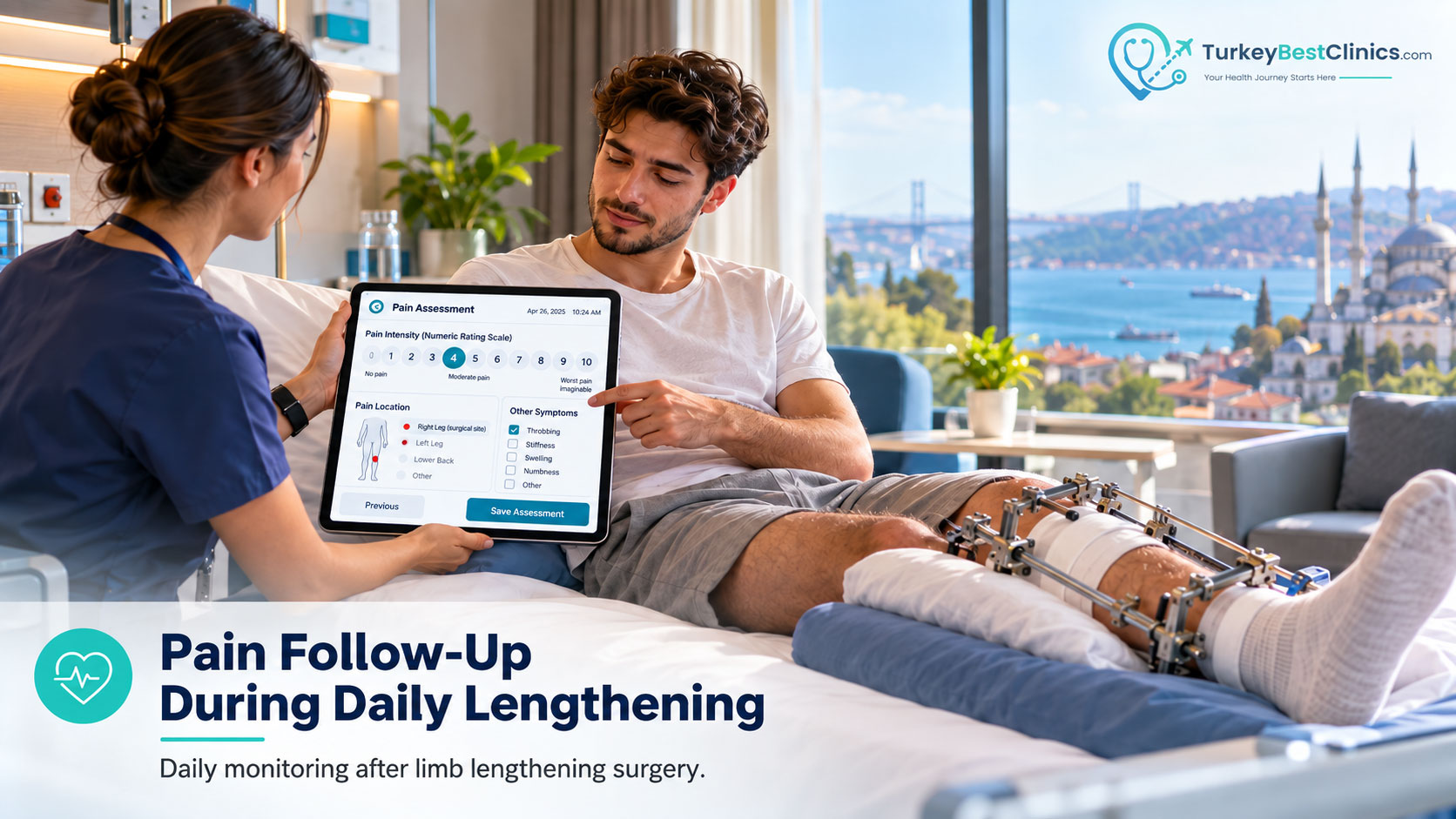
How Is Pain Monitored During the Daily Lengthening Phase?
During the limb-lengthening process, the bone segments are gradually moved apart by millimetres according to the plan determined by the doctor. During this period, the aim is not only to monitor the amount of lengthening but also to assess pain severity, its relationship with movement, joint range of motion, and the condition of the skin and soft tissues together.
Keeping brief, regular daily records helps the doctor interpret the process more accurately, either remotely or in person. A pain diary does not determine medical decisions on its own; any change in the lengthening rate, pause, or additional examination must be decided by the orthopaedic and traumatology specialist who performed the surgery.
Key information included in a pain diary
- Pain level at rest: rated on a scale from 0 to 10.
- Pain level during movement, standing up, or physical therapy.
- Location of the pain: the surgical site, bone line, area around the joint, or muscle group.
- Nature of the pain: throbbing, burning, stabbing, stretching, or constant pressure.
- The time of the daily lengthening application and any changes that occur afterward.
- Associated findings such as swelling, redness, discharge, numbness, loss of strength, or restricted movement.
- Its effect on sleep, walking, and physical therapy.
A numerical scale can be used in which 0 means no pain at all and 10 means pain that is extremely difficult to tolerate. Using the same scale every day, preferably at similar times, creates a more meaningful trend than a single high reading.
Limb-Lengthening Safety and Orthopaedic Monitoring Standards in Turkey
In Turkey, surgical limb lengthening should be planned within a fully equipped hospital infrastructure capable of providing postoperative imaging, physical therapy, and complication management. At accredited clinics holding a Ministry of Health-approved Health Tourism Authorization Certificate, operating-room sterilization, anaesthesia assessment, radiological imaging, laboratory access, and emergency care when necessary are addressed within the same care plan.
Turkish orthopaedic and traumatology teams assess bone healing, joint stiffness, nerve tension, and soft-tissue tolerance together when using external fixation systems, combined lengthening techniques, and motorized intramedullary nails. During an individual case assessment, the length of the bone segment, existing leg alignment, joint range of motion, bone density, and planned amount of lengthening are taken into account; the lengthening rate is not automatically applied in the same way to every surgical plan.
Daily communication and safety protocol
The patient coordinator explains before surgery which channel and time should be used to submit daily records. This may be a secure healthcare communication system, a scheduled video consultation, or the clinic’s designated online follow-up platform. The coordinator does not make medical diagnoses; they coordinate the delivery of measurements and symptoms to the appropriate team, translation support, and scheduled follow-up dates.
New severe pain, rapidly increasing swelling, marked redness or discharge, fever, changes in the colour or temperature of the foot, new numbness, inability to move the toes, or shortness of breath should be reported to the clinic without delay. If these symptoms occur, follow the emergency communication plan provided by the clinic in advance rather than waiting for the routine daily messaging schedule.
Your Limb-Lengthening Package and Daily Lengthening Plan
The planned package may include airport-to-hospital transfers, accommodation close to the hospital, medical interpreter support, and basic coordination for the initial care period; the scope should be clarified in writing according to the selected hospital and surgical plan. Before moving to the daily lengthening phase, blood tests, an anaesthesia assessment, leg-length and alignment measurements, X-ray checks, and joint range-of-motion assessments may be scheduled. The length of stay in Turkey is determined according to the type of surgery, the initial follow-up, and the patient’s ability to mobilize safely.
It is important that your companion can stay with you at the hospital during the designated hours, that your accommodation is within a short travel distance of the hospital, and that calm activities compatible with your daily lengthening and physical therapy restrictions are selected. While you rest, your companion may use nearby wellness facilities, quiet cafés, and parks for walks; easily accessible options are preferable to long walks or tiring programmes.
Example schedule for daily lengthening and pain communication
- Morning assessment: Record pain at rest, sleep quality, temperature, swelling, and the appearance of the surgical site.
- Pre-lengthening check: Compare the day’s application with the time and amount stated in the doctor’s written plan. If the plan is unclear, do not make changes on your own.
- Post-application record: Write down the pain score, duration of the pain, its relationship with movement, and its effect on daily function.
- Physical therapy note: Indicate whether there is any change compared with the previous day in knee, hip, or ankle movement.
- Evening notification plan: If requested by the clinic, send the daily form, photograph, or short video through the secure channel.
- Doctor’s assessment: The specialist team reviews whether the symptoms fall within the expected recovery range and, if necessary, recommends an in-person check-up, X-ray, or change to the plan.
Limb-Lengthening Costs in Turkey and International Comparison
The figures below are approximate ranges that may vary according to the surgical method, implant or fixation choice, hospital stay, physical therapy, and follow-up coverage. The final fee should be determined in a written quotation after reviewing the medical records, imaging, and surgeon’s assessment. You should also check separately how frequently daily pain monitoring is provided within the package and through which communication channel.
| Country | Approximate surgical and early follow-up cost | Currency |
|---|---|---|
| Turkey | €45,000–€85,000 | Euro equivalent |
| United Kingdom | £45,000–£90,000 | GBP |
| Germany | €60,000–€120,000 | EUR |
| United States | $80,000–$160,000 | USD |
This comparison is for budgeting purposes only and does not indicate medical suitability. For a more reliable financial assessment, the quotation should list the implant cost, anaesthesia, operating room, hospital stay, X-rays, physical therapy, possible additional procedures, companion accommodation, and online follow-up after returning home as separate items.
Factors Determining Limb-Lengthening Costs and How Pain Monitoring Works
Physician expertise and surgical experience
- The specialist’s experience in limb-lengthening surgery, deformity correction, intramedullary nails, and external fixator management.
- Whether the specialist evaluates preoperative leg alignment, the lengthening target, and joint range of motion within the same plan.
- Whether the specialist provides a written protocol covering daily monitoring areas such as pain, nerve tension, joint stiffness, and bone healing.
Device and surgical method used
- The choice between an external fixation system and a motorized intramedullary nail.
- The technical features of the magnetic or electronically controlled lengthening mechanism used in the motorized nail.
- Whether a ring or monolateral system is used for external fixation, and the care requirements of the wire and pin sites.
- Personalization of the lengthening rate by the doctor according to the bone region and soft-tissue tolerance.
| Methods compared for you | Potential key advantage for you | Recovery and hospital stay |
|---|---|---|
| Gradual lengthening with an external fixator | The amount of lengthening can be adjusted externally, potentially allowing flexible adjustments while monitoring the bone and alignment. | The initial hospital stay is usually planned for several days; frame care and longer-term physical therapy may be required. |
| Motorized intramedullary nail | Having less hardware outside the body may improve comfort when dressing and during daily care. | The initial hospital stay may last several days; weight-bearing, X-ray, and bone-healing checks continue according to the surgical plan. |
Clinic location and access to follow-up
- Travel time from the hospital to the international airport and accommodation area.
- The operating hours of Turkish- and English-language communication support for daily pain reporting.
- Access to X-rays, physical therapy, laboratory services, and emergency orthopaedic assessment at the same centre.
- Whether the dates, duration, and scope of online follow-up consultations after returning home are specified in the contract.
Choosing a location is not only about accommodation convenience; it is directly related to your ability to reach the hospital safely and quickly if pain increases or movement becomes restricted. Online follow-up cannot always replace an in-person examination and X-ray; you may need to have check-ups in your home country at intervals determined by your doctor and share the reports through a secure channel.
Next Steps: Questions to Ask About Limb-Lengthening Pain Monitoring
- When should the daily lengthening amount and pain score be reassessed by the doctor? Ask about the communication and follow-up plan to be used if pain increases, joint movement decreases, or neurological symptoms appear.
- What differences are there between an external fixator and a motorized intramedullary nail in terms of pain, movement, and companion support? Request a comparison based on your leg-length target, bone structure, and physical therapy needs.
- How will X-rays, physical therapy, and online follow-up be coordinated after leaving Turkey? Arrange in writing in advance how reports, images, and emergency communication will be shared between the orthopaedic team in your country and the surgeon in Turkey.
Bringing your surgical reports, existing X-rays, information about the medical products you use, and any documents relating to previous bone or joint problems to the initial consultation will make the assessment easier. Your personalized pain plan should be created after reviewing the surgical method, daily lengthening protocol, physical therapy goals, and safety warning signs together.